


Jay Nordlinger is a senior resident fellow at the Renew Democracy Initiative and a contributor at The Next Move.
Last week, I spoke with a young colleague of mine about coming of age. She came of age in the early Trump era. Trump Republicanism, the Trump style—it all seems perfectly normal to her (and why wouldn’t it?).
I, conversely, came of age in the Reagan era. So I have my own sense of what is normal and right, not having quite adjusted to our “new normal.”
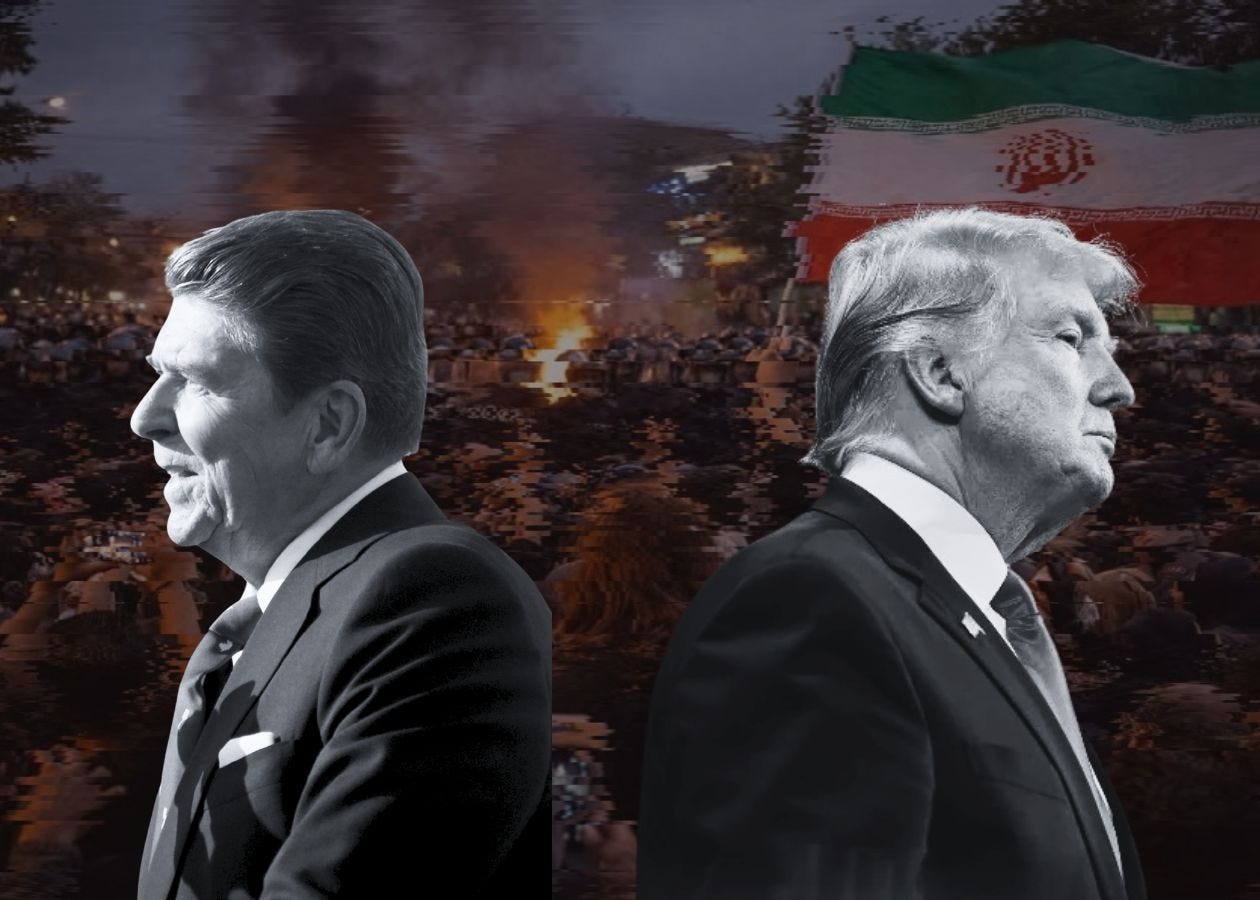
President Reagan always took care to distinguish dictatorships from the people ruled by those dictatorships. President Trump seldom takes any such trouble.
Without a peace deal with Iran, he said on Sunday, “we’re blowing up the whole country.” He also said, “If they don’t make a deal, I am blowing up everything over there.”
If you were an Iranian—and as anti-regime as they come—how would you feel about that? How would that sound in your ear?
Trump wrote, “Our Military, the greatest and most powerful (by far!) anywhere in the World, hasn’t even started destroying what’s left in Iran. Bridges next, then Electric Power Plants!”
Again, how would you feel, how would that sound to you?
In a television address, Trump said, “We are going to hit them extremely hard. Over the next two to three weeks, we’re going to bring them back to the Stone Ages, where they belong.”
Who is “them,” exactly? The bad guys? Who belongs in the “Stone Ages”?
We used to say that the US president was the leader of the Free World, responsible for assuring people under dictatorship that, whatever we could do practically, we were on their side. (More on this in due course.)
I recall President Reagan making a television address two days before Christmas in 1981. The Polish dictatorship, under pressure from Moscow, had just imposed martial law. Reagan said that Christmas was bringing “little joy to the courageous Polish people. They have been betrayed by their own government.”
Reagan announced some measures that the US was taking against that government—quickly adding, “These actions are not directed against the Polish people. They are a warning to the government of Poland that free men cannot and will not stand idly by in the face of brutal repression.”
ICYMI: Tune in to the latest episode of the Older/Wiser Podcast

Habitually, Reagan marked Captive Nations Week. This is how he put it in 1987: “For nearly three decades, Captive Nations Week has symbolized the American people’s solidarity with all throughout the world who courageously seek freedom and independence from Soviet domination.”
America, he said, “offers the world a vision of inalienable political, religious, and economic rights. This vision has always been shared among peoples subjugated by Soviet imperialism; and so has resistance, ever the catalyst of liberty.”
He also cited political prisoners, not just generally but specifically, by name: “people such as Gunārs Astra, Lev Lukyanenko, Mart Niklus, and Viktoras Petkus.”
Over and over—as a matter of both conscience and policy—Reagan and other officials of the era separated dictatorships from the people under their boot.
Here is the president in 1983, during Captive Nations Week: “Today we come to show solidarity with our brothers and sisters who are captives, not because of crimes that they have committed but because of crimes committed against them by dictators and tyrants.”
He went on to say, “To every person trapped in tyranny, whether in the Ukraine, Hungary, Czechoslovakia, Cuba, or Vietnam, we send our love and support and tell them they are not alone.”
Reagan liked to use our “radios” to communicate with people abroad: Radio Free Europe/Radio Liberty; the Voice of America; and Radio Martí, which broadcasts to Cuba, and was established under Reagan.
Under President Trump, our radios have been all but abolished. (For a piece by me on this subject, published last year, go here.)
On December 31, 1986, over the Voice of America, Reagan delivered a New Year’s address to “the peoples of the Soviet Union.” He said, “The American people are deeply concerned with the fate of individual people, wherever they might be throughout the world. We believe that God gave sacred rights to every man, woman, and child on earth.”
This was not fare you would hear from Soviet state media. You would not hear it in Russia’s media today.
One more memory of Reagan—this one from July 24, 1987, when he went to the Ukrainian National Catholic Shrine in Washington, DC, to speak to a Captive Nations conference. He began by saying, “Let us look forward to the day when Ukrainian Catholics and members of the Ukrainian Orthodox Church will again be free to gather and worship in churches like this in their own homeland.”
Further on, he said, “Our global commitment to freedom does not mandate the sending of arms or troops, but at the very least it means that any people whose liberty is denied or whose independence is violated—that these people know we Americans are on their side.”
That was the way it was. That was the principle, the ethos. We were on their side.
Do the Iranian people know it, unmistakably? I hope they do.
On Easter, Trump tweeted, “Tuesday will be Power Plant Day, and Bridge Day, all wrapped up in one, in Iran. There will be nothing like it!!! Open the Fuckin’ Strait, you crazy bastards, or you’ll be living in Hell—JUST WATCH! Praise be to Allah.”
Who will be “living in Hell”? Just the ayatollahs and their goons? How about “Praise be to Allah”? Is that sincere or mocking? How would it sound in an everyday Iranian’s ear?
Six days after the terror attacks of 9/11, President George W. Bush went to a mosque to assure Muslims that our fight—the war that had been forced on us—was not against them. This was not mere politeness or political correctness. This was hard national interest—for we needed the support of countless Muslims.
Yesterday, in a post about Iran, Trump wrote, “A whole civilization will die tonight, never to be brought back again.”
I ask once more: Can you imagine being an Iranian, hearing that?
In any event, a ceasefire is in place, as we go to press.
Looking back on Reagan, and beholding Trump today, I think of a French expression: Autres temps, autres mœurs—“Different times, different mores.” About five weeks ago, Senator Lindsey Graham (R, SC), said, “To Donald J. Trump: You just surpassed Ronald Reagan as the most consequential Republican president since Lincoln.” He went on to say, “You’re Reagan plus, plus, plus.”
One more French expression: À chacun son goût—“To each his own.”
More from The Next Move:
From Trump, a Noxious Equivalence

There is no moral equivalence between liberal democracies and dictatorships.


thanks so much for posting this enlightening historical perspective. Separate the people from the oppressor. This could be us in the US as well, when the world tires of the shenanigans.
To trump it isn't about the Iranian people, or any people, he couldn't care less, it's about him feeling manly, macho, mighty, he thinks Might makes Right, and it's HIS might, not the US military, or its economic might, it's him making himself feel oh so mighty over all, a small, little shell of a man faking himself.