


Linda Chavez is the vice-chair of the Renew Democracy Initiative and chairs the Center for Equal Opportunity. A veteran of multiple presidential administrations, she is also the author of four books and was a nationally syndicated columnist for thirty years. She continues to write frequently on immigration, civil rights, and politics. Linda is also the host of the Older/Wiser podcast from RDI and The Next Move.
Last week, the Supreme Court considered Donald Trump’s signature effort to redefine what it means to be an American—with Trump present in the courtroom.
In 236 years, no sitting president has ever attended oral arguments before the Court, a co‑equal branch of government. That did not stop Trump from seating himself squarely behind Solicitor General John Sauer, glowering at the justices until he departed once the opposing attorney began taking questions. The stunt was typical Trumpian norm‑busting, but it also underscored the importance of this issue to him.
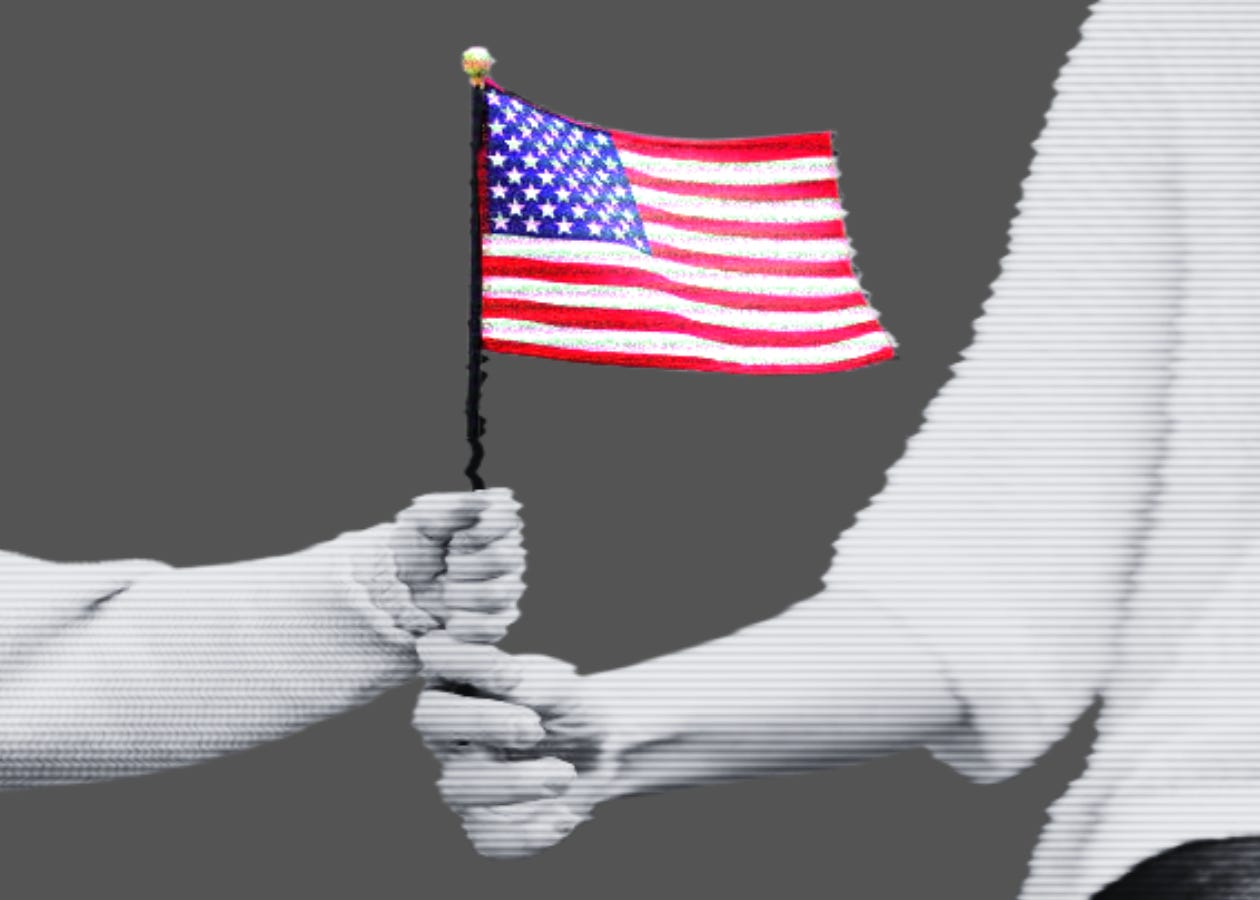
One of Trump’s first acts on Inauguration Day 2025 was to sign an executive order attempting to redefine birthright citizenship.
The United States, along with 32 other countries—mostly in the Western Hemisphere—grants automatic citizenship to persons born on its soil regardless of their parents’ citizenship, with limited exceptions for the children of foreign diplomats and invading soldiers. The Fourteenth Amendment to the Constitution provides that “All persons born or naturalized in the United States, and subject to the jurisdiction thereof, are citizens of the United States and of the State wherein they reside.” Trump’s executive order would sharply narrow that guarantee to the children of U.S. citizens and lawful permanent residents as defined by contemporary immigration law. Twenty-two states brought lawsuits against the president that were ultimately consolidated into Trump v. Barbara, the case argued on April 1.
Sauer’s argument on behalf of the Trump administration in favor of redefining birthright citizenship rested almost entirely on a fringe interpretation of the phrase “subject to the jurisdiction thereof.” In Sauer’s reading the phrase requires that parents whose children are entitled to birthright citizenship “not [owe] allegiance to any foreign sovereignty.” In this expansive reading, simply being a citizen or resident of another country means someone bears allegiance to its government.
(I have written extensively on the 1866 Senate debate over the phrase “subject to the jurisdiction thereof” in a lengthy back-and-forth with John Eastman, the architect of Trump’s efforts to overturn the 2020 election.)
Eastman is largely responsible for persuading Trump that it would be constitutional to deny birthright citizenship to the children of undocumented immigrants. This case is as ill-advised as Eastman’s election denial scheme.
ICYMI: Tune in to the latest episode of the Older/Wiser Podcast

In his opening statement, Sauer argued that “[t]he Citizenship Clause was adopted just after the Civil War to grant citizenship to the newly freed slaves and their children, whose allegiance to the United States had been established by generations of domicile.” (The full transcript is available here.) Justice Clarence Thomas alluded to this interpretation in his question during oral arguments: “How much of the historical debates around the Fourteenth Amendment had anything to do with immigration?”
Yet immigration was, in fact, a contentious issue in mid-nineteenth century America. The nativist Know Nothing movement had roiled politics in the decade before the Fourteenth Amendment was adopted, electing candidates at the local, state and national levels.
In 1856, the Know Nothings even fielded a presidential candidate—former president Millard Fillmore—who garnered eight electoral votes.
More than 13% of the population was foreign‑born at the time the Fourteenth Amendment was adopted, a figure only slightly below today’s level. Senators were acutely aware of the demographic changes underway, which inspired several racist, anti-immigrant statements in the floor debate. Yet no one suggested that only children whose immigrant parents had naturalized should be eligible for birthright citizenship.
It would have made little sense to condition birthright citizenship on parental naturalization since the naturalization process at the time was haphazard at best: certificates were issued without federal supervision, record‑keeping was inconsistent, and standards lacked uniformity. What’s more, the Trump executive order also creates a parental category of “permanent resident” that did not exist in 1866, since the US effectively had open borders at the time. The first restrictions on immigration were not enacted until 1882, with the Chinese Exclusion Act, and broadened to include Southern and Eastern Europeans in 1917 and 1924.
Lower courts, including the Ninth Circuit and First Circuit, rejected Trump’s executive order, treating the Supreme Court’s 1898 decision in United States v. Wong Kim Ark as settled law. The government’s challenge to that precedent ultimately turns on the meaning of “domicile” as used in the ruling in that case. During Wednesday’s oral argument, “domicile” or “domiciled” was spoken 124 times, including in numerous questions from the justices. Sauer contended that the legal definition of “domicile” requires allegiance to the United States, and the absence of allegiance to any foreign power. The facts of Wong Kim Ark, however, squarely contradict that reading.
Wong Kim Ark was born in San Francisco in 1873 to Chinese parents who were living there at the time of his birth. In 1890, after the passage of the Chinese Exclusion Act, Wong returned with his parents to China, only to come back to California later that year. In 1895, following another visit to China, Wong was denied reentry at the port of San Francisco, triggering a three‑year legal battle over his citizenship.
In 1898, the Supreme Court held that a child born to parents domiciled in the United States “becomes at the time of his birth a citizen of the United States,” notwithstanding ancestry. The court recognized Wong’s birthright even though his parents were, as they noted, “subjects of the Emperor of China” at his birth. But those facts, the court held, “cannot exclude Chinese persons born in this country from the operation of the broad and clear words of the Constitution.” The Supreme Court ruling in Wong Kim Ark belies Sauer’s argument that parents’ foreign “allegiance” determines whether their child can be subject to the jurisdiction of the United States. Certainly most illegal immigrants today could hardly be accused of holding allegiance to the governments that many of them fled.
If the plain text of the Fourteenth Amendment—and the understanding and intent of its drafters—controls the outcome in Trump v. Barbara, the result should be unanimous. I doubt it will be, but I expect even the most conservative justices will resist the efforts to twist the words of the Fourteenth Amendment, the history of its enactment, and the ruling in Wong Kim Ark into something that permits a president to undo a provision of the Constitution with the mere stroke of a pen.
More from The Next Move:
Trump’s Attack on Immigrants Will Redefine What It Means To Be American

The administration’s immigration aims and the meaning of citizenship.


Even before Wong Kim Ark and the 14th amendment, birthright citizenship was litigated on the state level, and was determined to be carried into the republic from English common law: https://crossingpointspolicy.substack.com/p/the-heiress-of-congress-spring?utm_source=share&utm_medium=android&r=th8gw
The first restrictions on immigration were not enacted until 1822, with the Chinese Exclusion Act, and broadened to include Southern and Eastern Europeans in 1917 and 1924.
Date should be 1882, not 1822.