


Editor’s Note: The Renew Democracy Initiative—publisher of The Next Move—is in Ukraine! We’ll be sharing daily dispatches from our delegation—read our first one here. Premium subscribers will receive each Ukraine Dispatch 24 hours before anyone else. Be the first to get on-the-ground news from the frontlines of freedom by upgrading to join our premium subscriber community today! All proceeds go to support the work of the Renew Democracy Initiative, including humanitarian assistance to communities in Ukraine.
Jay Nordlinger is a senior resident fellow at the Renew Democracy Initiative and a contributor at The Next Move.
Earlier this month, a Fox News host was talking with President Trump about the Iran war. The host said, “You think Putin is helping them?” (meaning the Iranians). Trump answered, “I think he might be helping them a little bit, yeah, I guess. And he probably thinks we’re helping Ukraine, right?”
Further on, Trump said, “It’s like, hey, they do it and we do it, in all fairness.”
First, it would be news if the United States were still helping Ukraine. Second, Trump’s instinct—on every occasion—is to defend or excuse Putin. Third, many of us will not accept a moral equivalence between helping Ukraine and helping the ayatollahs’ regime.
The Ukrainians are trying to save themselves from annihilation and subjugation by Russia. Russia’s ally, the ayatollahs’ regime, is as monstrous as the Kremlin.
We American conservatives always complained about “moral equivalence,” by which we meant a false moral equivalence, a false equating. The Soviets do it, we do it—there are no “good guys” and “bad guys” here.
Sometimes that was dressed up as realism. But it was always flawed, if not plain wrong.
One brief example, from 1978. The Kremlin was putting dissidents through show trials. Our ambassador to the United Nations, Andrew Young, gave an interview to a French newspaper, saying, “In our prisons, too, there are hundreds, perhaps thousands, of people whom I would describe as political prisoners.”
Young was, and is, a good and decent man. But what he said was both cuckoo and offensive.
President Carter, at a press conference, said, “I know that Andy regrets having made that statement, which was embarrassing to me. I don’t believe he will do it again.”
William F. Buckley Jr. had a line about moral equivalence. He worded it slightly differently each time, but here is one version: “The man who pushes an old lady into the path of an oncoming truck, and the man who pushes an old lady out of the path of an oncoming truck, are not to be denounced evenhandedly as men who push old ladies around.”
He should have lived to see Donald Trump and his administration. (But that would have done WFB no favors.)
ICYMI: Tune in to the latest episode of the Older/Wiser podcast:

A sign of things to come came in December 2015, when Trump was running for the Republican nomination. On television, Joe Scarborough asked him about Putin. Scarborough made the simple point that Putin is the type to murder his critics and invade foreign countries. “Obviously, that would be a concern, would it not?” asked Scarborough.
Trump answered, “He’s running his country, and at least he’s a leader, you know, unlike what we have in this country.”
Not giving up, Scarborough said, “But again, he kills journalists that don’t agree with him.”
Trump answered, “Well, I think our country does plenty of killing also, Joe.”
That should have been enough for the Republican Party and the conservative movement. We had always decried such a mindset. But the Right was changing, dramatically.
Trump won the nomination with ease. In the summer of 2016, the New York Times asked him about civil liberties in Turkey. The strongman, Erdoğan, had cracked down on the country viciously.
“I think right now, when it comes to civil liberties,” said Trump, “our country has a lot of problems, and I think it’s very hard for us to get involved in other countries when we don’t know what we are doing and we can’t see straight in our own country.”
Trump continued, “When the world looks at how bad the United States is, and then we go and talk about civil liberties, I don’t think we’re a very good messenger.”
Again, Republicans and conservatives would once have thrown a fit, rightly.
Trump was elected in November. Shortly after being sworn in, he had a conversation with Bill O’Reilly like the one he had had with Joe Scarborough. (This was another television interview.)
O’Reilly said, “Putin is a killer.” Trump answered, “There are a lot of killers. We’ve got a lot of killers. What, you think our country’s so innocent?”
This was not a campus radical, mind you. This was the president of the United States.
In June 2018, Trump flew to Helsinki to meet Putin. Before the summit began, Trump wrote, “Our relationship with Russia has NEVER been worse thanks to many years of U.S. foolishness and stupidity and now, the Rigged Witch Hunt!” The Russian foreign ministry answered, “We agree.”
How cozy.
American relations with Russia were indeed rocky. That was because of the Kremlin’s behavior, many of us thought: violating borders, murdering dissidents, interfering in foreign elections—all that.
Bless the name of Jeff Mason, a reporter for Reuters, who had a question for Trump at the summit press conference. Mason cited the president’s earlier statement about “many years of U.S. foolishness and stupidity,” etc. The question: “Do you hold Russia at all accountable, for anything in particular?”
“Yes, I do,” Trump answered. “I hold both countries responsible. I think the United States has been foolish. I think we have all been foolish.”
At least our president had graduated from blaming America alone to moral equivalence.
In the summer of 2020, the Afghan War was still on, and there were reports that Russia was supplying the Taliban with weapons—to use against our troops, of course. Asked about these reports, Trump said, “Well, we supplied weapons when they were fighting Russia, too.” (Trump was apparently referring to the Soviet war in Afghanistan.)
The pattern never changes. You might credit Trump with consistency.
In the summer of 2023, Trump was out of office and under indictment. He faced four criminal indictments: two at the state level, two at the federal level. Needless to say, he had abundant legal help.
On August 4, Secretary of State Antony Blinken wrote, “The United States strongly condemns Russia’s conviction of opposition leader Aleksey Navalny on politically motivated charges. The Kremlin cannot silence the truth. Navalny should be released.”
A Republican senator, Mike Lee of Utah, had a response: “Regimes that prosecute opposition leaders on politically motivated charges deserve strong condemnation.”
We can have a debate over the indictments of Trump—whether they were just or not. But this is undebatable: in America, Trump was reelected president, and in Russia, Navalny was murdered.
There is no moral equivalence.
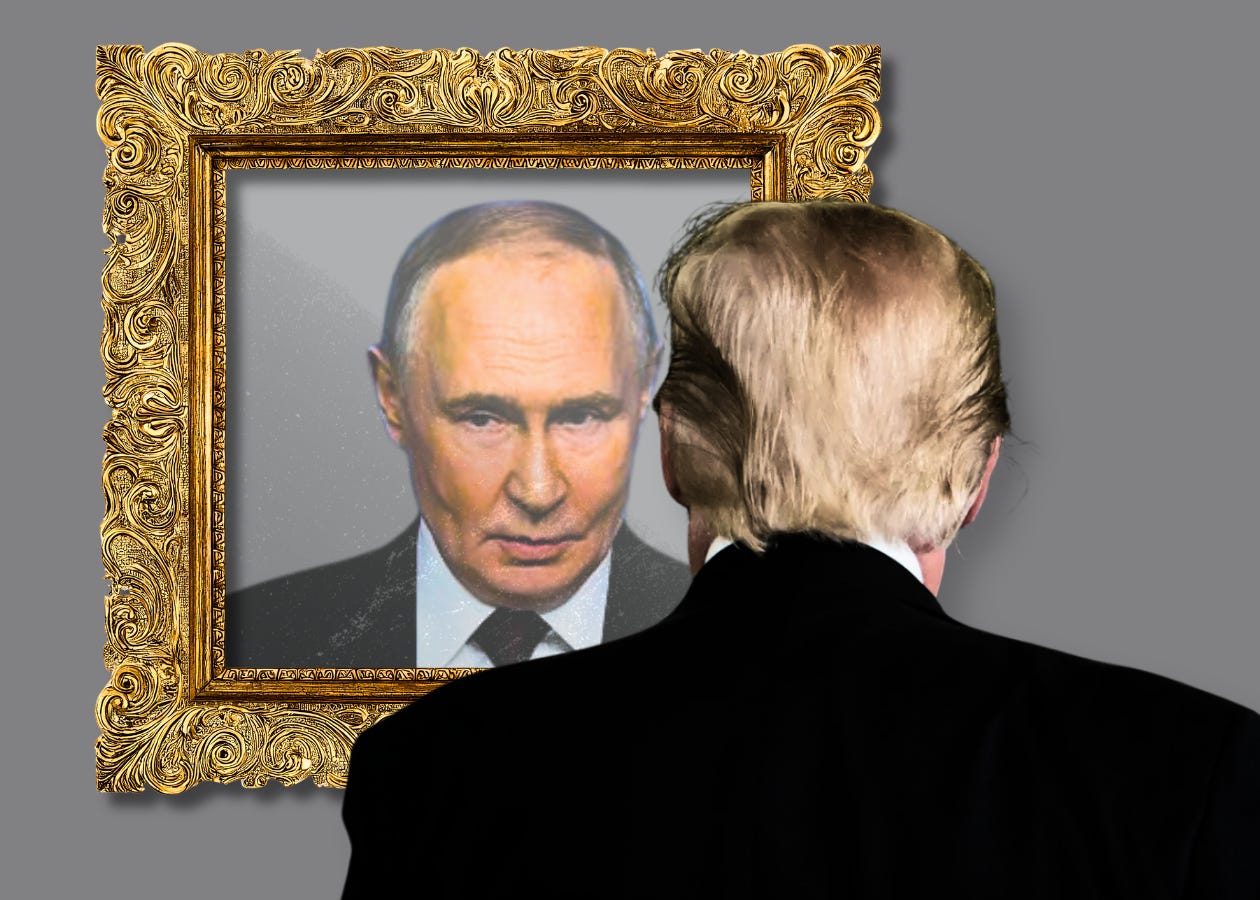
Trump is now about 14 months into his second term, and he and his administration have always drawn a moral equivalence—at best—between Ukraine and Russia: between invaded and invader.
February 24, 2025, marked the third anniversary of Russia’s full-scale invasion. At the United Nations, Ukraine offered a resolution condemning Russia for its aggression and calling for the withdrawal of Russian troops from Ukraine. The resolution passed 93 to 18.
Opposing it was Russia, of course. And the United States. Of course?
Secretary of State Marco Rubio said, “We didn’t feel it was conducive, frankly, to have something out there at the UN that’s antagonistic to either side.”
In December 2025, President Trump was standing next to Ukraine’s president, Volodymyr Zelenskyy, at Mar-a-Lago in Palm Beach. A reporter asked Trump about Russia’s unceasing attacks on Ukrainian civilians. Did this not show Putin wasn’t serious about peace?
“No, he’s very serious,” Trump answered. “I believe Ukraine has made some very strong attacks also.” In what may pass for graciousness or sympathy, Trump then turned to Zelenskyy and said, “I don’t say that negatively.”
About a week later, Trump was again talking about Ukraine and Russia, and he said, “They both have done some pretty bad things. Look, that’s Biden’s war. That’s not my war.”
Actually, it is Putin’s war—and that of his allies: China, Iran, North Korea, and so on down the blood-drenched line.
A false moral equivalence is not only illogical, it is also stomach-turning, even abhorrent. On this, as on so many other things, conservatives and Republicans were right the first time.


This is less a confusion about values. The president isn’t confused. He knows the difference between Ukraine and Russia. He just doesn’t care, because the distinction doesn’t serve his interests.
This is incentive-driven equivalence, not philosophical. When he says “they do it, we do it,” he’s not making a moral claim, he’s clearing the board of obligations. A negotiating posture dressed as a worldview.
The old moral equivalence at least represented a sincere, if wrong, belief. What gets performed now is something colder: the deliberate erasure of accountability so that no action requires justification and no alliance requires maintenance.
The Republican Party didn’t drift into this. It was pulled…and went willingly, because the base wanted permission to stop caring.
Reminds me a lot of the foolishness young people spouted in the late 60s and 70s, esp on university campuses... very leftist at the time. Sad to see so-called conservative adults buying into the same nonsense today.