


A note from Garry Kasparov: Perhaps you recently canceled a subscription to an oligarch-owned newspaper. Might I humbly suggest that you put that money toward supporting mission-driven media like The Next Move? I don’t receive a cent from your subscription fees—everything goes to supporting the work of The Next Move’s parent organization, the Renew Democracy Initiative. RDI is bringing political dissidents to tell their stories to students, business leaders, and public officials. Delivering life-saving humanitarian aid to frontline communities in Ukraine. And, of course, driving the conversation here on Substack. To help make the decision easier, we’re offering 30% off an annual subscription, now through March 4.
Jay Nordlinger is a senior resident fellow at the Renew Democracy Initiative and a contributor at The Next Move.
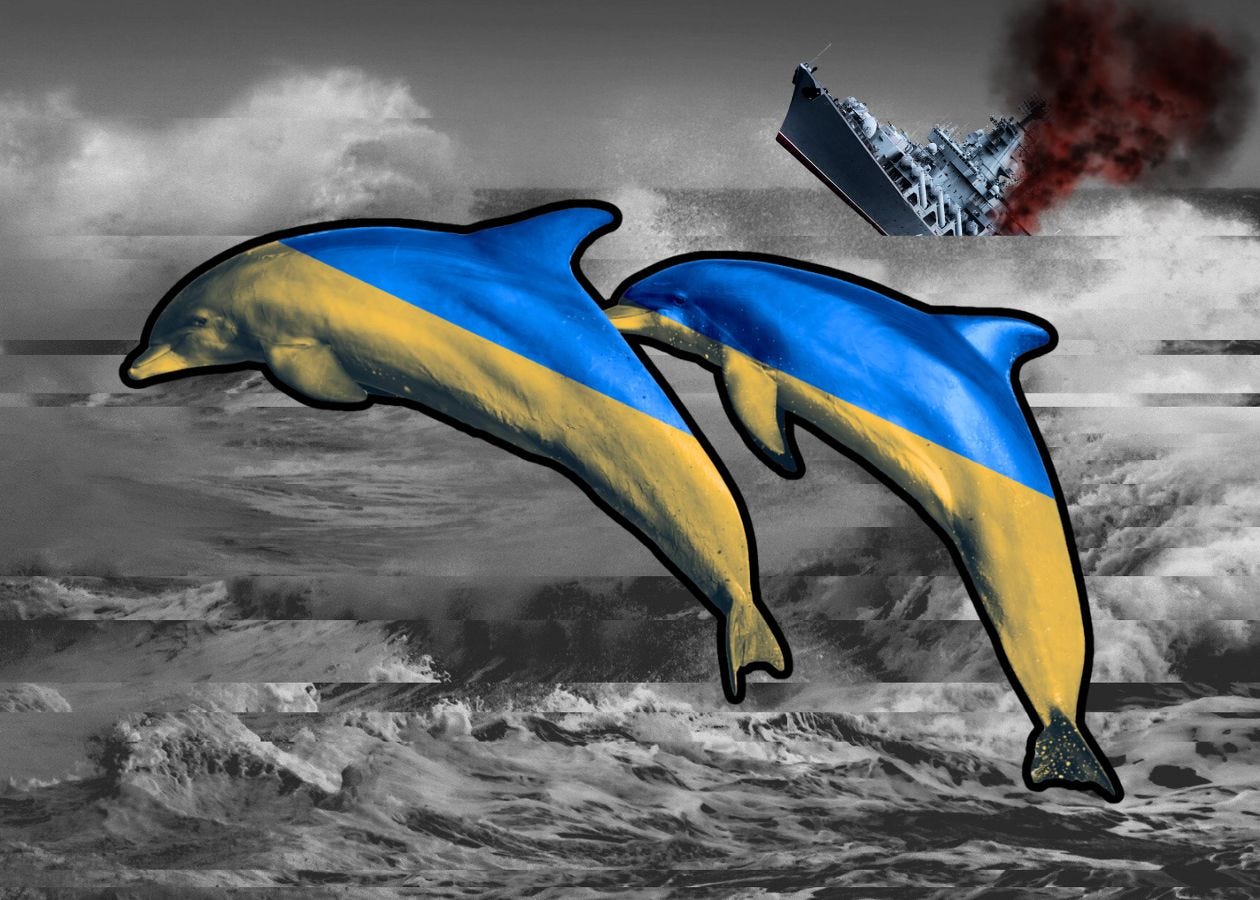
In 1993, Commentary magazine published an article with an arresting headline: “If Bosnians Were Dolphins.” The article was by Edward N. Luttwak, the scholar of grand strategy, born in Romania in 1942 (a very dark time).
“If the Bosnian Muslims had been bottle-nosed dolphins,” Luttwak began, “would the world have allowed Croats and Serbs to slaughter them by the tens of thousands?”
A further question: “If Sarajevo had been an Amazonian rainforest or merely an American wood containing spotted owls, would the Serbs have been allowed to blast it and burn it with their artillery fire?”
The answers, said Luttwak, were “too obvious,” and the questions “merely rhetorical.”
I have thought of Luttwak’s article in recent days and weeks when absorbing the news from Ukraine. Russia’s war crimes continue unabated. In fact, they have intensified. Putin acts as though no one cares and no one will stop him.
Is he wrong?
More from The Next Move:

Russian forces have again attacked a maternity hospital. “Again”? Yes. I will quote the Kyiv Independent: “Throughout the full-scale war, Russia has multiple times targeted maternity hospitals, alongside attacks on other civilian infrastructure.”
In 2022, for example, “Russian forces struck a maternity ward in Vilniansk in Zaporizhzhia Oblast, killing a two-day-old boy.”
This most recent time, they did not kill anybody, apparently, but they injured at least six.
They did manage to kill 16 coalminers in a bus, returning the miners from their shift.
This is daily life in Ukraine. Ho-hum. Not even the bombing of maternity hospitals can shake the world’s lethargy, can pierce the general numbness.
And the bombing of maternity hospitals is almost comic in its evil, isn’t it? (Not that coalminers’ lives are worth less than those of mothers, their newborns, the nurses, et al.)
After the latest attack, a regional official in Ukraine said, “The strike on the maternity hospital is yet another proof of a war waged against life.”
That is well worded: “a war waged against life.”
Ask yourself: What if the recent attacks had been the other way around? What if Ukrainian forces had struck a maternity hospital in Russia and killed 16 Russian coalminers returning from their shift? Wouldn’t the world have been up in arms? Wouldn’t there have been fulminations from the White House?
But it seems that Ukrainians were born to be attacked and Russians to attack them. That is the “natural” order of things.
A few days before the maternity hospital and the coalminers, Russia attacked a passenger train, killing at least five people. This was “terrorism,” said the Ukrainian president, Volodymyr Zelenskyy. Of course it is.
In Ukraine, there is daily heroism, because daily heroism is required. Maryan Kushnir performed a little (though he rejects the term “hero”). Kushnir is a reporter for RFE/RL, America’s combination of Radio Free Europe and Radio Liberty.
His neighbors’ apartment was struck with a drone. In the apartment lived a young couple with children. The apartment was rapidly disintegrating in flames. Kushnir went in and saw a little girl on a couch, screaming for her mother. He pulled her out but could not save the others.
Watch his testimony here.
Day after day, Ukrainians take to social media to describe—to try to convey to the world—the atmosphere in which they are forced to live. Maria Avdeeva, a security expert, tweeted, “Kyiv under attack. Residential buildings are burning. Multiple Russian missiles entering Ukrainian airspace.” And so on.
It is very cold in Ukraine now. I was there just once, when I visited Kyiv in December 2019. It was cold. But the capital was brilliantly lit and the buildings were well heated.
“Freezing and in the dark, Kyiv residents are stranded in tower blocks as Russia targets power system.” That is a headline from the Associated Press (over this article).
Families are sleeping in subway stations, seeking protection against both cold and Russian bombs. Here is a video from Kyiv. (I may well have been in that subway station myself, those years ago.)
Oleksandra Matviichuk spoke of a woman named Zhenya, “who froze to death in her apartment in Kyiv.” This woman, elderly, “survived the Holocaust, but did not survive this winter.”
Matviichuk, a human rights lawyer, is the executive director of the Center for Civil Liberties, in Kyiv. In 2022, the center shared the Nobel Peace Prize.
“We will remember this winter,” wrote Matviichuk. “When an entire nation froze in the cold right on the border with the European Union, fought against the Russian army’s advance, but did not give up.”
Should not these people be admired and celebrated, if not … you know: helped?
The Wall Street Journal published a report by Anastasiia Malenko (text) and Emanuele Satolli (photos). The heading: “Here in One Kyiv Apartment Building, They Are Freezing—but Not Giving Up.” The subheading: “Russian attacks on energy infrastructure have plunged much of Ukraine into darkness and cold but haven’t broken its resilience.”
Yaroslav Trofimov is the chief foreign-affairs correspondent of the Journal. Circulating his colleagues’ work, he said, “Read this, about how ordinary Ukrainians cope with Putin’s genocidal effort to make Kyiv unlivable. And imagine what would you do.”
I will tell you something. In New York, I live in a building with old-fashioned steam heat. Wonderful heat, in abundance. In the dead of winter, we have to crack open our windows, to balance the heat.
In the daily stream of news, I try to take note of names and faces—else the maimed and the dead become mere abstractions. Here is Mykhailo Protsenko, whose job was to rescue people from rubble after bombings. He was killed on February 7. Protsenko was 30 years old and “left behind his wife and two small kids.”
There’s a difference—a big difference—between those Bosnians, who were not dolphins, and the Ukrainians, who are also not dolphins. No one hailed the killers of the Bosnians as defenders of Western civilization, or not many did. No one cooed over the manliness of Slobodan Milošević.
He wound up at The Hague, where he belonged.
And the US president did not display a portrait of Milošević, or any of the other killers, in a place of honor at the White House.
Donald Trump has renovated the Palm Room. He has hung pictures as well. On top is a picture of him and Putin in Alaska last summer. You will recall the greeting that Putin received. Let me quote from a previous column of mine:
“President Trump rolled out the red carpet for Putin—literally. There was a military flyover in Putin’s honor. And Trump invited Putin to ride with him in his limo. As a report in the Associated Press put it, the two men were ‘casually chatting like reunited friends.’”
Contrast this with Zelenskyy’s greeting in Florida, about four months later. No US official was there to greet him. None.
In the Palm Room at the White House, the picture of Putin and Trump is first—on top—and below it is a picture of Trump with one of his grandchildren.
Do you think that people in Ukraine know about this, hear about it? They do. Imagine what that can do to morale. The United States is supposed to be the Leader of the Free World, “the last best hope of earth,” as Lincoln said.
Oleksandra Matviichuk had a question: “Why has Trump’s year of negotiations with Putin become the deadliest year for civilians in Ukraine since 2022?”
She answered her own question: “Because the human dimension in this war doesn’t matter to the US negotiators. So, Putin decided he could do whatever he wanted.”
Can anyone really, if only in the secrecy of his heart, deny it?


OK, so the US is a malign influence when it comes to addressing Russia’s aggression. Trump has an inexplicable admiration for Putin. That story is well known. But what about Europe? Where is the coalition of the willing? Why are they not doing more when this war is in their own backyard? It feels like they are dithering and rearranging the deck chairs while the Titanic sinks.
Putin is a monster and Trump is an utterly shameless bootlicker to him.