


Join us in New York: The Renew Democracy Initiative and the Ukrainian Institute of America invite you to a forward-looking conversation with RDI Chairman Garry Kasparov and CEO Uriel Epshtein, moderated by CNN’s Bianna Golodryga. We will discuss Ukraine and how we can defend freedom at home and abroad in the face of mounting geopolitical threats. Next Tuesday, February 10 in NYC. Register here.
Jay Nordlinger is a senior resident fellow at the Renew Democracy Initiative and a contributor at The Next Move.
“The beginning of wisdom is to call things by their right names.” So said Socrates, or Confucius. You will find attributions to both. In any case, great minds think alike.
Nick Cohen, the British journalist, began a column last week with a quotation from Camus: “To name things wrongly is to add to the misfortune of the world.” That, too, is right—a wise observation.
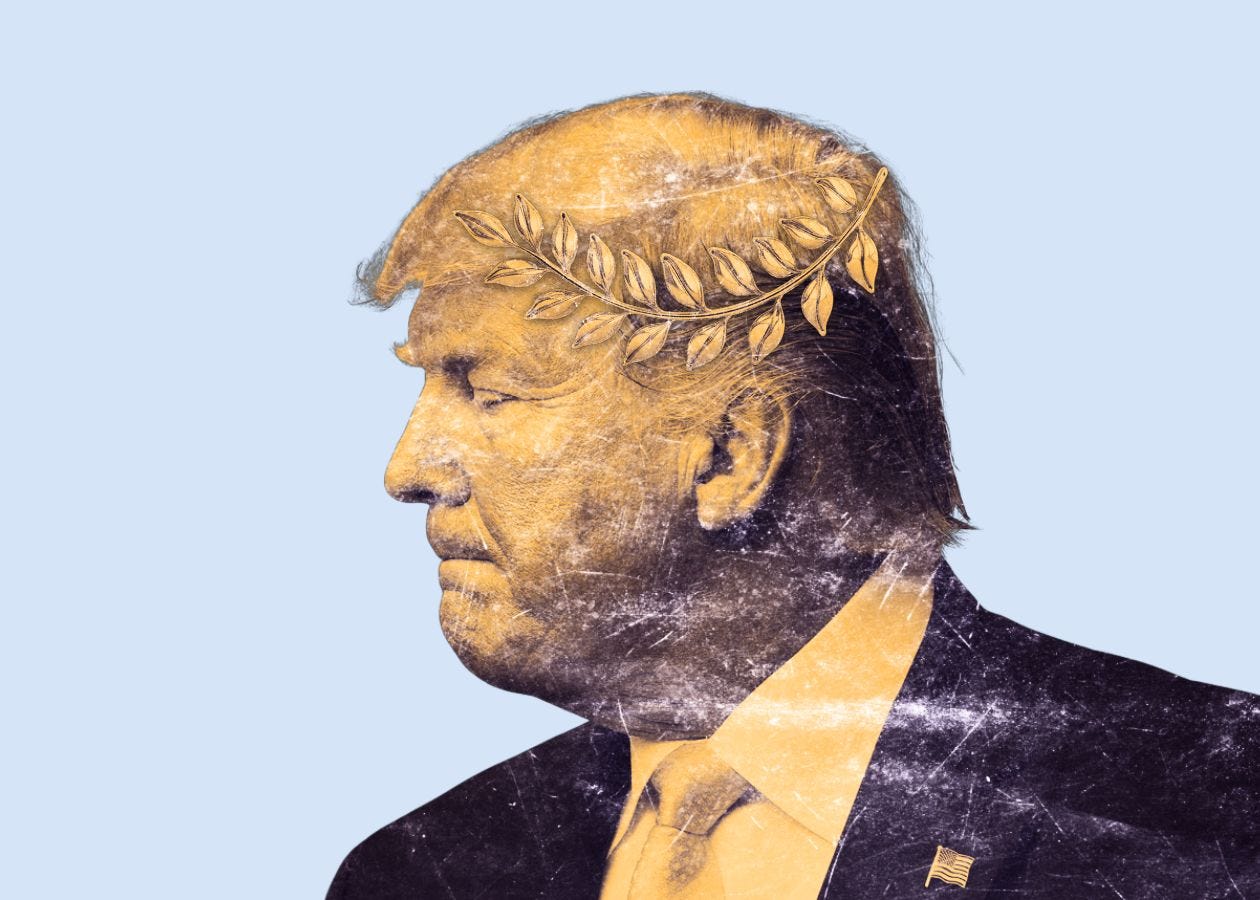
President Trump is a namer and renamer of things. There is a long tradition of this, from heads of state. But not in democracies such as ours.
On the first day of his second term, Trump declared that, henceforward, the Gulf of Mexico would be known as the “Gulf of America.” Never mind that this body of water had been called the “Gulf of Mexico” for almost 500 years. Trump had spoken.
The Associated Press balked. It refused to change its stylebook to comply with Trump. The White House retaliated by banning the AP from news conferences and similar events.
Karoline Leavitt, the White House press secretary, said, “If we feel there are lies being pushed by outlets in this room, we are going to hold those lies accountable.” (She must have meant the tellers of those “lies.”)
Last December, the National Press Club honored the AP with its press freedom award. Mike Balsamo, the club’s president, said, “The Associated Press stood its ground for a simple reason: journalism must be independent to be free. A newsroom that lets the government decide its words gives up its voice.”
The AP, said Balsamo, had chosen “principle over permission.”
Back in May, the US House passed a bill codifying Trump’s declaration that the Gulf of Mexico would be the “Gulf of America.” That bill has not yet cleared the Senate. In the House, only one Republican voted against it: Don Bacon of Nebraska (who is retiring at the end of the current term).
More from The Next Move:

“It just seems juvenile,” Bacon said. “We’re the United States of America. We’re not Kaiser Wilhelm’s Germany or Napoleon’s France. We’re better than this. It just sounds like a sophomore thing to do.”
Has “Gulf of America” caught on in the broad American public? I have heard it used only once unironically. A young man who works in shipping said “Gulf of America,” just as naturally as he would have said “Lake Erie” or the “Mississippi River.”
The rise and fall of names is a fascinating topic, and often political. I wrote an essay about it in 2015, here. But let us return to that gulf for a moment longer.
Two weeks ago, President Trump made a disclosure that was completely unsurprising: he had thought about naming the Gulf of Mexico after himself. “ ‘The Gulf of Trump,’ that does have a good ring,” he said. “Maybe we could do that. It’s not too late.”
People said he was joking. But “Trump-Kennedy Center” began as a “joke” too, didn’t it? More on this in due course …
Early last year, the administration gutted the US Institute of Peace, as it was gutting USAID, Radio Free Asia, etc. But then, whaddaya know? They renamed it the “Donald J. Trump Institute of Peace.”
The State Department announced that the name had been changed in order “to reflect the greatest dealmaker in our nation’s history,” i.e., Trump. Ordinarily, that’s the kind of statement you get from a campaign office, not the US State Department.
Caesaristic types like to name things after themselves. George C. Marshall, the Army chief of staff, the secretary of state, the secretary of defense, the Nobel peace laureate, was not such a man. He was practically the only person who called the Marshall Plan by its formal name: the “European Recovery Program.” Most people didn’t even know the formal name.
Rafael Trujillo was a caesar: the dictator of the Dominican Republic. In 1936, he renamed the capital city after himself. “Ciudad Trujillo,” he called it. For a full 440 years, the city had been called “Santo Domingo.” After Trujillo died in 1961, it was “Santo Domingo” once again.
I will tell you something—something personal. Apart from Nancy, Ronald Reagan probably had no greater admirer than I was. I’ll be a Reaganite till the end. But I didn’t like it when, in 1998, a Republican Congress changed the name of National Airport outside Washington, DC, to “Reagan.”
For one thing, it seemed too early—Reagan had been out of office for less than ten years. It also seemed too … partisan. How would I have liked “Bill Clinton Airport”? What’s more, “National Airport” is a perfect name for an airport serving our nation’s capital.
But at least Reagan didn’t name the airport after himself, you know? His admirers in Congress did (and President Clinton signed their bill).
President Kennedy did not name the performing arts center in Washington after himself. Congress did, after that president was murdered. It was to be his “living memorial” in DC.
Two and a half weeks after being sworn in the second time, Trump fired the Kennedy Center’s existing board and named his own—which named him chairman. In July, Republican congressmen moved to rename the opera house at the Kennedy Center the “Melania Trump Opera House.” (This has not occurred.) In December, Trump himself hosted the Kennedy Center Honors, which had been going on since 1978.
And a week and a half after that, Trump renamed the center, calling it “The Donald J. Trump and The John F. Kennedy Memorial Center for the Performing Arts.” He put his name first. On the building itself, he literally put his name over Kennedy’s name.
What kind of man puts his own name on another man’s memorial? And puts it first, and above? For that matter, what kind of man accepts another person’s Nobel medal? What kind of man essentially coerces a Nobel medal from a woman?
When Trump is out of office, many, many things will be named after him, no doubt. He is one of the most popular political figures in our history. The Republican Party has nominated him for president three times in a row. Never before had the GOP nominated anyone for president three times in a row. That distinction belongs to Trump, and Trump alone.
And, of course, the people as a whole elected him twice.
Trump has tens of millions of admirers, some of whom all but worship him. Never has an American politician had such a hold on his “base.” In a free society, people have the right to honor their heroes, with statues and the like. Of course Trump will be honored.
Why does he have to plaster his name on things—including other people’s memorials—now?
Earlier this week, Trump announced that he would close the Kennedy Center for two years for “renovation.” In other news—related—he is building an arch: a triumphal arch, to be placed near the entrance of Arlington National Cemetery, across the Potomac from the Lincoln Memorial. People are calling this the “Arc de Trump” (get it?)
In October, Ed O’Keefe of CBS News asked the president, “Who’s it for?” Trump pointed to himself and answered, “Me.”
This is not the American way—unless the American people want it to be so. May the republican spirit (note the small “r”) make a comeback.


Naming things like this is not the American Way, but when the madness is over we will follow the ancient Roman solution of damnatio memoriae.
He Told us in the beginning, that you only have to vote for me Once running for President, but he really meant Dictator! Steve Bannon openly claims ICE will be stationed at voting sites in November. And move on from Epstein, he was a friend of mine, and all the little girls loved me and how!
Steve Bannon, a former adviser to President Donald Trump and host of the “War Room” show, has pushed baseless claims that recent and future U.S. elections are “stolen,” and is now making the following threat: “We ‘re going to have ICE surround the polls…We’ll never again allow an election to be stolen.”
"Authoritarianism, said out loud," said Adam Kinzinger, a former House Republican and now staunch Trump critic. Indeed, it's dangerous. Election officials in some Democrat-run states are already preparing for potential federal intrusion in the midterms, CNN reported last week.