


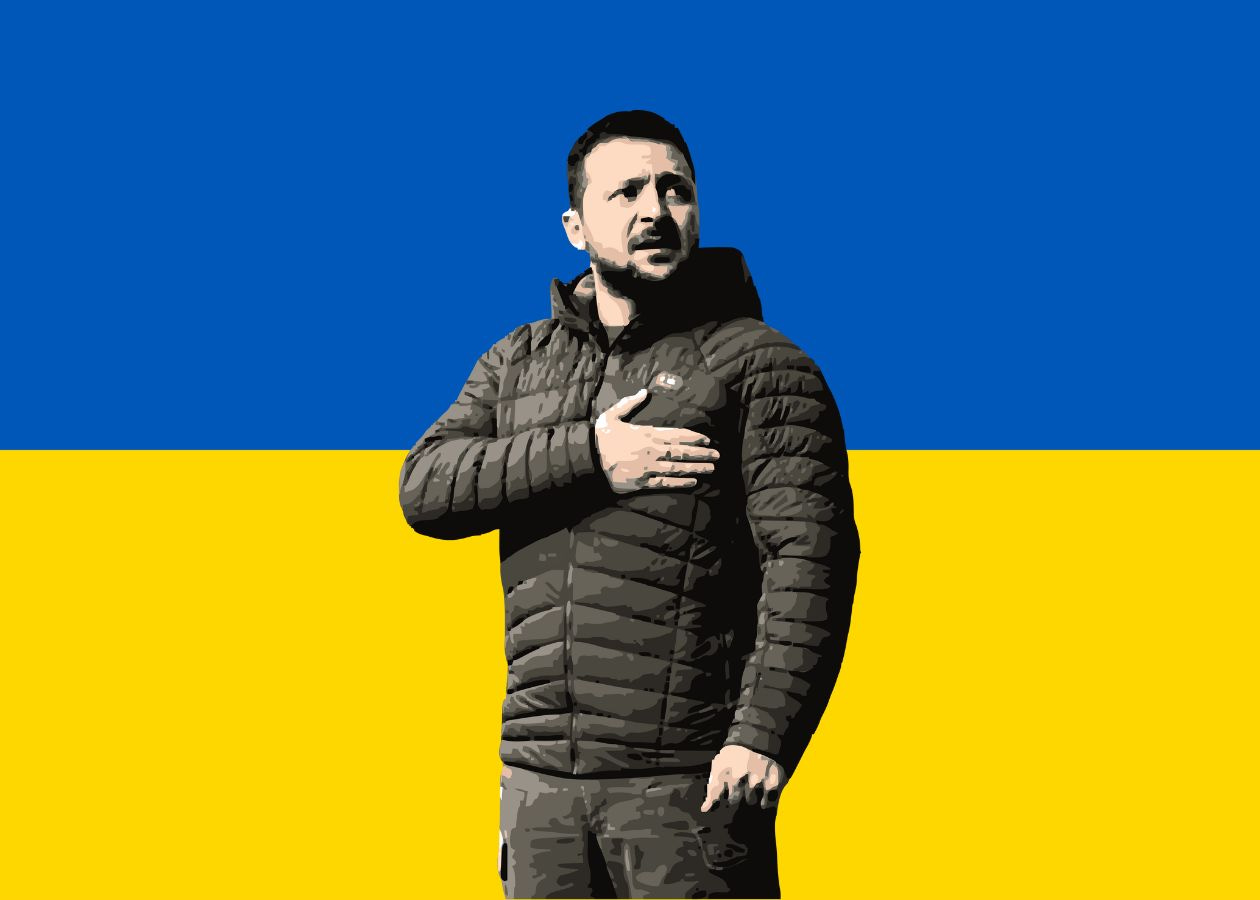
Jay Nordlinger is a senior resident fellow at the Renew Democracy Initiative and a contributor at The Next Move.
In a sense, I would prefer not to write about Ukraine. It’s painful—especially where the stance of my country, the United States, is concerned. But if the war is painful for me, as I sit in my armchair—what’s it like for the Ukrainians?
I went to Ukraine in December 2019. The war had been on, in the eastern part of Ukraine, for almost six years already. More than 14,000 people had been killed. And Ukrainians were bracing for worse.
Vitaly Portnikov, a leading Ukrainian journalist, remarked to me that “the post-Soviet space” was “pregnant with war.” If the Balkans were once “the powder keg of Europe,” the post-Soviet space threatened to be another.
And in February 2022, Russia launched its full-scale, all-out assault.
Since that time, I have written about Ukraine regularly—almost daily, if social media posts count. If someone like me can do nothing else, he can express horror at Russia’s atrocities and record the names of the victims, some of them.
He can also say that the fate of Ukraine is linked to the broader fate of the world.
In July 2014, Charles Krauthammer wrote a column about Gaza—another one. I sent him an email, saying, “Charles, I find that I can barely write about the Arab–Israeli conflict anymore, so weary am I from doing it, year after year, decade after decade. I’m glad you’re not weary—or that you push through it, to say the necessary, again.”
He answered, “I know exactly of your weariness. My reluctance to write about it once again is enormous. It’s only a sense of duty—and the shocking realization of how few are prepared to say the obvious truth anymore—that makes me do it.”
In October 2015, I wrote an essay called “Hung Up on Israel: An explanation for the sincere.” It was an answer to readers who asked, “Why do you write about Israel so much and care about it so much?”
In September 2023, I felt the need to write a similar piece: “Ukraine: Why the Fuss?”
Back in 2009, I had a long talk with Krauthammer and asked him a stark question: Will Israel survive? The survival of Israel, he answered, depended on two things: the will of its people to survive and the support of the United States.
I have suspected that the same is true of Ukraine. That the Ukrainians are determined to survive, there is no doubt. They have proven it through their sacrifices.
The support of the United States is an entirely different question.
During the Republican presidential primaries of 2024, and then the general election, I had a remarkable thought: The fate of Ukraine—and therefore of much else—might depend heavily on the American voter.
Donald Trump, JD Vance, and others in their party seethed with hostility toward the Ukrainians and made excuse after excuse for the Kremlin.
The new administration was sworn in on January 20, 2025. On February 28, the Ukrainian president, Volodymyr Zelenskyy, was in the Oval Office. I will let Aleksandr Dugin, the Russian ideologue who is often described as “Putin’s brain,” tell what happened: “Trump and Vance wiped their feet on Zelenskyy like a doormat.”
That day, I was participating in a seminar, which began at about nine and lasted till about six. We had a midday break—during which we absorbed the news out of the White House. During the afternoon session, one colleague of mine was absolutely silent. That evening, I questioned him about this.
“I was rattled by the Oval Office thing,” he said. “I wanted to think and talk only about Ukraine.” I understood him entirely.
Exactly ten months later, on December 28, Zelenskyy flew to Florida, to meet with President Trump and his team. Donald Tusk, the prime minister of Poland, sent a message via X: “Good luck, @ZelenskyyUA.”
When Zelenskyy’s plane landed, no US official was there to greet him. This is practically unheard of for a visiting head of state. And it was greatly contrasting with Vladimir Putin’s visit to Alaska in August.
President Trump rolled out the red carpet for Putin—literally. There was a military flyover in Putin’s honor. And Trump invited Putin to ride with him in his limo. As a report in the Associated Press put it, the two men were “casually chatting like reunited friends.”
Out of Florida, video circulated on the Internet, showing the Ukrainian team and Trump’s team, sitting across from each other. Trump’s team included Steve Witkoff, Pete Hegseth, and Stephen Miller. Some of us thought as Tusk had: “Good luck, Zelenskyy.”
From Trump, we heard the usual moral equivalence. Asked by a reporter about Russia’s unceasing attacks on Ukraine—its bombing of civilians—our president answered, “I believe Ukraine has made some very strong attacks also.”
Later, talking about Russia and Ukraine, he said, “They both have done some pretty bad things.”
Trump also said, “Russia wants Ukraine to succeed.” His envoy, Witkoff, wrote, “Russia remains fully committed to achieving peace in Ukraine.”
Republicans of my acquaintance like to style themselves “realists,” alleging that the rest of us are fuzzy-minded idealists (at best). Has there ever been a less realistic bunch than the Republicans in charge today?
Further talking about the Ukraine war, Trump said, as he habitually does, “Look, that’s Biden’s war. That’s not my war.” In truth, it is Putin’s war: he invaded Ukraine and is attempting to subjugate it. For the Ukrainians, it is a war of survival.
The secretary of state, Marco Rubio, said, “It’s not our war. It’s a war on another continent.” Wars in Europe have affected us in the past, have they not? Moreover, Venezuela, too, is on another continent—and the United States has just intervened militarily there, right?
In Rubio’s remarks, some of us caught a whiff of Neville Chamberlain, that well-meaning man, who spoke of “a quarrel in a faraway country between people of whom we know nothing.”
When Russia launched its full-scale invasion, Mr. Rubio was a senator. He took it upon himself to disseminate as much information about the invasion as possible, in order to explain “why America should care, why it matters,” as he put it. He said, “I think it’s important just to rally support for Ukraine here in America.”
Yes, it was, and it still is.
Last March, the British historian Andrew Roberts gave a speech in the House of Lords, of which he is a member. He said, “We must not underestimate the gravity of what has happened, which is that during a war against totalitarian dictatorship, the United States has effectively changed sides.”
After this most recent meeting between Trump and Zelenskyy, a Russian newspaper published some noteworthy lines—as spotted and reported by Steve Rosenberg, the Russia editor of BBC News.
“America no longer sees our country as a threat,” said the paper. “The US leader’s philosophy is closer to the values of Russia’s president, not the politicians of the Old World,” and “he sees Europe as a liberal stronghold that must be destroyed.”
Trump represents and speaks for many, many Americans—but not all of us. What can the rest of us do? Speak up! We can show Ukrainians, Russians, and others that the Trump administration is not the whole of America.
On New Year’s Eve, I met a couple in New York. He is a native of the city, she is a native of Ukraine. She said to me, “Thank you for caring about Ukraine.” It is a matter of simple human compassion. Also of cold interest—that of the democratic West.
More from The Next Move:
The Moscow-Mar-A-Lago Hotline

Recognizing a pattern: Putin calls, America blinks, and Zelenskyy leaves empty-handed.


For those interested in contributing directly to the Ukrainian defense forces or humanitarian endeavors of the government, I recommend and have donated to them at https://u24.gov.ua/ Slava Ukraini
I was born in 1952; I grew up thinking we, the United States of America, were the good guys. My faith was somewhat shaken by the war in Vietnam, but I never expected to see America supporting totalitarian Russia against a democracy. I am at a loss for what to say to my international friends...