


Editor’s Note: The Renew Democracy Initiative—publisher of The Next Move—is headed to Ukraine! Starting on Monday, we’ll be sharing daily dispatches from our delegation to Ukraine. The first installment will be immediately available to all readers—after that, each Ukraine dispatch will be exclusive to premium subscribers for the first 24 hours. Be the first to get on-the-ground news from the frontlines of freedom by upgrading to join our premium subscriber community today! All proceeds go to support the work of the Renew Democracy Initiative, including humanitarian assistance to communities in Ukraine.
Evan Gottesman is the director of communications and special projects at the Renew Democracy Initiative and managing editor of The Next Move.
There’s virtue in a short book that makes a compelling point.
One such book I recently happened upon is If Russia Wins: A Scenario, by Carlo Masala. At just 120 pages, I was able to read it on a short flight down from New York to DC’s National Airport.
This is not an exhaustive history of the war in Ukraine. It is, per the subtitle, a scenario, and an alarming one at that, sketching out the contours of another Russian invasion in Europe after the West abandons Ukraine.
Published in Germany last year, the English translation hit shelves in January, just days after another unusually friendly phone call between Donald Trump and Vladimir Putin.
The point of divergence in If Russia Wins is a hypothetical peace agreement leaving Moscow in control of the roughly 20% of Ukrainian territory it holds today. Volodymyr Zelenskyy is pushed into the arrangement by an unnamed American president who says, “I don’t do bad deals.”
The Geneva Treaty, as Masala dubs it, is his first warning to the reader: Even if Moscow does not physically conquer all of Ukraine, legitimizing any of its gains would be a Russian victory
With the democratic West done with the war, a rump Ukraine plunges into chaos while the Russians rebuild their military capabilities and political capital. Russia, of course, is not done with deadly imperial nostalgia, just as it wasn’t done after its wars in Moldova, Georgia, and Syria, nor following the 2014 invasion of Ukraine.
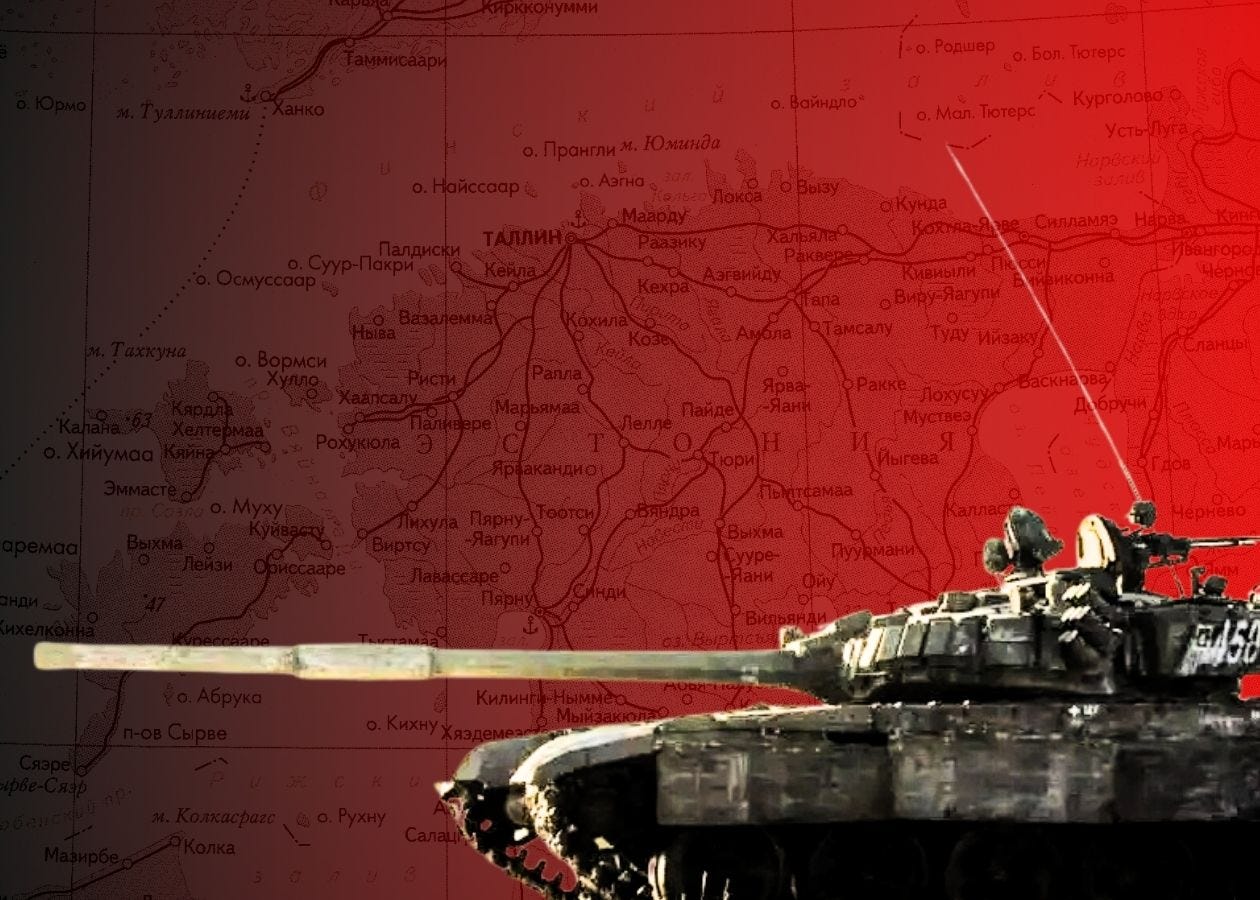
The next target is Narva, Estonia. Officially a city, but more of a town, it is home to just 54,000 people, almost all of whom are Russian speakers. A third are actually citizens of the Russian Federation. The expansive Ivangorod Fortress in Russia looms across the Narva River like a slightly-too-on-the-nose metaphor for Estonia’s past.
ICYMI: Tune in to the latest episode of the Older/Wiser podcast:

Masala has Russian soldiers crossing over to the west bank of the Narva and seizing the Estonian town.
Could it happen?
Estonia has been a NATO member since 2004. The Baltic states, Estonia, Latvia, and Lithuania, are the only former Soviet republics to be admitted into the alliance (the Baltics’ annexation to the USSR under the 1939 Nazi-Soviet pact was never recognized in Washington).
As a NATO member, Estonia is theoretically entitled to protection from its friends under the North Atlantic Treaty’s vaunted Article 5, which famously decrees that the allies “agree that an armed attack against one or more of them in Europe or North America shall be considered an attack against them all.”
(Notably, Article 5 doesn’t explicitly require NATO members to go to war to defend a besieged ally—only for each government to undertake “such action as it deems necessary.”)
The North Atlantic Treaty was drawn up with the Soviet Union in mind, and it has never really been tested. Article 5 was only invoked once, at the behest of the United States, in an asymmetrical war against the terrorists responsible for the September 11 attacks.
Despite this, a 2024 Quincy Institute brief confidently asserts that:
A variety of factors, including NATO air and naval dominance, the difficulty of conquering urban areas, NATO political commitments to its eastern border states, and Russian weaknesses revealed in the Ukraine conflict, mean that Russian aggression against even NATO’s weakest states would carry enormous risks and be unlikely to succeed.
Carlo Masala is not the first person to argue that Estonia—and Narva, specifically—could be in the Kremlin’s crosshairs. What makes Masala’s analysis stand out from the usual Beltway fare is that he goes after sacred cows like NATO.
Would Americans really join their European allies in a fight with nuclear-armed Russia over tiny Estonia?
Of course! many DC pundits and Western officials would answer. We have “political commitments”! “Air and naval dominance”!
Probably not, Carlo Masala counters, soberingly, and—at least as of now—more accurately. Western resolve would certainly be shaky if Russia “only” invaded Narva—a town the size of New Brunswick, New Jersey—just as the West stumbled when Russia “only” annexed Crimea.
The author is an instructor at the Bundeswehr University Munich, an institution primarily catering to future officers in the German military. At their closest points, Germany and Ukraine are about 370 miles apart, not much longer than the distance I covered reading Masala’s book flying from New York to our nation’s capital. If anyone can bring home the urgency of the war in Ukraine, it is a European for whom the war is local.
Yet what’s absent from If Russia Wins is a clearly stated argument as to why Americans and their Western European allies should care about Narva. The question of the Estonian border town’s relevance hangs over every page of Masala’s scenario like the old French pro-appeasement slogan, “Why die for Danzig?”—a reference to another Baltic flashpoint.
The answer—which largely goes unstated in If Russia Wins—is that compromise only makes expansionist dictators hungry for more.
Yet every act of accommodation presents a tantalizing reprieve. More than one American president has attempted a “reset” with Russia, and every one has gotten played. The result is not just changing lines on a map, but lives destroyed under authoritarian rule (last year, we published Ukrainian journalist Olya Bilan’s personal account of survival during the Russian occupation of Bucha—a different kind of warning from Masala’s geopolitical assessment).
The open-ended nature of Carlo Masala’s scenario is not necessarily a weakness in his argument, but a challenge to the reader: Georgia mattered because of Ukraine. Ukraine mattered because of Narva. And we certainly know why Danzig mattered. Do you want to find out, on your own soil, why Narva matters too?


Yes Evan — and that is precisely the point many still underestimate.
If Russia “wins”, it will not look like a dramatic parade in Kyiv, but rather a slow strategic shift: a weakened Ukraine, a fractured West, and a precedent that borders in Europe can be changed by force.
The real consequence is not territorial — it is psychological and political.
A Russian success would validate coercion as a tool of statecraft, embolden revisionist powers, and test NATO’s credibility, particularly on its eastern flank. We have already seen how Moscow probes for weakness; a perceived victory would only accelerate that behaviour.
In that sense, the question is not whether Russia wins territory — but whether it wins the future rules of the European security order.
And that is a much bigger stakes game.
This one is for the Americans wondering why we should care about Ukraine…