


A note from Garry Kasparov: Celebrate one year of The Next Move and save 30% when you upgrade to join our premium subscriber community—now through the end of April. Premium subscribers get invitations to exclusive Zoom conversations, early access to podcasts, and other benefits!
Upgrade now and don’t miss our next premium subscriber-exclusive call where I’ll be joined by former White House attorney Ty Cobb and RDI CEO Uriel Epshtein—coming up on Thursday, April 30 at 5pm ET/2pm PT. Click here to register.
Jay Nordlinger is a senior resident fellow at the Renew Democracy Initiative and a contributor at The Next Move.
Two weeks ago, the Boston Symphony Orchestra traveled south to appear in New York’s Carnegie Hall. They opened with three scenes from Nixon in China, the opera by John Adams. As the title suggests, it’s about Nixon’s historic trip to China in 1972.
Our program notes for the evening said the following: “By the 1980s, when Nixon in China was conceived, both former US president Richard Nixon (1913–1994) and the late Chinese leader Mao Zedong (1893–1976) were nearly universally maligned figures.”
Sure. One was one of the most blood-soaked dictators in history, and the other was a corrupt politician in a democracy, who, on the verge of impeachment, resigned and went home.
Our program notes referred to “Western antipathy to Maoist communism.” Oh? What about Chinese antipathy to that communism? What about the dissidents over the years who have given their lives in standing up to it?
One more quotation: “Adams and his creative partners, realizing the significance of Nixon’s visit, took an approach that avoids satire and latter-day political critique in spite of their inherent antipathy to Nixon and his politics.”
You have to wonder what they thought of Mao’s “politics.” According to The Black Book of Communism—published by Harvard University Press in 1999—Mao was responsible for some 65 million deaths.
The sheer horror of Chinese communism has never quite penetrated the American or Western mind. This is a source of wonder and bewilderment to Chinese dissidents and their supporters.
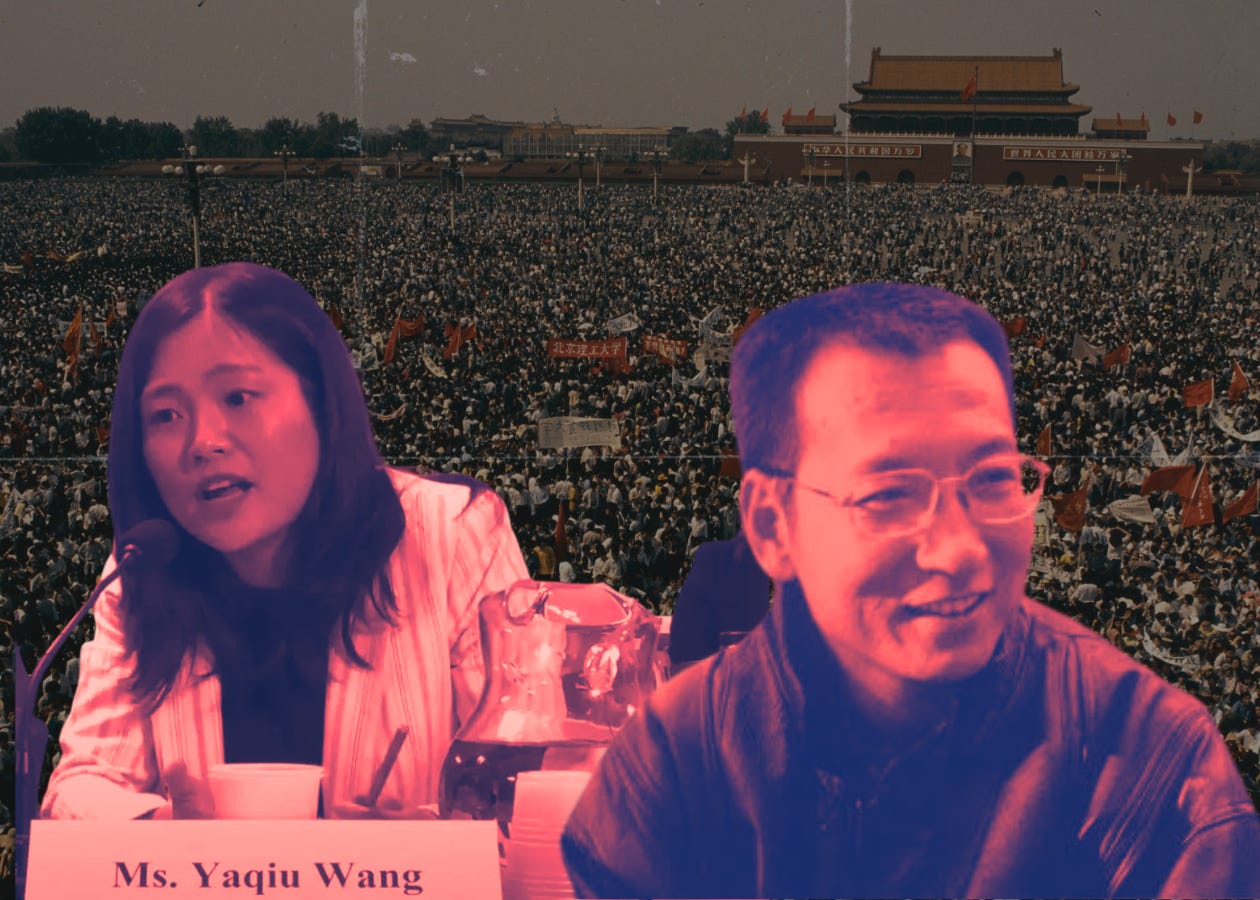
I have been thinking about China lately, in part because of the Boston Symphony concert, but mainly because I recorded a podcast with Yaqiu Wang. She is a Chinese human rights activist here in the United States. She is affiliated with the University of Chicago’s Forum for Free Inquiry and Expression. She has also worked for Freedom House, among other organizations.
She was born in the 1980s to a family of peasants in Zhejiang Province. That’s what it said right on their registration cards: “peasants.”
“My birth is itself a human rights story,” says Yaqiu. She was the third child in the family, at a time when China had its one-child policy. The first child, a son, had been born with a disability, so the second child, a daughter, was legal. The third? Illegal.
Yaqiu’s mother hid the pregnancy, as best she could. When schooltime began, Yaqiu kept her distance from her sister (who was five grades above her). It was better for people not to know about this multiple-child family.
“When I was growing up,” Yaqiu says, “I always heard the propaganda that extra children were a burden to society.” That’s what the government called them: “extra children.”
“I carried that shame until I came to America,” she says, “where I realized that having siblings is normal.”
She came as an exchange student, at the University of South Carolina. She noticed something about Americans—something that all Chinese notice, she says: Americans have “freedom on their face.” They carry themselves in a confident manner, unafraid.
Courtesy of a congressman, Yaqiu had a tour of the White House. “I fell in love with American democracy,” she says. “I am one of those people who feel they were born in the wrong country.”
At the same time, she works for her fellow Chinese every day: arguing for their rights. She has had to cut off communication with her family back home, painful as it is. She does not want to invite any trouble for them.
In our podcast, I asked Yaqiu Wang about political prisoners. For years, I wrote about Liu Xiaobo, probably the most prominent of Chinese political prisoners. He received the Nobel Peace Prize in 2010—received it in absentia. He died in 2017, still a prisoner.
ICYMI: Tune in to the latest episode of the Older/Wiser Podcast

Liu Xiaobo was, simply, one of the great men of our time.
There are many political prisoners in China today, and Yaqiu Wang gave me the name of one of them: Xu Zhiyong. He is a civil rights lawyer, born in 1973. He comes from Minquan County in Henan Province. “Minquan” means “civil rights,” believe it or not. Xu has said that the course of his life was practically predetermined.
In 2003, he co-founded the Open Constitution Initiative, which lasted until 2009, when the authorities shut it down. In 2010, he founded the New Citizens’ Movement, which is a network of democracy-minded people (a loose network, relatively hard to track and target).
Like most activists and leaders of his kind, Xu has been in and out of prison—although mainly in. He was arrested in 2013 and imprisoned until 2017. Once out, he resumed his activism, of course. In 2020, he was arrested once more and remains in prison today.
He has been tortured, as political prisoners, everywhere, routinely are.
Campaigning for him is his partner, personal and professional: Li Qiaochu. “It’s a great love story,” says Yaqiu Wang. Li was arrested in 2021 and imprisoned for three years and eight months. Once released, she went right back to work, campaigning for Xu, risking another arrest.
“People can be ‘crazy,’” Yaqiu observes, “but in such a heroic way.”
In 2012, Xu Zhiyong published a kind of manifesto concerning the New Citizens’ Movement. “This movement is a political movement in which this ancient nation bids utter farewell to authoritarianism and completes the civilized transformation to constitutional governance.”
The “goal” of this movement, Xu writes, “is a free China ruled by democracy and law.”
At the “core” of the movement is “the citizen.” And a citizen is “not a subject” but “an independent and free entity.” The citizen “obeys a rule of law that is commonly agreed upon” and “does not have to kneel down to any given person.”
In February 2020, as the coronavirus was spreading, Xu wrote an open letter to the ruling Communist, Xi Jinping, calling on him to resign. “What China needs above all other things is Freedom!” Xu wrote. “Only with freedom will creativity truly flourish and progress be possible.”
According to Yaqiu Wang, ordinary Chinese people strongly desire freedom and democracy. But it is very dangerous to express this desire. The likes of Xu Zhiyong and Li Qiaochu are never common, in any police state. But that does not mean that Chinese as a whole are happy with their lot.
She also has a message for citizens of her adopted country: “I really want Americans to know that what they have is very good, and they should cherish it”—and, if necessary, “fight for it.”


Liu Xiaobo. Li Qiaochu. Yaqui Wang. Shining examples to look up to while we fight to regain our democracy. Will we meet the challenges and sacrifices as they have?
Cheeto’s Corruption Of Conservatism
The always brilliant Thom Hartmann over at Raw Story(https://bit.ly/3OBrVZm) writes a distillation piece on today’s “conservative” movement aka the CNPP(Conservative Nazi Pedo Party) explaining its evolution since Eisenhower in the 1950’s to today’s dysmorphic conservatism that supports inequality based on a financial platform where government works only for the wealthy
This type of “I’ve got mine, screw you” political attitude currently has permeated all 3 levels of government and is far from what the conservative movement in the 1950’s meant which was to not radically or rapidly change society without first thinking through the consequences in detail, and then, when you do decide to make changes to the rules of society, you move forward in measured increments. Conservatively
Over decades of policies to ravage the principle that all men/women are created equal and aided by the likes of the John Birch Society, Reagan’s demand to cut social safety net programs, and Clarence Thomas’ corruption of SCOTUS, today’s conservative movement has become a fascist haven for the plutocratic wealthy class(Musk, Theil, Karp) willing to strike any corrupt deal that furthers their ends(Cheeto, Jared, Don Jr)
WE the People have slowly unconsciously witnessed the wealthy take over our country and turn it into a quagmire of corruption and graft It’s time to wake up and demand a equality and restore accountability