


Garry Kasparov is the chairman of the Renew Democracy Initiative, which publishes The Next Move.
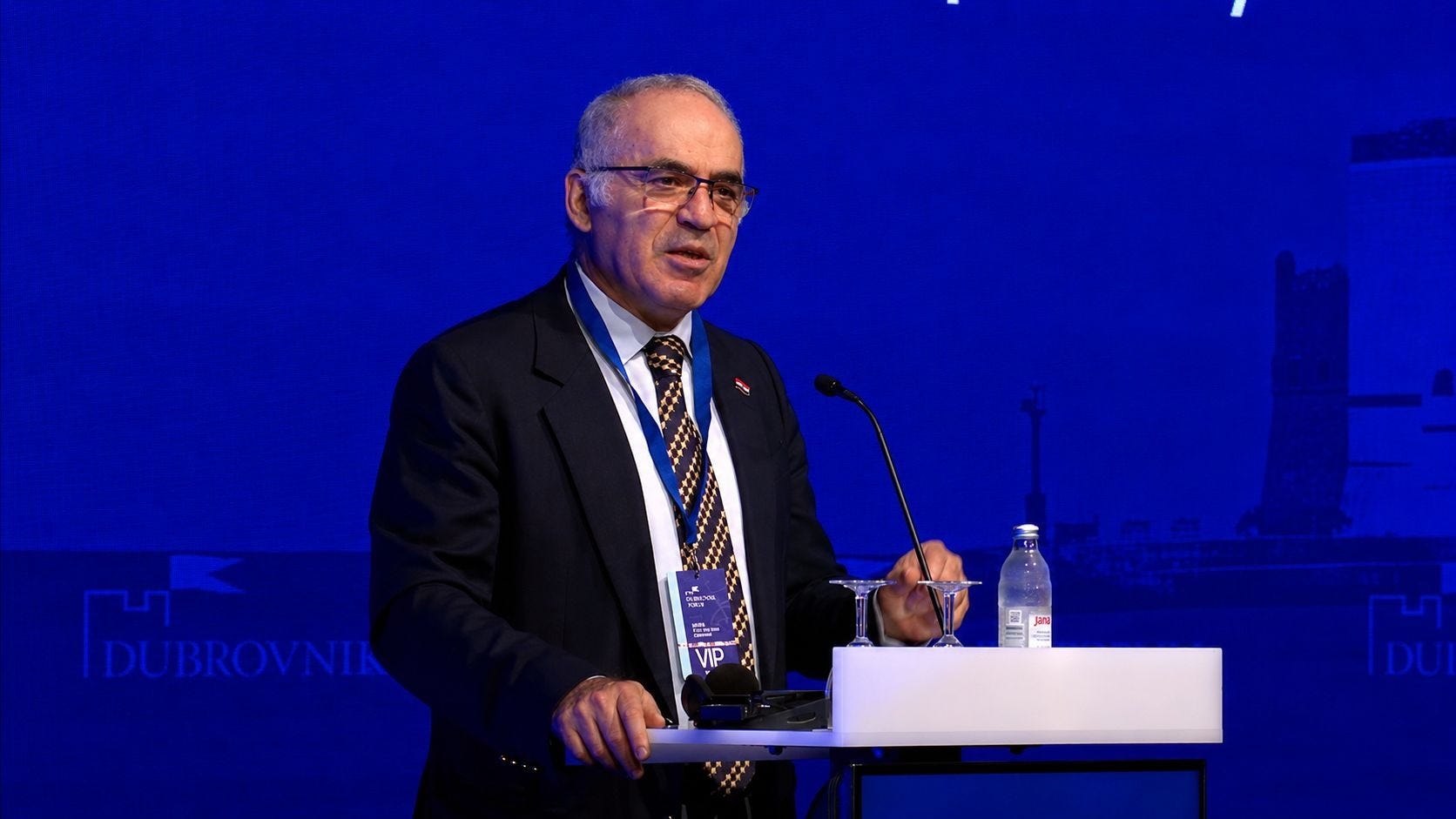
This past Saturday, June 27, I was invited to deliver remarks at the Dubrovnik Forum, a conference on international politics, security, and strategy. I opened a session on modern warfare, the defense industry, and Europe’s strategic choices. In attendance were officials from the governments of many NATO members and other democratic allies.
Here is what I told them:
Thank you. I would like to thank Prime Minister Plenkovic, the Ministry of Foreign and European Affairs, and the other organizers of the Dubrovnik Forum.
I have lived in New York ever since I was forced to leave Russia in 2013, facing imminent arrest. However, I am here as a proud citizen of the Republic of Croatia. We have more than an EU passport in common—we share democratic European values. And because of that, I will always speak of Europe in terms of “we” and “us.”
Standing here, in Croatia, a NATO member, I take no satisfaction from stating: NATO is effectively dead.
I already got in trouble for saying “NATO is dead” at the Halifax Security Forum last year. It doesn’t faze me. But I can see some faces beginning to turn, so allow me to explain what I mean.
NATO—the North Atlantic Treaty Organization—as it was originally conceived is irrelevant.
In 1949, the alliance was established as a bloc of democratic European nations under American protection with one purpose and to fight one war. Not a war in Afghanistan or Libya. This alliance was meant to fight a war to defend the continent from a Russian attack.
Well, Russia has begun its westward aggression. In 2014—expanding that attack in 2022.
Where are the Americans, the supposed guarantors of European security?
Under the Obama administration, they did nothing—actually, worse than nothing, by continuing negotiations with Russia on climate change, the Iran nuclear program, and the Middle East, while largely ignoring Putin’s blatant violation of the international order on European soil. Under the Biden administration, they dragged their feet, providing assistance to Ukraine too little, too late. They lectured Kyiv about “escalation” as Russia dragged Ukraine into an ever more gruesome war.
Now, under the Trump administration, the United States is hostile—arguably an active collaborator with Moscow.
Where are we, the Europeans? We have allowed our muscles to atrophy. The European institutions that lifted the continent out of the ashes of World War II—and enabled a nation like Croatia to prosper after the turmoil of the 1990s—these institutions were built without a serious military component.
Security? The Americans will take care of that! This was always the assumption.
It was only last year that the European Commission finally established a Directorate-General for Defense Industry and Space.
For decades, we prospered—but even as we prospered, our safety was an illusion, paid for by American largesse.
ICYMI: Tune in to the latest episode of the Older/Wiser Podcast

Now, we see that an alliance designed for collective security is functioning like a protection racket. This is the natural consequence of outsourcing our safety to Washington. We were blind to the isolationist mood rising at both ends of the American political spectrum.
So far, I have only given you bad news. But there is a silver lining, won through the sacrifice of thousands upon thousands of brave Ukrainians. Europe is indeed behind—militarily and technologically.
But Europe has a robust economy and manpower. Europe’s backwardness is the result of a political choice. We can catch up, with Ukraine as the cornerstone of a new European security architecture.
Ukraine is not only defying so-called “expert analysis,” fighting on into the fifth year of a Putin-planned three-day war—a three-day timeline, incidentally, shared by most Western governments. Ukraine is the only nation in Europe that is really preparing for the day after America withdraws. Ukraine is proactively building the post-American security order on the battlefield today. What they are doing is revolutionary.
Ukraine knocks out $50,000 Iranian Shaheds with improvised drones that cost a fraction of that price—far less expensive than American Patriots or even Israeli Iron Dome interceptors. Ukraine is ahead of many nations in integrating artificial intelligence into the battlefield. Ukraine will soon fly Swedish fighter jets in its air force rather than rely entirely upon American models. My country, Croatia, recently made a similar decision, purchasing French Rafales instead of American planes. Ukraine strikes back deep into Russia whether or not the worryworts in Washington give their blessing.
It is a tragedy that Ukrainians have paid a deadly price in order to reverse Europe’s technological and military decline. You can honor their sacrifice by supporting them—and following their example by pulling your weight abroad and innovating at home. It will ultimately be to the benefit of us all: advances in medical and consumer technologies are often downstream of developments in battlefield science.
Consider what Ukraine has accomplished despite the obstacles: Ukrainians only broke free of the Russian-Soviet Empire again in 1991, and their sovereignty has been under brutal attack for a third of its modern independent existence. Europe is wanting for willpower, not resources.
This is the challenge facing Europe and all countries that once counted on the United States for support.
I am joined at this forum by ministers from many such democratic allies: Japan, Germany, France, Italy, Lithuania, Albania, Slovenia, Bulgaria, Portugal, Kosovo, Hungary, North Macedonia… forgive me if I have missed any.
You will return to your capitals and debate the particulars of your foreign and defense policies.
But let these principles be your north star: a commitment to real European collective defense and homegrown technological excellence, the boldness to finally cut the umbilical cord with America, a serious recognition of the fact that Putin’s regime is devoted to perpetual war, and the self-respect to actually stand up and fight for our democratic way of life.
The Renew Democracy Initiative, publisher of The Next Move, is pleased to join the Institute for the Study of Modern Authoritarianism, publisher of The UnPopulist, as a media partner for the third annual Liberalism for the 21st Century Conference—LibCon 2026—in Washington, DC on July 16 and 17. Click here for more information and to register. Coinciding with America’s 250th anniversary, the theme of the conference is the Reconstruction Agenda. The conference will assess the damage that authoritarian and demagogic politics have caused to the country’s liberal institutions and propose a path forward to rebuild accountability and confidence in the rule of law. The conference features a stellar lineup, including RDI Vice Chair Linda Chavez, along with Francis Fukuyama, Anne Applebaum, David French, Hong Kong dissident Nathan Law and many more. We’ll be there and so should you.


Yes Europe needs to sever ties with USA given the policies that country has adopted and the divisions amongst its people who ultimately appoint policymakers every 2 and 4 years. Europe cannot gamble on the whims of American voters. It is already doing so in the defence sector. It needs to do so in the technology sector too as a matter of urgency. Europe can and should become more self reliant. Its diversity is its greatest strength.
Truth can often be confronting for those too long accustomed to the gentle, yet too often beguiling tones of those who might seek to deflect the world’s gaze from their true purpose. A little blunt truth telling is a powerful thing; congratulations.