


A note from Garry Kasparov: In a world of oligarch-owned outlets, it’s more important than ever to support mission-driven media. You can take a stand by joining our premium subscriber community. Your support helps drive the work of the Renew Democracy Initiative, including delivering life-saving humanitarian aid for Ukraine (I don’t receive one kopek from your contributions!). Read on to the end of this article for an update on RDI’s activities on the frontlines in Ukraine.
All eyes are on Iran, but my Soviet upbringing has my heart first and foremost in Ukraine. While the casual observer might see the wars in Ukraine and Iran as being totally separate, they are actually more deeply connected than one might think.
I’ve shared the analysis that follows with friends on Capitol Hill, and hope you’ll benefit from it as well.
The Ukraine and Iran conflicts are close in a strictly geographic sense. The northwesternmost point in Iran is just 550 miles from the occupied Crimea—a shorter distance than most of Ukraine is from the city of Moscow, as the drone flies.
More importantly, Iran and Russia are authoritarian accomplices.
Iran outfitted the Russian military with Shahed attack drones and provided specialists to train Kremlin forces to murder Ukrainians with them. Russian forces have fired 57,000 Iranian drones at Ukraine since the full-scale invasion began. Ukraine, ever the resilient and innovative nation, has become a hub of expertise in drone interception.
The US could have tapped Ukraine for insight on how to stop Iranian UAVs before it took on the Islamic Republic. Washington could have provided Ukraine with Tomahawk missiles for the purpose of destroying the Alabuga drone factory in southern Russia, where localized production of Shaheds is taking place. America declined.
Because the Trump administration is openly hostile to Kyiv, it missed these opportunities and left American troops, bases, and allies exposed to pilotless attacks from Iran.
It’s not too late to change course. Given the Islamic Republic’s support for Putin, the Ukrainians are eager for the Iranian regime to take a hit (among world leaders, few seemed happier than Volodymyr Zelenskyy to see Ali Khamenei “pay for [his] crimes;” Democrats who are typically keen to support Zelenskyy should listen to him here).
On Thursday, the Ukrainian leader announced that he’d complied with an American request for help dealing with Shaheds (will JD Vance say “thank you”?). The US and the Gulf Arab states are now reportedly looking to buy Ukrainian interceptor drones to combat the Shahed threat. To think, the most powerful country on Earth and the wealthy oil kingdoms are turning to Ukraine for their defense. Imagine the kind of collaboration that would be possible if the US and its allies threw their full weight behind Kyiv.
ICYMI: Tune in to the latest episode of the Older/Wiser podcast:

Back to the Moscow-Tehran partnership. It isn’t just a matter of Iran sending drones to Russia. The deadly Russia-Iran trade is a two-way street. Under Vladimir Putin, Russia has emerged as the Islamic Republic’s top arms supplier. The Kremlin has managed to keep up the flow even as its forces are ground down along the line of contact in Ukraine.
The fact that Moscow is still able to supply Iran with weapons after four years of war in Ukraine is a monumental policy failure on the part of the United States and its European allies. If the Ukrainians had received everything necessary to deal more decisive blows to the invaders, Russia might not have had the resources to help its fascist friends in Tehran.
Russia has improved upon the Shahed’s design after using it to lethal effect in Ukraine. While President Trump was busy feting Putin with handshakes, phone calls, and flyovers, Iran acquired new Russian attack helicopters, armored vehicles, rifles, jets, and critical spare parts for air defenses and planes. Fresh deliveries of Su-35 fighters are slated to begin this year. Those weapons are already being turned against Americans in uniform and civilians in neighboring countries who are forced to weather the death throes of the ayatollahs’ regime.
There is a lot of talk about a new war in the Middle East depleting stocks of American weapons that could have gone to Ukraine. Yet the United States still has plenty of Cold War-era equipment collecting dust in the California desert. Those weapons aren’t exactly state of the art, but they would offer a welcome boost to Ukraine’s fight. Currently, American taxpayers are footing the bill for the storage of tanks and other systems. Well, there’s no time like wartime to go for cost optimization.
The US-Israel attack on the Iranian regime is an opportunity to turn the tide against a global authoritarian network centered on Moscow. However, that objective cannot be accomplished piecemeal.
I am not holding my breath for Donald Trump’s fundamental attitude toward Kyiv to change. But this is no longer just a question of attitudes. The United States’ failings on Ukraine have now cost American lives in the Middle East. Perhaps those brave US servicemembers’ sacrifice can finally put sufficient pressure on the administration to give Ukraine what it needs to win.
An update on the Renew Democracy Initiative’s work in Ukraine
Now, something a little more positive!
Since 2022, the Renew Democracy Initiative (publisher of The Next Move) has delivered roughly $15 million in humanitarian aid to frontline communities in Ukraine. That includes bulletproof vests, food, medical supplies, and sleeping bags, among other essentials. It won’t win the war by itself, but it keeps people warm, well-fed, and, most importantly, alive.
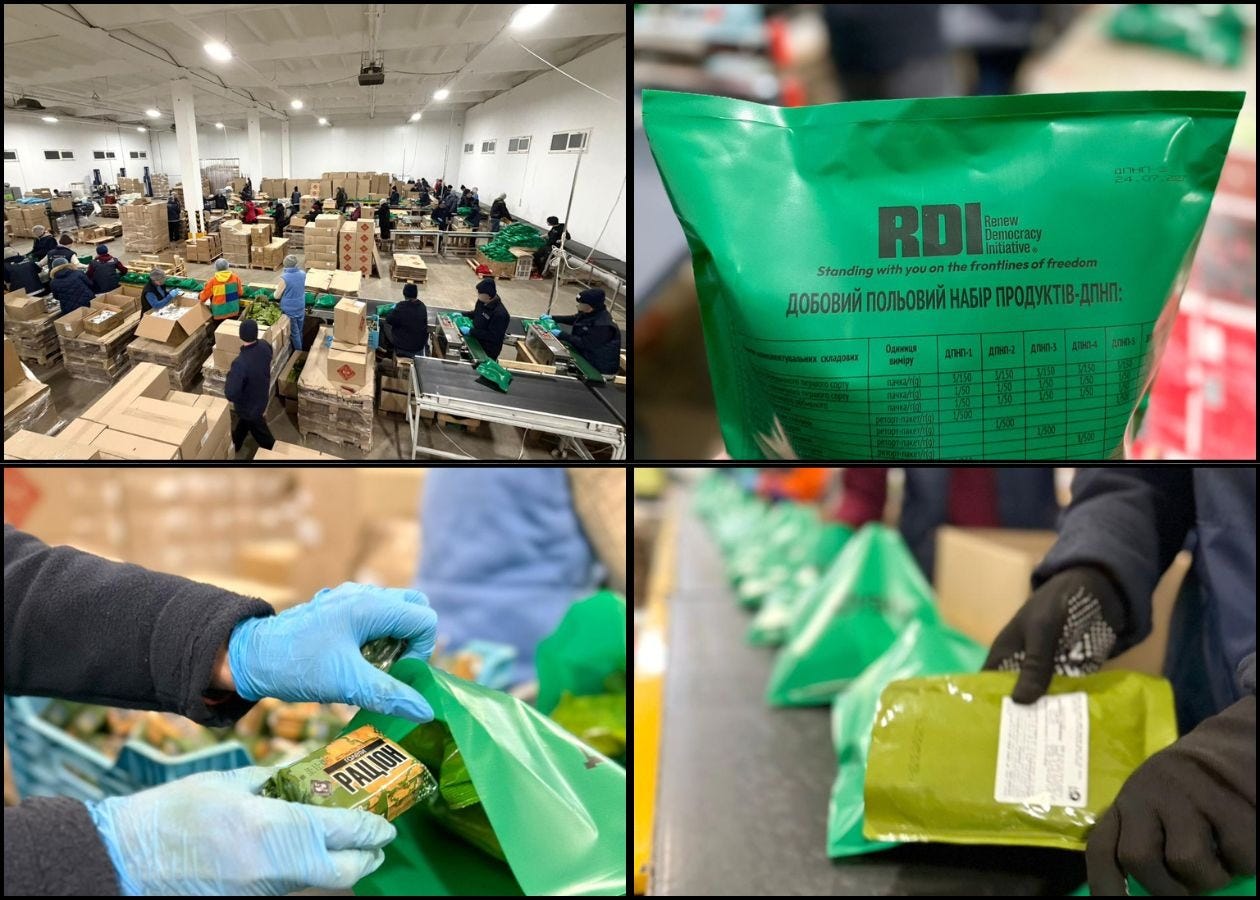
We recently ordered 70,000 meals ready-to-eats (MREs, an acronym familiar to anyone who’s spent time around the military), mostly for the Kharkiv region. Kharkiv is located on the Russian border and is the target of relentless bombardment. The first tranche—21,504 MREs to be precise—were delivered this past week. Roughly half will go to civilians, and another half for the Ukrainian soldiers bravely defending their homeland.
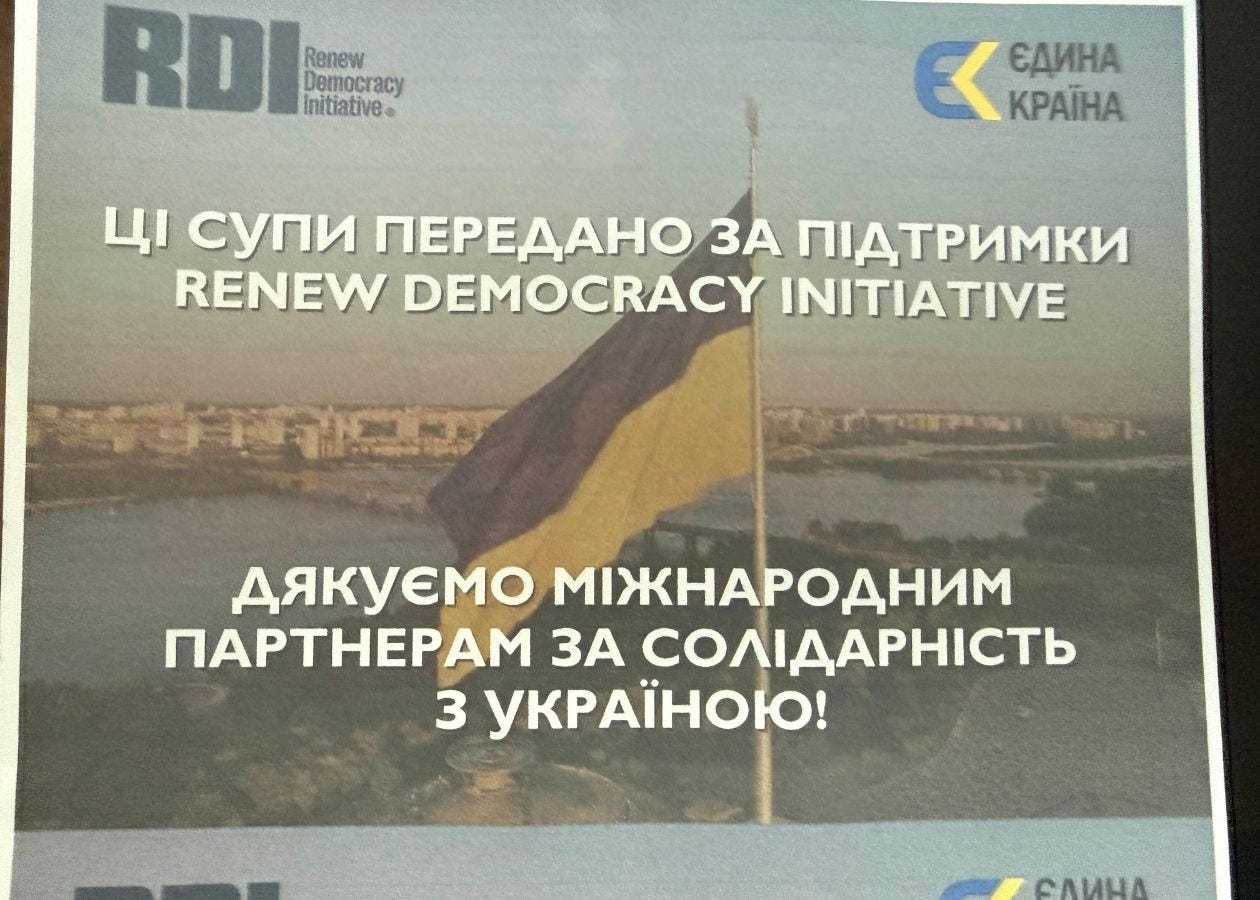
On top of that, the Renew Democracy Initiative recently secured 31,000 warm meals for the capital city of Kyiv, where residents are enduring freezing nights and blackouts. We hope our Ukrainian friends like soup!
You can support RDI’s work by upgrading to join our premium subscriber community. RDI CEO Uriel Epshtein will also be leading a delegation to visit our partners on the ground in Ukraine later this month, so stay tuned for firsthand updates from the front here at The Next Move!
More from The Next Move:

What Would a Free Iran Mean for the World?

Five writers, each from a different country, on the global consequences of Iran's protests.
One angle that may deserve even more attention is the structural link between the Iran theatre and the war in Ukraine.
Iran has not merely been a political partner for Moscow; it has become a practical enabler of Russia’s war effort, most visibly through the supply of Shahed drones that have been used extensively against Ukrainian cities and infrastructure.
That creates a strategic paradox.
A weakening of Iran could, in principle, degrade Russia’s access to some of these capabilities. But at the same time, a widening Middle Eastern conflict risks diverting Western attention, production capacity, and political bandwidth away from Ukraine.
In other words: the Iran crisis could simultaneously weaken one pillar of Russia’s war machine while also weakening Ukraine’s support structure.
Which effect dominates will likely depend less on battlefield events in Iran and more on whether Western governments maintain strategic focus on Ukraine while managing a second crisis.
The real test is therefore not only military — it is one of political prioritization and strategic discipline.
Please help me understand...why has the Trump Regime abandoned Ukraine? I thought they liked "winners". It's clear that if Russia stops fighting the war will end as they are the aggressor. Therefore, Russia NOT Ukraine, needs to agree to a cease fire. End of conflict, end of bloodshed.
On the other hand, the Ukrainian Freedom Fighters cannot stop fighting as they are defending their people. If they stop fighting their sovereignty will end; Ukraine will end!
Putin does not want a "win" he simply cannot afford to lose. Losing ends his empire building goals and exposes him to face accountability for his ruthless aggression and merciless war crimes.
The Trump Regime support for Ukraine is now or never. We need diplomacy not deal-making. It's give and take. Give President Zelenskyy the military aid he needs to end the bloodshed. In exchange, Zelenskyy would help the Trump Regime to learn from his strategic military knowledge of fighting a ruthless aggressor.