


A note from Garry Kasparov: The Trump administration could soon launch a war with Iran without oversight or accountability. To navigate the crisis, we will need a deep understanding of America’s place in the world rather than allow ourselves to get distracted by the outrage du jour. That’s why I’m inviting our premium subscriber community to a Zoom conversation on the last half-century of American foreign policy with Ed Luce, Financial Times US editor and author of Zbig: The Life And Times of Zbigniew Brzezinsky, America’s Great Power Prophet, taking place on Wednesday, March 4 at 5pm ET/2pm PT. You can find registration details here.
To make this opportunity more accessible, we’re offering 30% off a premium subscription, now through March 4. I don’t receive a cent from your subscription fees—everything goes to supporting the Renew Democracy Initiative. RDI is bringing political dissidents to tell their stories to students, business leaders, and public officials. Delivering life-saving humanitarian aid to frontline communities in Ukraine. And, of course, driving the conversation here on The Next Move.
Jay Nordlinger is a senior resident fellow at the Renew Democracy Initiative and a contributor at The Next Move.
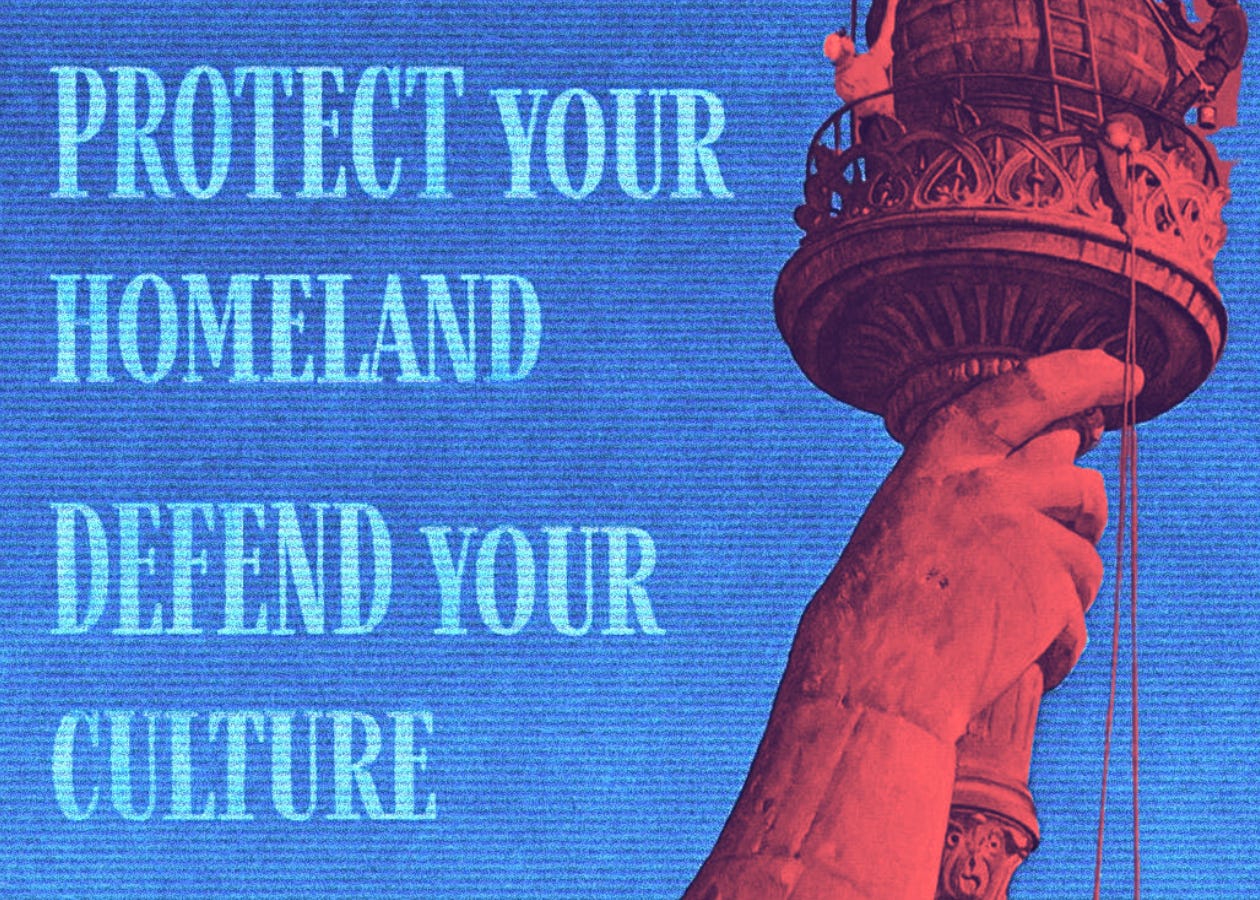
The recruitment ads of ICE, our immigration agency, merit a long article unto themselves. Some of them belong to the category of agitprop. Here in this column, I would like to concentrate on one particular pitch.
“Defend your culture!” says one ad. “For our country, for our culture, for our way of life,” says another. I will cite one more: “Protect your homeland. Defend your culture.”
Jeh Johnson, a former secretary of homeland security, said, “The recruitment rhetoric is ‘Defend your culture.’ What does that mean?” We might ask the same question.
Another question has entered the chat in recent days: What is “white culture” or “white identity”? A Trump State Department nominee has talked a lot about “white culture” and “white identity.” He worries about their “erasure.”
Questioned about this by a senator, the nominee mentioned, among other things, “foodways.” Insert your Velveeta joke here. Also, the “French” in “French fries” is not very American, is it? (White though it may be.)
One of the reasons I rejected the Left, long ago, was that they were obsessed with race and ethnicity, and played “identity politics.” (I’m generalizing here.) I was an E pluribus unum guy (as I still am). Today, the Right resembles the Left in myriad ways.
(For a piece of mine on this subject—on its foreign policy aspect in particular—go here.)
In my column today, I will not cover the ground of American culture. There are countless volumes on the subject. You might start with Perry Miller, the great historian who helped to launch American Studies. You might even start with Crèvecœur, who published Letters from an American Farmer in 1782. But I will offer a few thoughts.
When I was a kid, there was a jingle: “Baseball, hot dogs, apple pie, and Chevrolet.” (You pronounced that “Cheverlet.”) The next line went, “They go together in the good ol’ USA.”
Harold Hill cried, “Remember the Maine, Plymouth Rock, and the Golden Rule!” Who was he? The titular character in The Music Man, the 1957 hit by Meredith Willson. I wrote about it once, calling it the Great American Musical.
My piece is apparently unfindable on the Internet—but you can have it in a collection, for the low, low price of $13.85.
Speaking of musicals: The Department of Homeland Security put out a video, accompanied by a text that said, “This is our own, our native land.” The video used a song: “Climb Ev’ry Mountain,” from The Sound of Music, by Rodgers & Hammerstein.
Both of those fellows were born in New York. But the composer’s parents were Jews from the Russian Empire. (The family name, Rogazinsky, was made into “Rodgers.”) The lyricist was Oscar Hammerstein II. Oscar the First was a Jew from Germany.
Irving Berlin was a Jew from Russia (its empire). He gave us our all-American Christmas carol: “White Christmas.” He also gave us “God Bless America.” Dimitri Tiomkin was another Jew from the Russian Empire. He helped forge the sound of the American West—cowboys and Indians and all that—with his theme to Rawhide.
Aaron Copland helped forge that sound too (with his ballet Rodeo, for example). He was born in Brooklyn—but his parents were Jews from that same empire.
The Gershwins, too, were of that background. They wrote Porgy and Bess, which is arguably our national opera. The story is about black people in Charleston, S.C. Is the opera part of white culture or black culture?
It is part of American culture, and the musical culture of the world.
ICYMI: Tune in to the latest episode of the Older/Wiser podcast:

On Easter Sunday 1939, Marian Anderson sang in front of the Lincoln Memorial. The great black contralto—“The Lady from Philadelphia”—had been denied use of Constitution Hall by the Daughters of the American Revolution, those “Heritage Americans” (in recent parlance).
She opened with “My Country, ’Tis of Thee.” Then she sang a Donizetti aria, a Schubert song, and several spirituals.
Black culture? White culture? American culture? Culture culture?
We are a diverse nation, with multifarious cultural pockets. The daughter of a lobsterman in New England will not have a quinceañera. (Will she?) But no American should really be spooked by either a lobster or a quinceañera.
Still, there is a common culture, and every nation needs ties that bind, or “mystic chords of memory,” as an American once said.
Our common culture includes the higher and the lower—Walt Whitman, sure, but also his fellow New Yorkers the Bunkers, of All in the Family.
For poets, we have, in addition to Whitman, Emily Dickinson, Robert Frost, Langston Hughes, Wallace Stevens … For novels, we have The Scarlet Letter, The Great Gatsby, To Kill a Mockingbird …
(Some of us think that Stoner, by John Williams, published in 1958, deserves a place in the canon. This is an ongoing campaign, and frustration.)
When I was growing up, there was a painting by Winslow Homer on my wall. (Not the real thing, alas—a poster.) It was Breezing Up. You’ve seen American Gothic a time or two. And several Norman Rockwells. And Jackson Pollock’s creative drips.
Charles Ives stocked his Symphony No. 2 with popular tunes. Time was, most Americans would have recognized them. Does anyone know “Columbia, the Gem of the Ocean” today? Maybe not, but it still belongs to our “mystic chords.”
The choreographies of Martha Graham are part of our patrimony. (Matrimony?) She teamed with Copland for Appalachian Spring. That is as American as high school football on Friday nights, and vice versa.
About Hollywood, we could go on and on. Hollywood has shown America to itself, and America to the world. In its golden age—there’s another phrase in current parlance—Hollywood was stocked with immigrants and refugees.
Do you know this anecdote? Otto Preminger passes a table of men speaking Hungarian. He stops to reproach them: “You’re in America now. Speak German!”
I have offered a few thoughts about the arts and sports and whatnot. But very important is our political culture. Our democracy. In one of those recruitment ads, ICE speaks of “our way of life.”
Well, what about the Constitution? What about our long-established norms? When you lose an election, you concede it. If you’re president, you attend your successor’s inauguration.
Those rioters on January 6 halted a constitutional process. They threatened the vice president, the speaker of the House, and others, with death. The president called them “patriots” and pardoned them all.
Immigration is part and parcel of our national story. The 2024 presidential campaign featured Donald Trump and Kamala Harris. Three of their four parents were immigrants, and the fourth was the son of immigrants.
Repeatedly in that campaign, Trump said that immigrants were “poisoning the blood of our country.” Immigration must be lawful, for without the law, we are lost. The adjective in “ordered liberty” is as important as the noun. But “poisoning the blood of our country”? Really?
A welcome of refugees is also part of our story, our culture. With shameful exceptions, we have provided a haven for the terrorized and persecuted.
Today, our door is shut to refugees—except, curiously, to white South Africans. Surely we can do better, be more ourselves?
In this country, you don’t put your name on someone else’s memorial. You don’t hang a giant banner of yourself on the Justice Department. This is not North Korea.
Presumably, fights over American culture and the American way—fights over “Who are we?”—will go on for as long as our country exists. I am not the last word. Neither are you, neither is ICE.
But, dammit, I agree: “Defend your culture.” Defend our constitutional republicanism and our civil society. Or, as we say at the organization whose publication this is: renew democracy.


That's what Black Hawk said. . . This "homeland" was stolen from him.
. . . or are we talking about immigrants? For the most part, they were defending their lives by seeking refuge here, not their "culture."
Everyone is entitled to culture, subcultures and common cultures, familial cultures, whatever, but for how meaningful culture feels, it is still, from a spiritual perspective, illusory.
When this idea of defending one's culture comes up, it implies that it is under attack. But when a culture requires that other cultures be eradicated as an expression of itself, that's something else far more threatening to the human species and the human spirit.
If one culture requires that another be denied, it has no place in American society.
The language here echoes a familiar pattern in scapegoating propaganda. “Defend the culture” or “protect the homeland” has appeared in many political systems that later defined culture in increasingly exclusionary terms. The rhetoric often begins abstractly, then gradually shifts toward identifying internal enemies.
The most pernicious thing about “defend your culture” is how undefined it is. Ambiguity allows people to project their own fears into the phrase, which makes it a powerful mobilizing tool.