


David Volodzko is the news editor at the Foundation for Individual Rights and Expression (FIRE), a free speech nonprofit. He is also the author of the newsletter The Radicalist. This essay is an excerpt from his upcoming book, Memoirs of an American Dissident.
What can I say about losing a father? Now, as a father myself, if my daughter should read these words when I am gone, what would I want her to know? Perhaps I would tell her about the film Schindler’s List, in which there’s a famous scene with a little girl in a red coat. It’s a startling image because the movie is otherwise black-and-white, and then suddenly, a bouncing splash of red. You see her during a scene depicting the liquidation of the Krakow ghetto. A beautiful child. Later, you see her again, her face destroyed but the coat unmistakable, as she lies on a cart stacked with bodies being wheeled toward the burn pits. It is one of the most haunting scenes in the movie.
But now, reverse the effect, and imagine instead that the whole world is full of bursting color, and that one of those colors belongs to your father. Green, let’s say. When he dies, the world carries on, of course, in Technicolor joy, as if mocking your grief. Except now all the green is gone. All the trees, all the grass, every cup of tea, grey as stone. Life is otherwise normal, but every time you see a summer field the color of gravel where others see fresh life, the pain of memory pinches. But in that painful grey, there’s a depth of beauty others cannot comprehend. The grey of the ocean deep. The grey light of dawn. In time, it becomes darkly beautiful to you. Like a dingy bookmark saving your favorite page. I lived in that grey world for a long time. But then something happened.
Shortly before my father’s death, I had returned to America after living almost 20 years in Asia as a professor and a journalist. The first thing I did upon returning was rent a cabin in the Appalachian mountains with my wife, who was my girlfriend at the time. The woods were gorgeous. Fat-trunked sycamores beside rivers, towering tulip poplars, white oak on the higher ground. A blizzard locked us in the cabin for a week, but I didn’t mind one bit. We danced, drank bourbon, made love. It was good to be home again. America the beautiful. After an extended job search, I had a really good interview for a position with The Seattle Times, one of the largest newspapers in the United States, to join its team as a columnist and a member of its editorial board. Given the paper’s national ranking, and its regional influence as the largest outlet in the Pacific Northwest, I considered sitting on its board one of the most prestigious positions in American mainstream journalism.
Still, taking the job would be no easy lift. We had recently bought a home in rural Georgia. I had convinced my parents, as well as my brother and his wife, to move to the area so we could all be together. It was one of the happiest times of my life. Family dinners every Friday, summer cookouts on Lake Allatoona, camping in the bear country beneath Blood Mountain. But one evening, before I had gotten the callback about the position, my phone rang. It wasn’t Seattle. It was my mother. She was hysterical. I couldn’t understand anything she was saying. When I got to my parent’s place, she handed me the phone and a man on the other end of the line told me my father had been run over and killed while crossing the street. The man on the phone had not yet told my mother. She looked at me, her eyes wide like a child’s, and after pausing to steady my voice, I destroyed her life with a few words.
Months later, my mother moved back to her native home in the Bahamas. Shortly after that, the call came from Seattle and my wife and I made the difficult decision to move. Maybe, I thought, this new chapter would be a brighter path. My wife flew out to Seattle with our newborn daughter and began apartment hunting while I drove the moving truck up. I made my way through Chattanooga, with its river steamboat like a scene out of Mark Twain, past Nashville, past the old rail yards and stone bridges of St. Louis. I camped in the Badlands of South Dakota, waking up to see the sun spread itself over the bare, rainbow rocks. Dad would’ve loved it there.
When I got to Wyoming, I slowed down, made fire under the clean granite peaks of the Grand Tetons, and again in the dark and dense spruce woods of Yellowstone, where I awoke with a herd of bison calmly wandering past my tent. Thank God they didn’t walk over me. I saw Montana for the first time, and beheld its cathedraled spires of snow. Northern Idaho stunned me with its beauty, its smooth and rolling hills and winding rivers like mirrors, reflecting the bruised purple and rose of its perfect sky. God shed his grace on thee.
It was a magnificent trip, pure Americana, but I couldn’t so much as make a fire or hang a bear bag without thinking of the man who taught me how. All the mountain majesties and fruited plains were pale as ash. Finally, I came to Washington, first to Spokane, an outdoorsy and blue-collar city with friendly folk who had a plainspoken charm. I headed south through wine country, then over the Cascade Mountains and into the piney slopes of southern Seattle.
I threw myself into the city, studying it obsessively, and rapidly came to adore the place. I listened to every episode of every podcast about the place. I read two dozen books. I studied its history, politics, geology, climatology, and read about the tribes of the Coast Salish world—the Duwamish, Suquamish, and Muckleshoot peoples. By the time my ass hit the saddle, I was ready to ride. I interviewed city council candidates for the paper’s endorsements. I met Mayor Bruce Harrell, who explained his plans to revitalize downtown after Covid. I got a private tour of Sea-Tac Airport, trying to understand its congestion issues. It was tame stuff compared to my earlier work on authoritarian regimes, genocide, and war. But I absorbed it all and loved every minute. Yes, Seattle had a brittle and ideologically conformist atmosphere, and the polite but distant air people call “Seattle nice.” But I was charmed by its coffee culture, its strong Asian community, its loveable weirdness, and by the vanishing flavor of Old Seattle, blue-collar and grunge. This was still the city of Nirvana and Pearl Jam, and though it was fading fast, you could find the shrapnel fragments if you went looking.
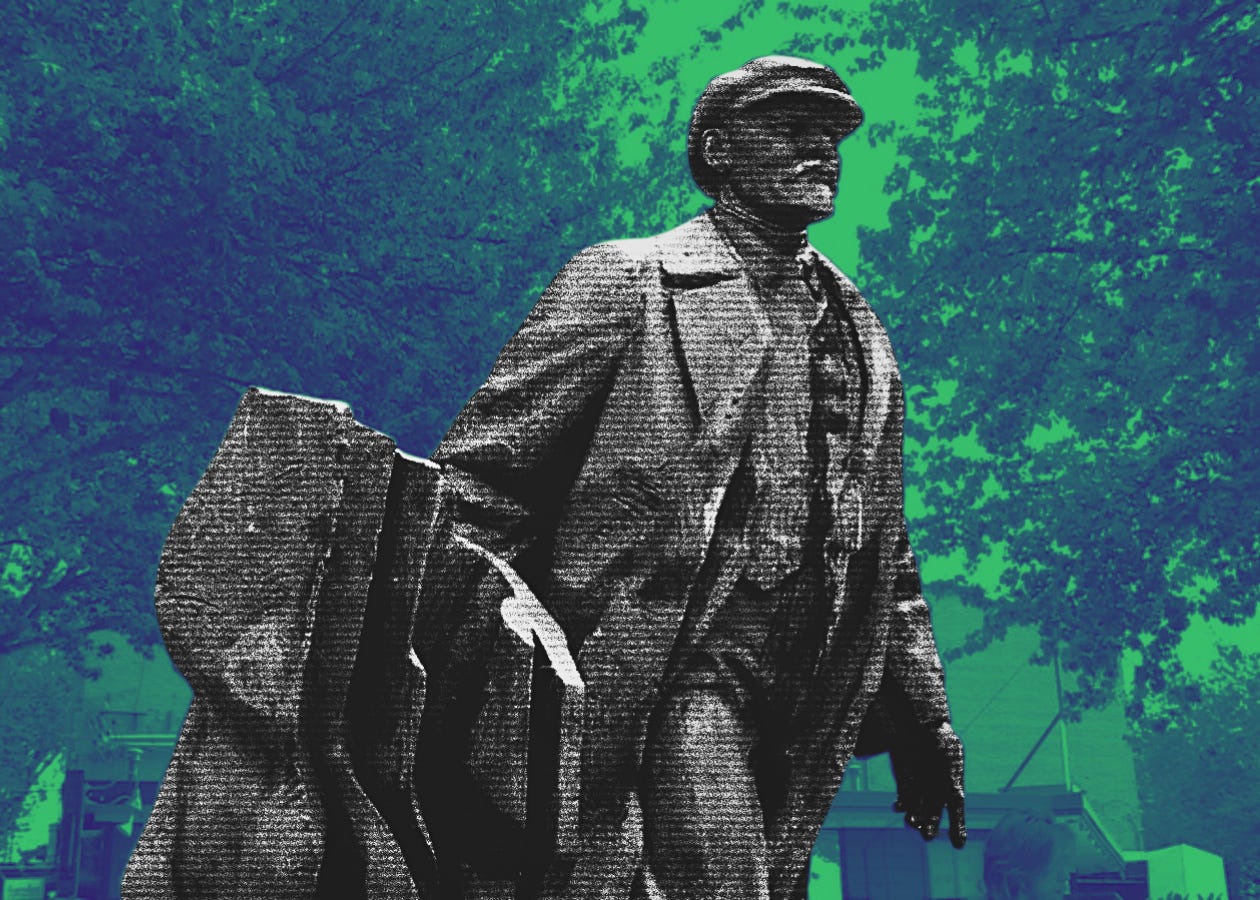
After writing a series of editorials on topics such as the airport and orcas, my boss Kate Riley asked me to write my first column about the city’s 16-foot bronze statue of Vladimir Lenin. I had wanted to write about the cost of early childhood education, being a new father myself, but given my Russian ancestry, I saw the Lenin statue as an opportunity to introduce myself and my family background to readers. In my column, I recalled making pelmeni by hand with my babushka Alla, my hands and face covered in flour as we worked in the cold of my grandparents’ basement in Paterson, New Jersey. I talked about my grandfather Josef, who had been a horse rancher before he came to the United States as a refugee after escaping a Nazi concentration camp. The only thing worse than that, he used to say, was the Russia Lenin had built. As I wrote in my column, “Josef knew he would never see his family again, but every holiday, my family stood around the kitchen table while he packed a box to send home, filling it with mundane but greatly needed raw cloth, buttons, paper. Josef had pre-sliced bread, but his mother needed flour. He had electric light, she needed candles.”
Then I came round to the statue. I wrote that, naturally, it offended me. Lenin was a demon of censorship whose regime had murdered members of my family. I hated him like I hated Stalin or Hitler. Though as New Yorker editor David Remnick recounted in his book Lenin’s Tomb, Vyacheslav Molotov, one of the few men who intimately knew both Lenin and Stalin, once remarked that compared to Lenin, Stalin was “a mere lamb.” Despite this, I explained that I believed the statue should not be torn down by fiat. I was personally offended, outraged even, but I believed in the principles of free expression and democracy, and if anything was to be done about the statue, I felt it should be done fairly.
ICYMI: Tune in to the latest episode of the Older/Wiser podcast:

The column ran without controversy. Many people in the community wrote to thank me for my words. One man told me his Russian mother fell to her knees and wept when she saw a statue of Lenin, the monster who had slaughtered her parents, standing in the heart of an American city. Communists also wrote to tell me I was a fool to disrespect Lenin. Others criticized me for arguing to tear the statue down, which was the opposite of what I’d said.
Then I shared the column on Twitter, observing the moral hypocrisy of tearing down statues of Confederate generals while defending one of a communist dictator. Someone replied that America has a special relationship with the Confederacy, so this was not a fair comparison. Good point, I replied, but then what about Hitler? Both Hitler and Lenin were genocidal European dictators whose evil cursed humanity around the same period of time, in roughly the same patch of land, yet we would never tolerate a statue of Hitler, for obvious reasons. In a lengthy thread in which I made my views on Hitler’s evil crystal clear, and even noted that my grandfather had survived a Nazi concentration camp, I explained that “Hitler only targeted people he personally believed were harmful to society whereas Lenin targeted even those he himself did not believe were harmful in any way.”
Still, Twitter being Twitter, my comment was ripped from its context, and the response was immediate and hysterical. What happened next was like watching a fire spread across dry grass. Accounts with communist flags in their bios and “Leninist” in their handles came for me. They called me a Nazi. They called me a Holocaust denier. They told me to kill myself. They threatened to kill me.
The whole thing was like a contagion. Each new person arrived not having read my column or my comments, but reacting to someone else’s reaction to someone else’s outrage, like a drunken game of telephone in which the original message is replaced entirely by the emotion it generated. At one point, a disinformation analyst, whose literal expertise was identifying exactly this kind of cascade, reposted someone’s comment calling me a Nazi. When I wrote to him privately, asking him to take even a few seconds to review what I had actually said, he came back in under two minutes with an apology. “No worries,” I said. But I remember thinking, if the guy whose job it is to spot this can’t spot it, what chance does anyone else have? Was this not what my grandfather had fled Russia to escape? The intolerant silencing. The threat of death over an opinion.
As the mob grew, I told my boss Kate, but she simply replied, “Nobody cares what happens on Twitter.” And yet the death threats kept pouring in. I called her back later, and she could see that I was rattled. I asked her for advice. “I can’t tell you what to do with your Twitter,” she said, “but log off and have a glass of wine and play with your daughter.” She recommended that I stop engaging folks online, saying it was just feeding the furor. I knew she was right. But later that day, I saw a local journalist posting that my ancestors were literal Nazis who had “killed tens of thousands of Jews.” I replied that, in fact, my ancestors were killed by Nazis, not the other way around. But no effort to explain myself made any difference to anyone. As one friend told me, “David, they’re not misunderstanding you. They’re pretending to misunderstand you so they can act high and mighty.”
As the furor grew, my bosses, Kate and Melissa Davis, decided to review all my online comments and concluded the accusations against me were utterly false. They told me my job was secure. Kate said, “We’ve got your back, David. We’re not going to stand for a lying Twitter mob coming after one of our own.” I breathed a sigh of relief. In some way, I had never really let myself grieve my father, having had to keep it together for my family, as the eldest son. But the weight of a thousand voices telling me I was evil had affected me. It’s a strange fact, but however certain you are of a thing, having enough people tell you you’re wrong can shake even the surest mind. Psychologists call this the Asch effect. I had studied it as a grad student. But knowing a thing and knowing a thing are two different things. The attacks had shaken me deeper than I had realized. Maybe it was fear for my daughter. Maybe it was buried grief over my father. But when Kate said they had my back, the relief hit me like a wave and I almost wept.
The decision was put before the editorial board, and no one objected. Two hours later, Kate called. I was home, rocking my daughter in my arms. I handed her to my wife and took the call. “Effective immediately,” she began. I was quiet for a moment. The official reason was that I had continued posting online after being told to stop. Even though, when I had asked Kate for advice on what to do about the mob, she had told me, “We can’t tell you what to do with your Twitter account.” But she had given me the advice to log off, and now that was being presented as if it had been an order. An order I had violated. So the official reason they fired me was because I told a “journalist” online that Nazis killed my family. But when I pointed this out on the phone, an HR representative who had apparently been on the line the whole time, interrupted to say, “We’re not here to debate this. The decision has been made.” Clearly, I was not actually being fired for telling someone my family was killed by Nazis. I was being fired because the “lying Twitter mob” was becoming a PR nightmare, and someone higher up had decided to override the board and feed me to the wolves to lighten their sled.
I have since explained in detail precisely what I meant by my commentary on Lenin versus Hitler, and if people hear me out, weigh the evidence for my claim, and yet wholly disagree, that’s fine. In fact, it’s healthy. That is my honest read of the facts, but yours may differ. Good-faith disagreement is the nature of open discourse and free expression, two principles that lie at the very heart of journalistic ethics—and American democracy. But firing an opinion columnist for having an opinion? For comparing one dictator to another, the obvious point being that both are evil? Is that really what we’re doing now?
The media had a field day with me, but the headlines bore no resemblance to anything I had said or believed. Even The Daily Beast, which had published my work exposing Nazis (and so its editors knew better) smeared me without a word of context. The Free Press gave me a chance to tell my own story in an essay aptly titled, “My family was hunted by Nazis. But I was fired for ‘defending Hitler.’” In the days after, I did what writers do when the institution collapses beneath them—I built my own floor. I had been attacked for my speech, so I chose to keep speaking. Louder now. I started a Substack, The Radicalist, where I write about the extremist movements I had spent my career studying. Slowly, the work found its audience. People wrote to me. Katie Couric expressed support. Elon Musk said he would fund the legal fees for anyone fired over a tweet, adding that my case looked like a good one. And I got to interview some of my lifelong heroes, people like the Nazi hunter Efraim Zuroff and the legendary Ayaan Hirsi Ali, one of the world’s greatest living dissidents, who told me, “You are also a great dissident. Just keep at it and keep doing what you’re doing.”
Finally, the scales of truth had turned my way. But even weeks later, the death threats had not slowed, and we had a baby girl to consider. Breaking our lease ended up costing us over $10,000. Fortunately, Blocked and Reported host Katie Herzog and her partner offered to put us up while they were out of town. They lived not far from the city, and we gratefully said yes. My daughter ended up learning to walk in their home. Of course, I will never be able to repay Katie for being life-changingly kind to me and my loved ones. But I often think of it, my girl’s first steps, taken in a borrowed house, outside a city we had fled, at the end of a year that had burned everything down. But my little girl didn’t know any of that. She just stood up and walked across the room one day, clear out of nowhere, and watching her, I felt something I hadn’t felt in a long time. I burst into laughter. As she waddled away from me in the funniest way, I noticed her socks were blindingly green.
Not everything in life has to make sense or math out. Sometimes shit happens. Sometimes there is no takeaway. But looking back on it all, I suppose what I would want my daughter to know, if she reads these words when I am gone, is that you must never let the unlistening crowd decide what you can say. Freedom of speech is the freedom to be yourself, and there are no mistakes when it comes to that, my love. But also remember to always carry on, because in life, winter will come—but eventually, the green grows back.
More from The Next Move:

From Trump, a Noxious Equivalence

There is no moral equivalence between liberal democracies and dictatorships.

Thank you for your honesty, bravery, and willingness to share. When otherwise intelligent and reasonable people turn morally ugly, this is the result.
Fascinating and moving. Mobs of uncomprehending dolts are the worst, especially when they have some good credentials that should alert them to be much more careful about their claims!