


Jay Nordlinger is a senior resident fellow at the Renew Democracy Initiative and a contributor at The Next Move.
Since we are adults, let us stipulate that democracies often have to engage with dictatorships, and that foreign policy is not for the pure. A lot of nose-holding is involved. Paramount is the national interest, and realism is required.
Yet America has long been a nation apart—not merely “another pleasant country on the UN roll call, somewhere between Albania and Zimbabwe.” I have quoted a phrase from the first President Bush.
He saw America as “a unique nation, with a special role in the world.”
Once, President Carter was meeting with Andrei Gromyko, the Soviet foreign minister. Carter brought up the case of a political prisoner: Anatoly Shcharansky (later known in Israel as “Natan Sharansky”). Gromyko was nonplussed. The United States and the Soviet Union had nuclear arsenals to discuss. And the president wanted to talk about a prisoner?
Shcharansky, in Gromyko’s words, was but “a microscopic dot.”
Carter’s successor, Ronald Reagan, always brought a list of political prisoners when he met with Soviet Premier Mikhail Gorbachev—a list of prisoners that he (Reagan) was especially interested in. Gorbachev grumbled, “Too many lists.”
A very different president is Donald Trump. The matter of human rights does not seem to figure in his thinking. In fact, he is likely to pour praise on dictators—including anti-American ones. Toward the end of his first term, I did a roundup of his relations with dictators: here. A roundup of such relations in his second term bids to be equally full and pungent.
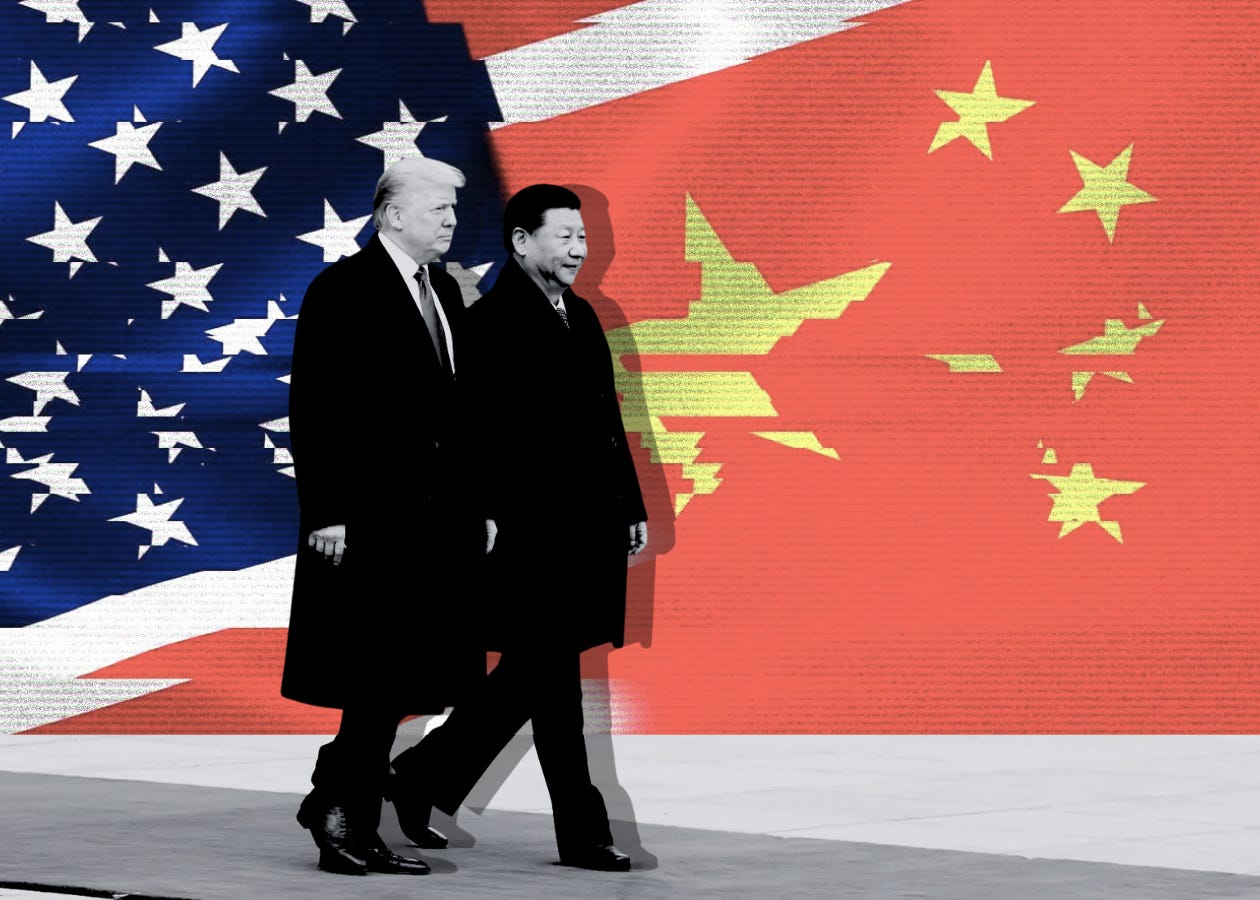
On his visit to China earlier this month, Trump said to Xi Jinping, “You’re a great leader,” and, “It’s an honor to be your friend.”
Xi presides over a one-party police state with a gulag (laogai). That state is committing genocide against the Uyghur people. Xi has crushed Hong Kong and threatens to swallow Taiwan. Etc.
A great citizen of China was Liu Xiaobo, the democracy leader and political prisoner. He received the Nobel Peace Prize, in absentia, in 2010. He died, still a prisoner, on July 13, 2017.
On that very day, Trump said of Xi, “Well, he’s a friend of mine. I have great respect for him. We’ve gotten to know each other very well. A great leader. He’s a very talented man. I think he’s a very good man.” And so on.
ICYMI: Tune in to the latest episode of the Older/Wiser Podcast

In 2019, as Beijing was crushing Hong Kong, many people, including some members of his own party, were imploring Trump to “stand with Hong Kong.” Said Trump, “Look, we have to stand with Hong Kong, but I’m also standing with President Xi. He’s a friend of mine. He’s an incredible guy.”
You have noticed this “friend of mine.” John Bolton, one of Trump’s national security advisers in the first term, addressed this matter at the Copenhagen Democracy Summit earlier this month.
Trump “thinks he’s friends with Xi Jinping and with Vladimir Putin,” said Bolton. “And I will guarantee you, that’s not how they see Trump. I think they both see him as an easy mark.”
In a 2023 interview, Trump said, “They’re all top of the line.” He was referring to Putin, Xi, and Kim Jong-un. “President Xi is a brilliant man,” said Trump. “If you went all over Hollywood to look for somebody to play the role of President Xi, you couldn’t find—there’s nobody like that. The look, the brain, the whole thing.”
Trump is consistent in this belief. In Beijing this month, he said, “If you went to Hollywood and looked for a leader of China to play a role in a movie—he’s Central Casting. You couldn’t find a guy like him.”
The first US president to go to China was Richard Nixon. “The week that changed the world,” he called it: February 21–28, 1972. Accompanying the president’s party on the trip was William F. Buckley Jr., the conservative journalist. He was nauseated by what he saw.
“We have lost—irretrievably—any remaining sense of moral mission in the world,” WFB wrote.
He continued, “Mr. Nixon’s appetite for a summit conference in Peking transformed the affair from a meeting of diplomatic technicians, concerned to examine and illuminate areas of common interest, into a pageant of moral togetherness at which Mr. Nixon managed to give the impression that he was consorting with Marian Anderson, Billy Graham, and Albert Schweitzer.”
When Nixon toasted “the bloodiest, most merciless chief of state in the world,” said WFB—he meant Mao—“he did so in accents most of us would reserve for Florence Nightingale.”
After this latest summit, President Trump posted a picture of himself with his Chinese counterpart, writing a caption that made him sound like an excited and awed schoolboy: “The man I am walking with is President Xi, of China, one of the World’s Great Leaders!”
If Trump pours praise on anti-American dictators, he makes sure to pour scorn on American leaders who are his political opponents. Consider two examples: one from 2019, one from this month.
In May 2019, Joe Biden, kicking off his campaign for the Democratic presidential nomination, said, “Are we a nation that embraces dictators and tyrants like Putin and Kim Jong-un?” In retaliation, North Korea’s official “news agency” called Biden a “fool of low IQ.”
That is a favorite Trump phrase: “low IQ.”
In the White House, Trump issued a tweet, saying, “I have confidence that Chairman Kim will keep his promise to me”—concerning weapons—“& also smiled when he called Swampman Joe Biden a low IQ individual, & worse. Perhaps that’s sending me a signal?”
During this month’s summit in Beijing, Xi Jinping mentioned the “Thucydides trap,” whereby a rising power and a declining power come to blows. Someone must have explained the implications of this statement to Trump, which prompted a tweet from him:
“When President Xi very elegantly referred to the United States as perhaps being a declining nation, he was referring to the tremendous damage we suffered during the four years of Sleepy Joe Biden and the Biden Administration, and on that score, he was 100% correct.”
Xi Jinping and Kim Jong-un may be monstrous Communist dictators, but at least they’re not “Sleepy Joe,” right?
At home, the two Trump terms have been a festival of lawlessness, vulgarity, and corruption. But our president’s sweetness on monstrous dictators may be the most painful thing about the whole ordeal.
The Renew Democracy Initiative, publisher of The Next Move, is pleased to join the Institute for the Study of Modern Authoritarianism, publisher of The UnPopulist, as a media partner for the third annual Liberalism for the 21st Century Conference—LibCon 2026—in Washington, DC on July 16 and 17. Click here for more information and to register. Coinciding with America’s 250th anniversary, the theme of the conference is the Reconstruction Agenda. The conference will assess the damage that authoritarian and demagogic politics have caused to the country’s liberal institutions and propose a path forward to rebuild accountability and confidence in the rule of law. The conference features a stellar lineup, including RDI Vice Chair Linda Chavez along with Francis Fukuyama, Anne Applebaum, David French, Hong Kong dissident Nathan Law and many more. We’ll be there and so should you.
More from The Next Move:

I Almost Died

A concussion. A fractured sternum. A punctured lung. Eight stitches to cap it all off.

Trump may have meant 'honored to be your friend'......in the same way he was'
honored to be invited to Jeffrey Epstein's island'...... so much for notions of honor. How did we come to this.
Pretty one sided. By the second half of this century, China will most likely be miles ahead of the United States both economically and politically.