



Sabina Cherner is a communications intern at the Renew Democracy Initiative, which publishes The Next Move. She is a student at Tufts University, where she is studying international relations and economics.
Ariane de Gennaro is a communications intern at the Renew Democracy Initiative and an incoming JD candidate at Harvard Law School. She previously wrote for the Yale Daily News and worked in the office of Senator Mazie Hirono.
A few weeks ago, we were grabbing a burger at a popular joint when a pack of German soccer—sorry, football!—fans stumbled in. They had clearly just returned from Germany’s group-stage match against Ecuador at MetLife Stadium, still decked out in jerseys and bucket hats. After briefly conversing amongst themselves they asked what we’d recommend (the obvious answer: a double burger and the loaded, animal-style with the signature house sauce). A few bites in, one of the fans turned to his friends, still chewing, and in that thick, Central European accent declared that they simply don’t make hamburgers like this back home (which left us wondering if this German had been to Hamburg).
That’s the World Cup in miniature, and now that the tournament has closed, with Spain beating Argentina 1-0 in an exhausting extra-time final, it’s worth examining what the United States showcased to the world in the last five weeks hosting it alongside Canada and Mexico. For one summer, the US reintroduced itself to millions of people, not through fraught geopolitics, but through the spontaneous and entirely sincere America that exists between the highways and stadiums; the America of the burger spot where we encountered those curious German fans.
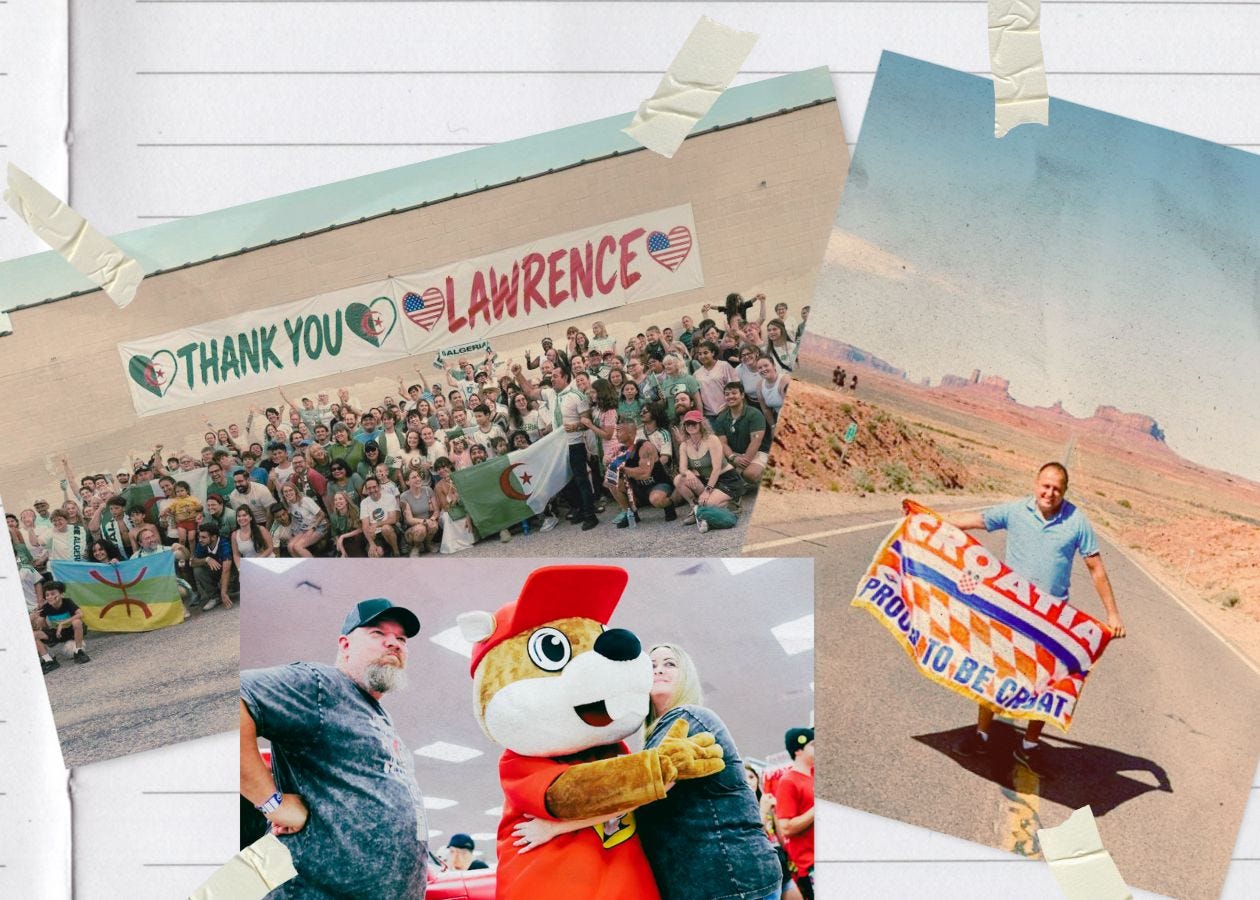
Videos of foreign fans marveling at free soda refills, discovering Buc-ee’s with religious awe, touring suburban Walmart’s as if they were at the Met, and road-tripping between host cities to see national parks they never knew existed. Football tourists were falling for a country that, by many surveys, they’d soured on in recent years.
In many host cities, Americans also rediscovered the wider world. In Lawrence, Kansas, the University of Kansas’ marching band rehearsed and performed Algeria’s national anthem to show their support for their temporary guests. Boston pubs experienced unprecedented beer shortages and introduced an extended “last call” curfew during the eventful, yet brief, week during which they hosted the Scottish Tartan Army. Strangers offered rides, meals, and hospitality to fans they are unlikely to cross paths with ever again.
None of these efforts were choreographed by a tourism board or a State Department strategy memo, and that’s precisely why it landed.
ICYMI: Tune in to the latest episode of the Older/Wiser Podcast

It’s worth sitting with how strange this timing is: America’s reputation seemingly improving as its government tightens visa restrictions, empowers ICE agents to knock on the doors of citizens who post the “wrong” opinion online, and threatening to revoke broadcast licenses of networks who won’t air the president’s speeches. The better side of America that ultimately showed up for visiting fans from abroad persists in spite of the Trump administration’s hostile posture toward the world.
Nonetheless, the positive feedback comes as a welcome reprieve after years of the world dunking on American tourists, American politics, and American culture (or lack thereof). The World Cup, then, has been positive for international impressions of the United States—right?
Of course, it would have been impossible to avoid the uglier politics altogether. Fresh from a disruptive appearance at the NBA Finals, President Trump made a more direct intervention at the World Cup. In a knockout match against Bosnia and Herzegovina, one of the US’s star players, striker Folarin Balogun, received a red card, resulting in his suspension from the upcoming match in the Round of 16.
The United States would have to play without one of its strongest assets—that is, until President Trump gave FIFA a call. It was unfair, he said, to suspend a player for what shouldn’t have even been a red card. Trump normally doesn’t watch much soccer, but he knows these things.
FIFA—an organization known for its corruption—lifted the suspension in response to the intervention of its powerful host.
In the end, the United States was knocked out in a humiliating 4-1 loss against Belgium. The defeat was made all the more embarrassing by the unprecedented interference in favor of the American team. The situation seemed to offset the authentic joy that fans from around the world were experiencing on the ground. Up top, America was still consumed by political overstep and dysfunction.
Ordinary Americans spent a summer proving that our country still has real, exportable decency to offer the world. They did so unscripted and mostly unaware of the public diplomacy role they were carrying out.
Our president spent the summer undercutting that positive impression. Whatever goodwill the US earned from the World Cup was earned over countless small unremarkable interactions. Whatever stains on our reputation we suffered can be attributed to a man who cannot even watch a soccer match without trying to rig it in his favor.
Fittingly, the closing image of the whole affair was Trump himself, standing on the MetLife Stadium pitch on Sunday night, handing Spain’s captain the trophy. Spanish Captain Rodri raised it, La Roja celebrated a second title, and the American president got to be the man at the front of the photo anyway. A photo that was soon posted on the FIFA official social media with Trump conveniently cropped out, and then shortly posted by the White House with the president front and center. There is a strange, almost accidental honesty to the whole scene— the country did the work, and the man at the podium still found a way to make it all about him.
Hosting a global spectacle such as the World Cup has never been proof of a healthy democracy. Strongmen have used sporting events to launder their regimes’ legitimacy for decades—Russia providing a recent example with the 2018 World Cup, held after Moscow had already annexed Crimea and invaded eastern Ukraine. America showcased its more human side over the past five weeks, recouping some much-needed goodwill. Now, it’s our turn to show up as good citizens, hold our leaders accountable, and demonstrate that the best of our nation won’t be outweighed by the worst of our government.
More from The Next Move:

Some Big Truths To Displace Trump’s Big Lie

The president’s dishonesty demands more than just a five-Pinocchio rating.


Excellent and Thank You. The USA is NOT trump.
An experience possibly appreciated by some of the privileged few who could afford to attend. Progress, really?