


Is NATO dead? Find out on our next premium subscriber Zoom call, featuring former NATO Secretary General and Prime Minister of Denmark Anders Fogh Rasmussen. The conversation—exclusively for premium subscribers—will take place on Wednesday, May 27 at 9am ET. For more information and registration, click here.
Jay Nordlinger is a senior resident fellow at the Renew Democracy Initiative and a contributor at The Next Move.
Anders Fogh Rasmussen, a veteran politician, is known to be direct. He had barely greeted his audience before he said, “Let me be direct: The world we once knew, and the democratic foundations we once took for granted, are collapsing.”
Rasmussen was speaking at the Copenhagen Democracy Summit on Tuesday.
He was the prime minister of Denmark from 2001 to 2009. He was the secretary general of NATO from 2009 to 2014. Three years later, he set up the Alliance of Democracies Foundation, in Copenhagen. This “summit” is the foundation’s annual event.
Let me pause for a quick commercial: On May 27, we at The Next Move will host a Zoom conversation between our Garry Kasparov and Rasmussen. For information about this event, and to register, go here.
Preceding Rasmussen in directness was Mark Carney, the prime minister of Canada—not in Copenhagen but in Davos, last January.
“Let me be direct,” said Carney. “We are in the midst of a rupture, not a transition.” And “this rupture calls for more than adaptation. It calls for honesty about the world as it is.”
Up in Copenhagen, Rasmussen said, “The rupture in the post–World War II order has happened. The United States no longer has the will to lead. And from the perspective of Greenlanders, the global policeman has gone rogue.”
More on Greenland (an autonomous territory of Denmark) in due course.
Rasmussen was speaking “in sadness,” he said, for “much of my life’s work has been dedicated to the transatlantic alliance.” True. But “we do not have the luxury to lament what has passed into history. Our job is to build what comes next.”
So, what comes next? What’s the next move, from the perspective of this Dane and his partners?
Not a “G7,” which stands for “Group of Seven,” and includes the United States. No, a “D7,” standing for “Democracies-7.” (Sounds a bit like a movie title, as in Ocean’s Eleven.) This would be an alliance of seven “middle powers,” as Rasmussen says, borrowing a phrase that Carney used in Davos.
“These countries are not hegemons like China or the United States,” said Rasmussen in Copenhagen, “but they still have the money and the muscle to matter, collectively.” These middle powers “must grasp the torch of freedom and the burdens that come with it.”
The seven that Rasmussen has in mind are the European Union, the United Kingdom, Canada, Australia, New Zealand, Japan, and South Korea. (Is it cheating a little to count the EU as one country or power? We might entertain that question later.)
Rasmussen emphasized the overwhelming importance of Ukraine. “Ukraine’s security is our security,” he said, “and we are failing to meet the moment.” An EU or a NATO without Ukraine is hollow. Nonsensical. “Ukraine must be an integrated part of a new European security architecture,” said Rasmussen.
And “I want to be honest with you about the costs of defending democracy.” (Rasmussen had already mentioned the “burdens” of leadership.) “Higher defense budgets mean tough choices on welfare and taxes.” There are “real trade-offs,” and “I will not pretend otherwise.”
But, said Rasmussen, “we must consider the alternative”—the alternative to self-defense, and collective defense. The alternative is “a world where the strong pick off the weak; a world where democracies are treated as trading chips; a world of submission, of repression, of war.” And “that is not a world I will accept for my grandchildren.”
Typical politician’s rhetoric, maybe—but somehow, in Copenhagen, it sounded earnest and urgent. The Ukraine war is not hypothetical. Neither are Putin’s greater ambitions. Neither is the new direction of America.
ICYMI: Tune in to the latest episode of the Older/Wiser Podcast

Last year, I went to Denmark in order to report on the dramatically altered relations between Washington and Copenhagen. President Donald Trump had been threatening the Danes over Greenland. “We’ll get Greenland,” said Trump. “Yeah, 100 percent.” More than once, he refused to rule out military force.
Americans might think that this is “trolling” or “owning the libs” or “Trump being Trump.” But Danes are unamused and on alert.
Denmark’s refusal to cough up Greenland is one reason that Trump has turned his back on NATO, treating the alliance as some hostile power, rather than America’s creation, in the American interest. (Denmark is one of the twelve founding members of NATO, by the way—“present at the creation.”) Talking to the press last month, Trump was candid, as he often is.
“And you know, it all began with, if you wanna know the truth, Greenland,” said the president. “We want Greenland. They don’t want to give it to us, and I said, ‘Bye-bye.’”
Following Anders Fogh Rasmussen to the podium at the Copenhagen Democracy Summit was the prime minister of Greenland, Jens-Frederik Nielsen. He gave a diplomatic, though firm, speech, which he ended with a call for mutual respect—for civilized international behavior, rather than the law of the jungle, might makes right, and spheres of influence.
“Let’s sit respectfully around the table together,” said Nielsen. “Then nobody will be on the menu.”
Mette Frederiksen has been the prime minister of Denmark since 2019. With Rasmussen, she sat down for a conversation at the summit. They are different politicians: he a conservative (or classical liberal), she a social democrat.
Rasmussen told the audience that he and Frederiksen differ sharply on domestic policy. But on foreign policy, defense, and national security—they are as one.
He had an opening question for her: “How do you think the world’s democracies should respond to the strongmen of this world—Xi Jinping, Putin, Trump?” Look, I am nothing if not a realist about the American president. But even I had to gulp at this grouping.
Frederiksen is all for an alliance of the “middle powers.” The collapse of the old world order demands a new. “So we better hurry up,” she said. “We have to speed up. We have to scale up.”
Rasmussen often speaks of a “coalition of the willing,” using a phrase popularized by President George W. Bush some 25 years ago. (Denmark, of course, was a stalwart part of this coalition, with Rasmussen as prime minister.) In his conversation with Mette Frederiksen, Rasmussen said that a coalition of the willing must not be a “coalition of the waiting.”
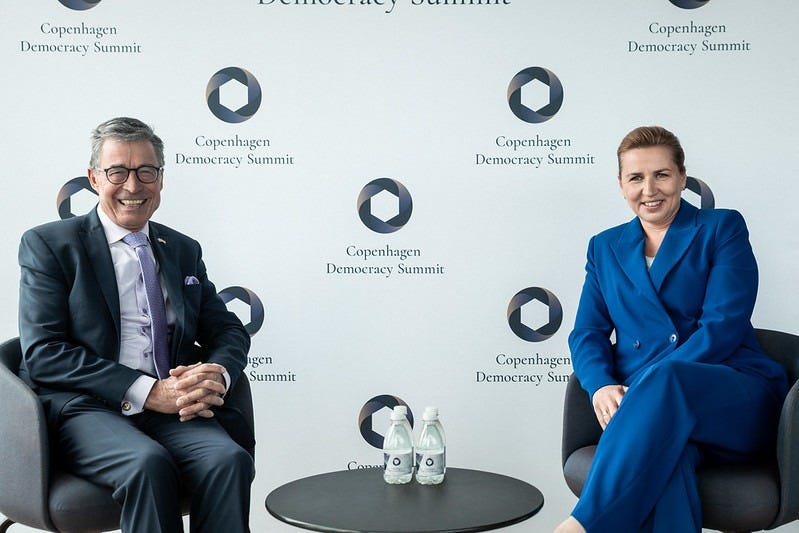
Frederiksen was in full agreement. “A coalition of the waiting will be a disaster.” She went on to say, “The problem for us Europeans is that we still think and behave as we did in peacetime, and it is no longer peacetime.” Putin has seen to that. “Therefore, we have to change our mindset. If we don’t, Russia is going to win.”
Since Russia’s full-scale invasion of Ukraine, Denmark has increased its defense spending from 1.3% of GDP to 3.5. Frederiksen has implored her fellow Europeans to get serious. If Europe “is not willing and able to defend itself,” she said at the summit, “then who are we?”
About the Ukrainians, she spoke movingly. They have held off the Russians, sparing the rest of Europe, so far. “The main reason that Ukraine is still standing is Ukraine,” said Frederiksen. “It’s not the rest of us.” The Ukrainians have been denied NATO membership, they have been denied certain arms. “We have been asking them to fight for the entire European Union with one arm tied behind their back,” said Frederiksen. “That has been a huge mistake.”
She is palpably wary of peace negotiations between Russia and the United States—“so-called peace negotiations,” she called them, every time she mentioned them. “A bad so-called peace deal for Ukraine would probably be a disaster for the rest of Europe,” she said. “Any Russian win” would be a loss, for the Free World.
I titled my report from Ukraine last year “America Rattles Denmark.” The subheading was, “A report from an allied capital in a strange time.” My impression a year later is that Denmark is through being rattled. The shock of a belligerent Washington, or a transformed Washington, has worn off. A new day is upon us, whether we like it or not.


Corruption Is The Name Of The Game
Cheeto lied to keep himself out of jail in the 2024 election declaring he was for small business and the farmer/rancher, he was going to get rid of the corruption of the Biden crime family, end foreign wars, and tackle inflation on Day 1 There were gullible voters who bought all of the lies and here we are not to mention that the Nazi Republicans rigged the election Now through 18mo in this Nazi regime the American people are witnessing paid off pardons, abuse of the pardon power, Cheeto’s rich friends protected in the Epstein-Trump files, Cheeto’s family profiting in cryptocurrency, lack of competitive bidding for lucrative government contracts, self dealing Cheeto suing of the federal government to his benefit and the detriment of the American taxpayer, building projects in DC that nobody wants, leaving the taxpayer the bill
Now for Cheeto inflation is surging and he says he doesn’t care about average Americans He’s elated that Jim Crow 2.0 is back and his CNPP(Christian Nationalist Pedo Party) continues to destroy voting rights At fellow fascist Netayahu’s urging he put the country into a foreign war without Congressional approval and more than likely will throw Taiwan under the bus to get trade concessions from China
Remember, that the Nazi Republicans have rubber stamped these lies and corruption rampant in Washington
[I lived in the US until recently]… do people in America know what you and I and everyone else in the world know? Does your average Republican voter know?