


Jay Nordlinger is a senior resident fellow at the Renew Democracy Initiative and a contributor to The Next Move.
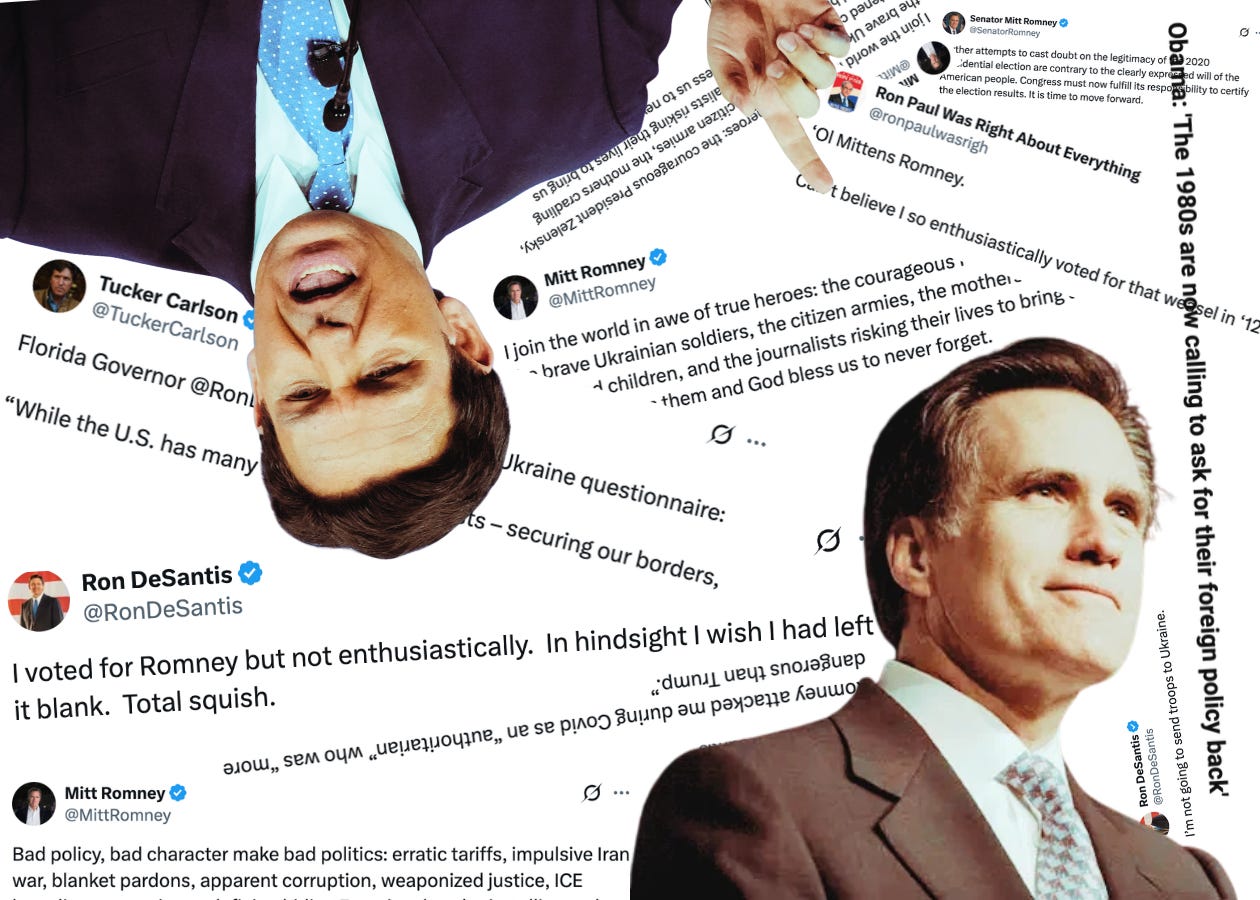
Mitt Romney has been pretty quiet since leaving the Senate in January 2025. He has essentially retired from public life. But after the midterm elections, he posted a statement on X. “Bad policy, bad character make bad politics,” he began. He ended, “Hoping for a course correction, for the country and for my party.”
His party is the Republican Party, as you know. Romney was the governor of Massachusetts, a US senator from Utah, and the Republicans’ nominee for president in 2012.
Someone else posted a statement on X—a person whose handle is “Ron Paul Was Right About Everything.” He, or she, wrote, “ ‘Ol Mittens Romney. Can’t believe I so enthusiastically voted for that weasel in ‘12.”
Ron DeSantis, the governor of Florida, had a response to that—a concurrence: “I voted for Romney but not enthusiastically. In hindsight I wish I had left it blank. Total squish.”
We all have different ideas of staunchness and squishiness. Romney strikes me as admirably staunch—on the rule of law, a free economy, the national interest . . . He can be counted on to defend basic American values, as many of us conceive them.
DeSantis? He’s apt to blow with the Republican wind. I would not call him a “total squish,” as he called Romney. But I would not cite him as an example of spine.
Over and over, Romney has shown spine. And independence of mind, which is related. In February 2020, Romney became the first senator in history to vote against a president of his own party in an impeachment trial. A year later, he was joined by six other Republicans in Donald Trump’s second impeachment trial. But in 2020, he stood alone. Friends and staffers told him, in no uncertain terms, that he was throwing away his career. He did it anyway.
In a floor statement, he said, “Were I to ignore the evidence that has been presented, and disregard what I believe my oath and the Constitution demands of me for the sake of a partisan end, it would, I fear, expose my character to history’s rebuke and the censure of my own conscience.”
For a long while, Ron DeSantis was coy about who had won the 2020 election. In August 2022, a headline in Politico read, “DeSantis won’t say if he thinks 2020 was rigged. But he’s campaigning for Republicans who do.” Those Republicans included Kari Lake and JD Vance.
A year later, DeSantis was coming around a little bit. A headline from the Associated Press read, “Ron DeSantis acknowledges Trump lost 2020 election after years of avoiding direct answers.”
The likes of Romney had faced physical threats for acknowledging the election results after the election. Romney quipped to his wife, Ann, “If I get shot, you can move on to a younger, more athletic husband.” That was funny, but the situation was dead-serious.
DeSantis ran for the Republican presidential nomination in the 2024 cycle. In September 2023, Romney announced that he would not seek reelection to the Senate. Surveying the GOP presidential field, he said, “It’s pretty clear that the party is inclined to a populist-demagogue message.”
ICYMI: Tune in to the latest episode of the Older/Wiser Podcast

When it comes to Ukraine and Russia, the difference between Romney and DeSantis is stark. Romney has always had Putin’s number. And he knows the stakes of the Ukraine war.
In a 2012 general-election debate, Barack Obama chided Romney for his view of Russia and the threat it posed: “The 1980s are now calling to ask for their foreign policy back.” But listen to Madeleine Albright, speaking in 2019.
She had been secretary of state in Bill Clinton’s second term. She, along with Obama and other Democrats, had knocked Romney for having too stern a view of Putin’s Russia. But now she was testifying before the House Intelligence Committee, and she said, “I personally owe an apology to now–Senator Romney, because I think that we underestimated what was going on in Russia.”
A sense of Romney can be had in a statement he made on February 26, 2022, two days after Russia’s full-scale invasion of Ukraine:
“I join the world in awe of true heroes: the courageous President Zelensky, the brave Ukrainian soldiers, the citizen armies, the mothers cradling frightened children, and the journalists risking their lives to bring us truth. God bless them and God bless us to never forget.”
Further into the war, he said,
“It is in America’s interest to support Ukraine. If Russia can invade, subjugate, and pillage Ukraine with impunity, it will do the same again to others, and a world at war diminishes the security of Americans.”
A third statement from Romney, on this general subject:
“The single most important thing we can do to strengthen America relative to China is to see Russia defeated in Ukraine. A weakened Russia deters the CCP’s territorial ambition and halts Putin’s vision of reestablishing the old Soviet Union.”
This is, in a word, realism.
Ron DeSantis was a member of the US House when Russia invaded Ukraine in 2014, beginning the current war. Barack Obama was in the White House. Trump’s first election was two years away. DeSantis was staunchly in Ukraine’s corner.
“We in the Congress have been urging the president—I’ve been—to provide arms to Ukraine,” he said. “They want to fight their good fight. They’re not asking us to fight it for them. And the president has steadfastly refused. And I think that that’s a mistake.”
DeSantis went on to say, “I think that when someone like Putin sees Obama being indecisive, I think that whets his appetite to create more trouble in the area. And I think if we were to arm the Ukrainians, I think that would send a strong signal to him that he shouldn’t be going any further.”
This was normal Republican talk, until the advent of Trump and Trumpism. In a 2017 interview, DeSantis gibed at Democrats: “They criticized Mitt Romney in 2012.” Oh, yes, they did.
But in 2023, DeSantis was running for the GOP presidential nomination. The environment was different—Trumpified. And DeSantis had adapted.
On February 20, President Biden went to Ukraine, to express American solidarity with that people under siege. DeSantis went on Fox & Friends. Referring to Biden, he said, “While he’s over there, I think I and many Americans are thinking to ourselves, ‘Okay, he’s very concerned about those borders halfway around the world. He’s not done anything to secure our own border here at home.’”
This was a favorite DeSantis talking point. Later in 2023, he said, “I wish the DC elites cared as much about our border as they do about the Ukraine–Russia border.” The “DC elites,” you see. Romney was right: “a populist-demagogue message.”
Like other candidates, DeSantis filled out a questionnaire about Ukraine from Tucker Carlson, then of Fox News. “While the U.S. has many vital national interests,” he wrote, “becoming further entangled in a territorial dispute between Ukraine and Russia is not one of them.” Is that what Russia’s war of annihilation against Ukraine is? A territorial dispute?
In the wake of criticism, DeSantis “walked back” this remark, but not far. He said that his phrase “territorial dispute” had been “mischaracterized.” By whom, and how? In any event, Donald Trump had it exactly right: DeSantis was just “following what I am saying.”
Isn’t that the story of the Republican Party and the conservative movement in this era? Following what Trump is saying?
The Washington Post’s Josh Rogin wrote a column headed “DeSantis’s Ukraine dodge is the opposite of leadership.” That is a neat summation of my own view.
And this “dodging” is seen in matters larger and smaller. Take something relatively small, but significant: DeSantis refused to say whether he had received a booster shot for COVID-19. At the time, the Republican wind was blowing in an anti-vaccine direction (and has not abated). A Fox host, Maria Bartiromo, asked DeSantis whether he had received a booster shot. His answer: “So, uh, I’ve done whatever I did, the normal shot, and that at the end of the day is people’s individual decisions about what they want to do.”
On no issue has DeSantis been dodgier, or “squishier,” than on the issue of January 6. Romney, of course, is the opposite of dodgy or squishy. On the day itself, from the Senate floor, Romney said,
“What happened here today was an insurrection, incited by the president of the United States. Those who choose to continue to support his dangerous gambit by objecting to the results of a legitimate, democratic election will forever be seen as being complicit in an unprecedented attack against our democracy.”
Across the country, Republican voters were upset. Inflamed. They had been told, repeatedly, that the election had been stolen from them. Romney addressed this forthrightly and manfully: “The best way we can show respect for the voters who are upset is by telling them the truth. That is the burden, and the duty, of leadership.”
In utter contrast was Ron DeSantis. Campaigning in New Hampshire, he was asked by a 15-year-old student about January 6. The young man said, “Do you believe that Trump violated the peaceful transfer of power—a key principle of American democracy that we must uphold?” DeSantis answered him as follows:
“I wasn’t anywhere near Washington that day. I have nothing to do with what happened that day. Obviously, I didn’t enjoy seeing, you know, what happened. But we’ve got to go forward on this stuff. We cannot be looking backwards and be mired in the past.”
Is that what a leader says? Is that what a leader—a non-“squish”—tells a high-school student?
After watching a video of the exchange, Chris Christie, a rival candidate, said of DeSantis, “He wasn’t anywhere near Washington. Did he have a TV? Was he alive that day? Did he see what was going on?” Christie then noted that “we had members of Congress who were running for their lives. We had people trying to hunt down the vice president of the United States, chanting, ‘Hang Mike Pence.’” Etc.
Politics, like art, is subjective. We all have our tastes, our opinions, our standards. I know many people who regard DeSantis as a “real man” who “tells it like it is” and “won’t back down” and all that. Romney, in their eyes, is an overly polite marshmallow—a “total squish,” as Big Ron says.
Some of us see it differently. Completely differently.


Mr. Kasparov and Mr. Nordinger, this is a no-brainer. In a choice between Romney and DeSantis, give me Romney every time every day everywhere. Ron DeSantis is a political opportunist. That's it. Nothing less! You're right, he bends like a Reed in the wind. Whichever way the wind is blowing is the way that Ron DeSantis will wind up genuflecting. Thank you for Post. It was very helpful! Mr. DeSantis is being talked about as a particular possible presidential candidate For the Republicans in 2028. Oh my God! Trump lite?
Mr. DeSantis and others remind me of Soviet-era saying that X has firm convictions -- he always goes with whatever Pravda says that morning. Good and courageous people -- including Mitt Romney -- often make mistakes and sometimes change their views, but they are always driven by the Golden Rule and other moral laws. Many others succumb to the temptations of authoritarianism, whether in Russia, China, Turkey, Israel, or USA. Most Republicans today fall into this category.