


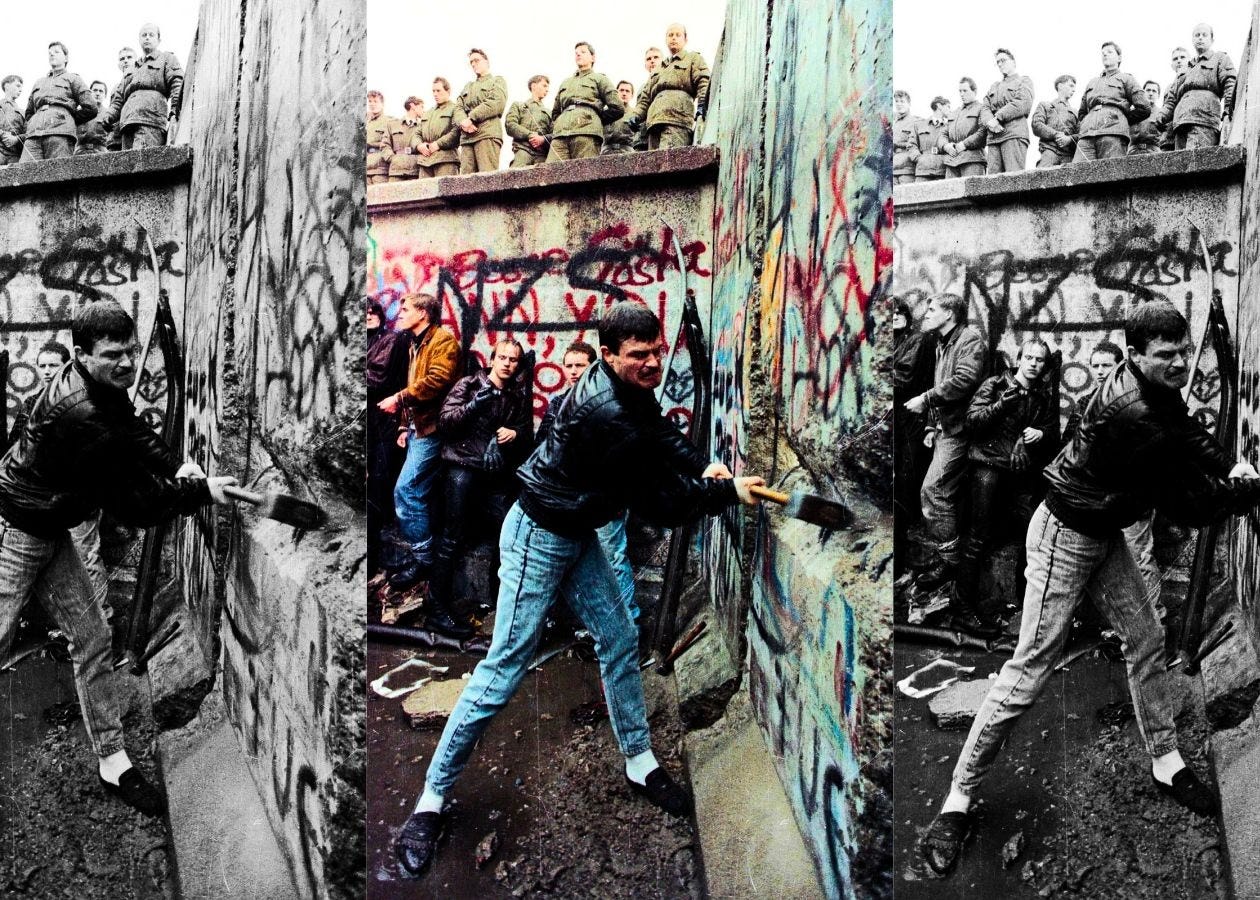
I was invited to speak at this year’s Berlin Freedom Week. Here’s what I said in my speech yesterday—and why I didn’t say it in person:
Berlin Freedom Week has now become a tradition. It coincides with my own anniversary of becoming a world chess champion on November 9, 1985.
I also remember another November 9: November 9, 1989. I recall it quite well. As a young Soviet champion, I had unique access to the West through my competitions. Over the preceding years, I’d seen the promise of the democratic world and the cracks in the Iron Curtain. In a single night, those cracks burst open.
But as we reflect on November 9, let’s remember that dates don’t make a difference—people do. The fall of the Berlin Wall is not about November 9. It is about the brave East German and Polish and Czech and Soviet dissidents who risked their lives fighting the communist regimes. Biermann and Walesa and Havel and Sakharov. It is about the bold Western leaders who outmaneuvered and outpressured the rigid party bosses in Moscow. Kennedy and Reagan, Thatcher and Kohl.
Because of these men and women, who possessed strong values and clarity of purpose, we celebrate November 9. But with different players, at different moments, November 9 has also been a black mark on the calendar. November 9 is Kristallnacht in 1938. It is the second day of Hitler’s Beer Hall Putsch in 1923.
People count. Actions count. Dates are just a way of organizing them.
It is much the same with treaties and alliances. German Chancellor von Bethmann-Hollweg was not wrong when he said, in 1914, that a treaty is merely “a scrap of paper.” It is the leaders who guarantee a treaty, who give it teeth. This is why you will never hear me celebrate NATO’s Article 5. Not because I don’t support NATO—I believe in the principles behind the alliance—but I support NATO doing something to live up to those principles. To support Ukrainian victory by providing them with everything that they need to defeat Russia.
That’s the bare minimum.
We have to stop resting on our laurels, celebrating the past, and take action with our view firmly on the horizon.
Let this be the last Berlin Freedom Week where we pat ourselves on the back for the fall of the wall, and let this be the first Berlin Freedom Week where we finally get on a war footing and take the fight to the dictators’ doorsteps.
I have found that urgency mostly lacking in Europe. There are signs of resistance. In the Baltics. In Scandinavia. In Poland. The places where the memory of Russian imperialism is genetic. Yet even there, resolve is slipping. What can we say when the Norwegian prime minister and Finnish president chat with Vladimir Putin on the phone and preach about “dialogue”?
A month ago, I was at the Warsaw Security Forum. No matter how many Russian violations of Polish sovereignty, no matter the brutality of the war right over the border in Ukraine, no matter the centuries of Russian colonization of Poland, no one was ready to say in public that they were in a war with Russia and that Europe must respond accordingly.
And in the centers of power—in Brussels, in Paris, here in Berlin? There was never any fight to begin with.
No matter how transparently Russia aggresses against the democratic world, Europe remains stubbornly detached. That detachment invites Russia to be even more brazen in its actions abroad.
That brings me to why I am not in Berlin.