


Jay Nordlinger is a senior resident fellow at the Renew Democracy Initiative and a contributor to The Next Move.
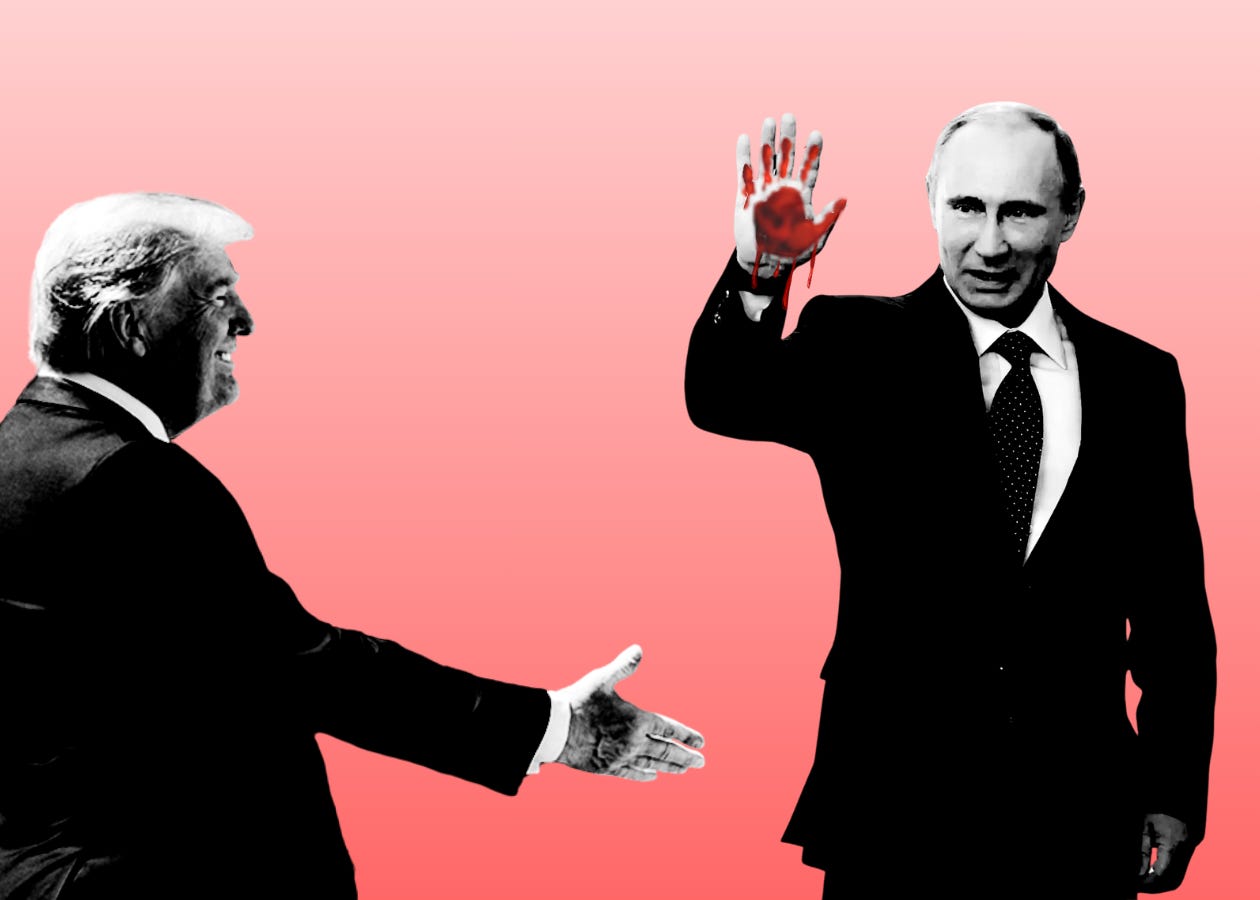
In recent days, Vladimir Putin has intensified his campaign of murder and terror in Ukraine. Also, President Trump has invited Putin to attend the G20 meeting in Florida this coming December.
The secretary of state, Marco Rubio, said, “We think it’s an opportunity for him to engage, not just with the president, but with other world leaders. We hope that’s an invitation he’ll accept.”
Putin can “engage” with them whenever he wants—by phone, perhaps. But at a G20 meeting, while his hands are soaked in blood? The old Rubio would have cried bloody murder.
Trump, however, has always wanted Putin to resume his place at international gatherings, without preconditions. As soon as he became president in 2017, he wanted Putin to return to the G7, making it the G8 again.
The United States and other members had suspended Russia from the group after its invasion of Ukraine in 2014. But Trump wanted Russia readmitted, without any change “on the ground”—specifically, Ukrainian ground.
From the G7 summit in 2018, held in Canada, Trump said, “This used to be the G8, not the G7. And something happened a while ago, where Russia is no longer in.” That “something” was Russia’s invasion of a neighbor.
Putin has not been to a G20 meeting since 2019. He attended the one in 2014, held in Australia months after the Russian invasion. He was mingling with other leaders, slapping backs. When he got to the Canadian prime minister, Stephen Harper, he extended his hand. After a second or two, Harper took it, saying, “Well, Vladimir, I’ll shake your hand, but I really have only one thing to say to you, and that is, get out of Ukraine.”
Putin smirked that smirk of his and said, “Well, I’m not in Ukraine.” Harper then said, “That’s why it’s a waste of my time to talk to you.”
(I got this account from Harper in a 2018 podcast.)
What manner of man, what manner of leader, are we inviting to Florida? Here is a news report from a couple of days ago: “Russian missile and drone strikes killed at least four people, including a child, in Kyiv and the surrounding region overnight …”
Another report says, “A Russian drone strike on the National Academy of Sciences in Kyiv killed at least two people on Monday.”
There is footage, if you can bear it, of Russian forces dropping bombs on a man walking his dogs.
ICYMI: Tune in to the latest episode of the Older/Wiser Podcast

It’s important to know some names and faces, lest the dead, the murdered, be mere abstractions. A Ukrainian soldier, Danylo Ivzhenko, posted a tribute to his wife, Maria: “Today, a Russian attack on a business center killed the most important person in my life. … Last year, we took out a mortgage and planned to have a baby this winter.”
In another attack, a 2-year-old boy named Kyrylo was killed. So were his grandmother, both grandfathers, and other relatives. His mother survived, severely wounded.
Russian forces have kidnapped thousands of Ukrainian children, and now these children, older, are being forced to fight in the Russian army against Ukraine.
Then there is starvation—the deliberate starvation of Ukrainians. One headline reads, “ ‘Hell on earth’: last residents eat weeds to survive in Russian-occupied Oleshky.” Anne Applebaum commented, “Another mass famine, carried out by another cruel regime.”
In 2018, Applebaum published a book about the Holodomor, i.e., the starving of Ukrainians by the Kremlin in the 1930s. (“Holodomor” means, literally, “murder through starvation.”) In his own book—a groundbreaking study in 1987—Robert Conquest used the term “terror-famine.”
Putin’s Russia is aiming to destroy Ukraine thoroughly. The headline over this article reads, “Russian Attacks Destroy Millions of Books, the Heart of Ukrainian Culture.”
This is to say nothing of what Putin’s dictatorship is doing to Russians in Russia. In 2017, I wrote about a political prisoner, incredibly brave, as such prisoners tend to be. He is Yuri Dmitriev, a researcher associated with Memorial, the organization founded by Andrei Sakharov and other Soviet-era dissidents. (Memorial shared the Nobel Peace Prize in 2022, and needless to say it is now banned in Russia.)
A week ago, Dmitriev was “rushed from Penal Colony No. 18 in Mordovia to a prison medical facility in the village of Barashevo after a suspected stroke,” says this report. The prisoner is now 70.
Vladimir Putin is not a normal head of state or government. Every day, he directs a war of conquest, filled with atrocities. War crime after war crime. Obviously, democratic governments often have to deal with monsters such as Putin in the diplomatic realm. But they do not have to invite these monsters to routine international gatherings.
In 1931, Nancy Astor, the British parliamentarian, met Stalin and had a question for him: “When are you going to stop killing people?” That is the central question, screamingly urgent.
More from The Next Move:
Trump and Xi Have a Laugh

And they have it at the expense of Joe Biden. Is this American? Is it right?
New Details: Assassins Were Indicted. Very Likely, I Was Their Target.

An update in Putin’s murder plot on American soil.
