


A note from Garry Kasparov: If you enjoy what you read here, might I humbly suggest that you put that money toward supporting mission-driven media like The Next Move? I don’t receive a cent from your subscription fees—everything goes to supporting the work of The Next Move’s parent organization, the Renew Democracy Initiative. RDI is bringing political dissidents to tell their stories to students, business leaders, and public officials. Delivering life-saving humanitarian aid to frontline communities in Ukraine. And, of course, driving the conversation here on Substack.
Jay Nordlinger is a senior resident fellow at the Renew Democracy Initiative and a contributor at The Next Move.
When Vladimir Putin paid a visit to Budapest in 2017, Viktor Orbán, the Hungarian prime minister, said, “We all sense—it’s in the air—that the world is in the process of a substantial realignment.” Yes. But the extent and shape of that realignment, few could foresee.
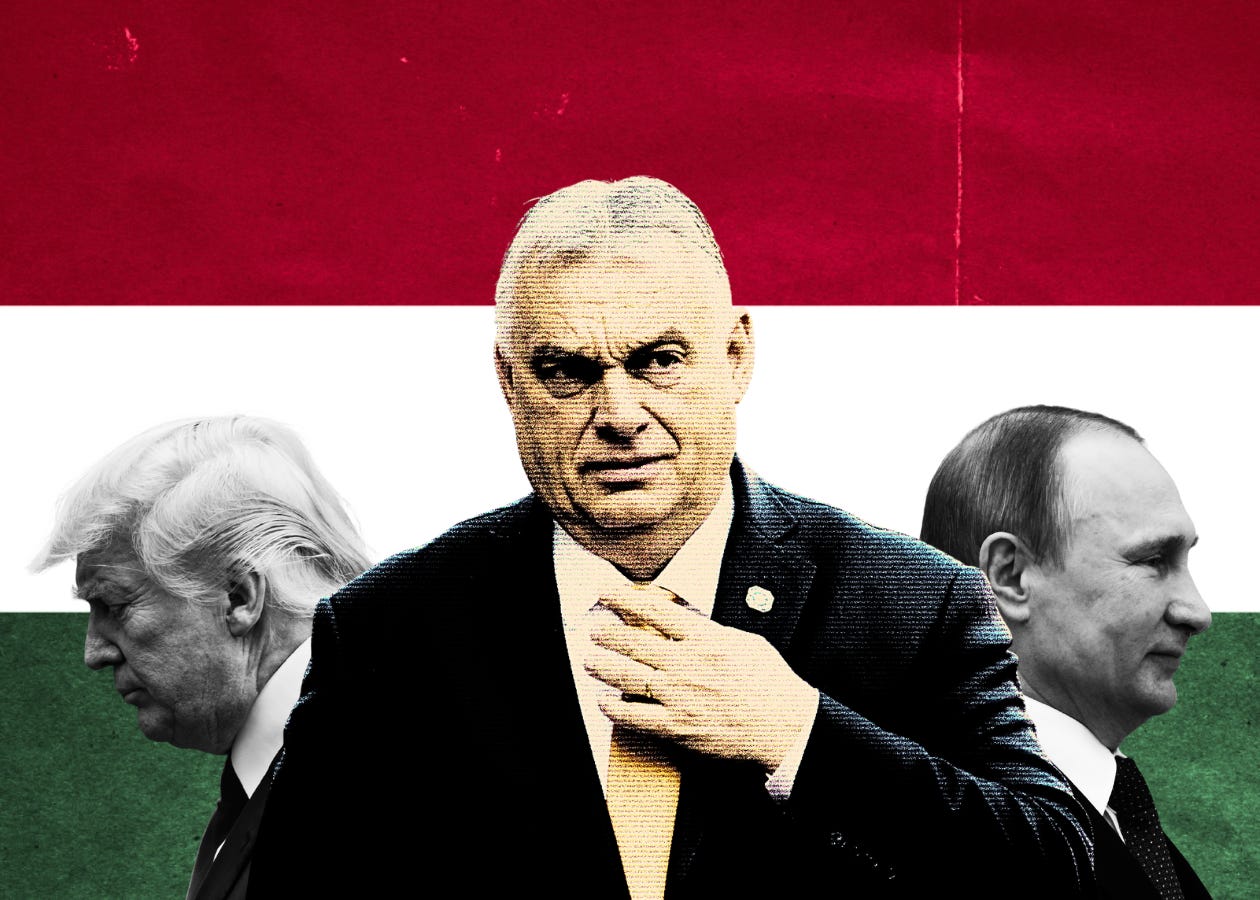
Orbán has been in office for five terms. He’s going for a sixth. And both Russia and the United States—both the Kremlin and the US administration—have endorsed him. In their own ways, they are campaigning for him.
Hungarian voters will go to the polls on April 12.
If you don’t count Alexander Lukashenko, the dictator of Belarus, Orbán is Putin’s closest ally in Europe. And he is a beau idéal of the nationalist-populist Right in America: a rock star at CPAC, the Heritage Foundation, and so on.
George F. Will wrote something pointed in a column last month: “Putin’s only sympathizer in the European Union, Hungary’s Viktor Orbán, might now have firmer support among American authoritarians (‘national conservatives’) than among Hungarians.”
Some Americans and other foreign enthusiasts have gone to Budapest to work for Orbán. That is, they are on his payroll. Still others go to visit, to sit at Orbán’s feet. They are pilgrims, in a way.
In 1981, Paul Hollander wrote a book called Political Pilgrims. It’s about leftists who traveled to the Soviet Union, Fidel Castro’s Cuba, Mao’s China, etc. Hollander was an American scholar who had been born in Budapest. He fled in 1956 when Moscow crushed the Hungarian uprising.
Given the stream of visitors to Budapest today—and to Moscow as well—there could be an update of Political Pilgrims.
The story of what Orbán has done to Hungary need not be detailed here, in this brief article. In 2018, Arch Puddington, of Freedom House, wrote, “Hungary has become a model for the dismantling of a European democracy by a democratically elected government.”
(That article appeared in The Weekly Standard under the title “Are Conservatives Giving Up on Democracy?”)
Patrick J. Buchanan is a very different man from Puddington. In that same year, he wrote that Hungarians “have used democratic means to elect autocratic men who will put the Hungarian nation first.”
The following month, Prime Minister Orbán declared, “The era of liberal democracy is over.” The British historian Simon Schama could not help tweeting a response:
“Well, no, Orbán, liberal democracy will see you and your nativists off because liberal democracy has John Milton, John Locke and J. S. Mill and you have Nigel Farage, Marine Le Pen and Steve Bannon.”
I can assure you that, on the American right, those last three have a lot more fans than the first three do.
In Viktor Orbán, Donald Trump has found a kindred spirit. During a 2019 meeting at the White House, Trump said to him, “It’s like we’re twins.”
ICYMI: Tune in to the latest episode of the Older/Wiser podcast:

It is unusual for a US president to endorse a candidate in a foreign election—in an election held in an allied country. The country is our ally, not an individual. But Trump is an unusual president.
“Viktor Orbán is a true friend, fighter, and WINNER, and has my Complete and Total Endorsement for Re-Election as Prime Minister of Hungary,” Trump wrote last month.
Three days later, his secretary of state, Marco Rubio, was in Budapest, standing by Orbán’s side. Said Rubio, “Especially as long as you’re the prime minister and the leader of this country, it’s in our national interest that Hungary be successful.”
Rubio gave, in effect, a campaign speech for Orbán. To say that this is unusual for a secretary of state would be an almost comical understatement.
And Vladimir Putin? What is he doing? How’s he helping out? A headline from the Financial Times (March 11) tells part of the tale: “Kremlin backs covert campaign to keep Viktor Orbán in power.” The subheading reads, “Vladimir Putin endorses plan drawn up by Russian consultancy that is under western sanctions.”
That report is here.
Another report, from Bloomberg (March 14), is headed “Orban’s Election Campaign Turns to Russia for Help in Final Stretch.”
A Wall Street Journal editorial (March 13) is related: “Viktor Orbán Carries Putin’s Water.” The Journal’s editors explain that Orbán is “blocking an EU loan that Ukraine needs to keep fighting Russia.”
In previous campaigns, Orbán has used George Soros, the Hungarian-American financier, as his primary bogeyman. (Never mind that Orbán went to Oxford on a Soros scholarship.) This year, the bogeyman is Ukraine’s president, Volodymyr Zelenskyy.
On the campaign trail, Orbán said, “This election is about whether Zelenskyy gets to form a government or I do.” Will Hungarian voters actually fall for that? Orbán would know better than you or I. His party has a campaign poster that shows the Ukrainian president in a jolly mood and says, “Don’t let Zelenskyy have the last laugh.”
In a tweet, Orbán’s foreign minister, Péter Szijjártó, claimed that the European Union “continues to make decisions according to the demands of @ZelenskyyUa.”
Szijjártó is a frequent visitor to Moscow, especially for the purpose of making energy deals. In November 2021, as Russian troops massed along the Ukrainian border, he received the Kremlin’s Order of Friendship. He has certainly earned it.
March 1, 2024, was the day of Alexei Navalny’s funeral. (Navalny was the Russian opposition leader killed in prison.) On that day, Szijjártó met with his Russian counterpart, Sergey Lavrov, and photos showed the two of them laughing it up together. This was revolting, to some of us.
I can imagine a poster—different from Orbán’s, but borrowing from it: “Don’t let them have the last laugh.”
Maybe I could tell you something personal. I was once on a cruise that had Foreign Minister Szijjártó as a guest speaker. The ship was docked in Budapest. In a private gesture of protest—against the politics that Orbán’s government represents—I took a walk around town, while Szijjártó was aboard.
President Trump and his team never miss an opportunity to mock and scorn Zelenskyy—a man leading a country that is fighting for its survival against a Russian onslaught. A few days after the Iran war began, Trump wrote, “Sleepy Joe Biden spent all of his time, and our Country’s money, GIVING everything to P.T. Barnum (Zelenskyy!) of Ukraine.”
More recently, Trump said, as he always has, that Zelenskyy is the obstacle to peace in Ukraine, not the invader, Putin. “Zelenskyy is far more difficult to make a deal with.”
If that is so, maybe it’s because the deal Trump has in mind is Putin’s fondest wish, at the moment?
Linger over something: We Americans are at war with Iran. Russia is aiding Iran, as usual. Russia is helping Iran target our troops. Ukraine is helping us, in combating Iranian drones. Trump has eased sanctions on Russia. And is dumping all over Zelenskyy.
In Hungary, the United States and Russia—Trump and Putin—are backing the same guy: Viktor Orbán, whose bête noire, whose bogeyman, is Volodymyr Zelenskyy. If Orbán loses, there will be tears in the White House and the Kremlin, both. You recall Orbán’s words in 2017: “a substantial realignment.”
An old saying goes, “Politics makes strange bedfellows.” The current alliance for Orbán tells us a lot about our times, and what it has to say is bad, bad news for freedom and democracy.


The convergence of Washington and Moscow behind Orbán is striking, but the more important question is structural: why does this convergence exist at all? Both Trump and Putin benefit from a fragmented Europe that cannot act collectively. Orbán is not the cause of that fragmentation. He is its most useful symptom. As long as one member state can block EU decisions on Ukraine, sanctions, and energy, the collective capacity of Europe remains hostage to the electoral outcomes of 10 million Hungarians. That is the vulnerability worth examining.
Why I am not Catholic, or proud to be an American anymore….Pope Leo will not condemn mobsters like The Don and all his Catholic in Claim Only Capos like Vance, Rubio, Homan, Cruz….and the President of the United States palling around with terrorists like Putin, Xi, Un…Orban….We the People need to de -Trumpify RIGHT NOW. Resistance and confrontation with all things TRUMPISM is not futile, it is your moral duty. God HELP U.S. Please take him away