


A note from Garry Kasparov: In a world of oligarch-owned outlets, it’s more important than ever to support mission-driven media. You can take a stand by joining our premium subscriber community. Your support helps drive the work of the Renew Democracy Initiative, including delivering life-saving humanitarian aid for Ukraine (I don’t receive one kopek from your contributions!). Read on to the end of the article for an update on RDI’s activities on the frontlines in Ukraine.
Jay Nordlinger is a senior resident fellow at the Renew Democracy Initiative and a contributor at The Next Move.
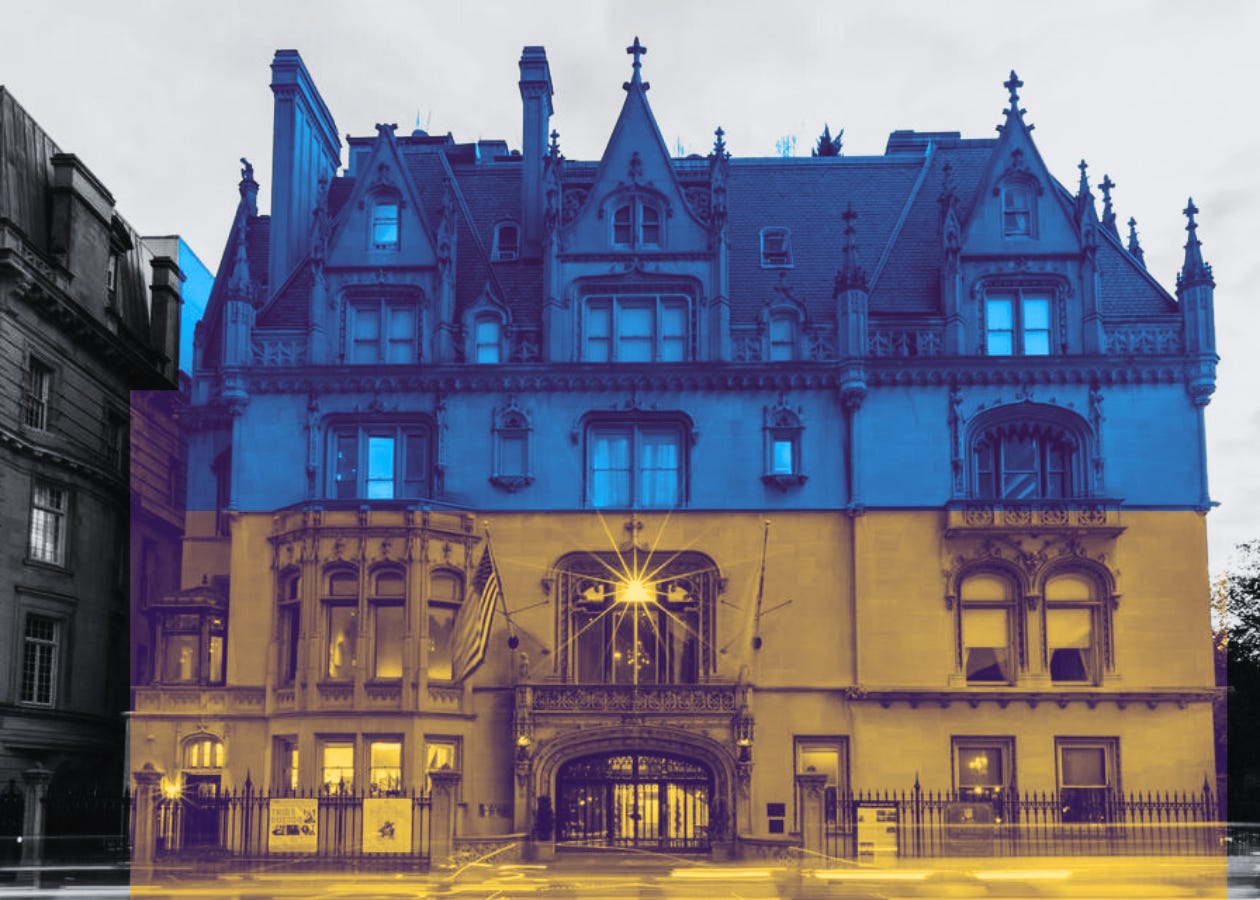
There’s an old expression: “We’ve got to stop meeting like this.” In recent years, some of us have been meeting at the Ukrainian Institute of America, understandably. I was there last week. And last month.
UIA was founded in 1948 and is housed in a Gilded Age mansion on the Upper East Side of Manhattan. I first visited the institute in 1999, when William F. Buckley Jr. took me to hear a talk by Robert Conquest.
It was a mark of Bill’s esteem for Bob that he attended that night. Bill was not doing that kind of thing very often in those years, especially at night.
Conquest was an invaluable historian and man of letters. He had just published his book Reflections on a Ravaged Century. (This was on the eve of the millennium, remember.) In 1986, he had published The Harvest of Sorrow, about the terror-famine in Ukraine. That same year, Bill Buckley hosted Conquest and others on television, to discuss the subject.
To watch the program—which I watched with wide eyes, back then—go here.
The terror-famine was inflicted by the Kremlin on the Ukrainians in the early 1930s. It is also known as the “Holodomor.” For decades, this monstrous crime was suppressed in academic and other circles. Bob Conquest meant a lot to Ukrainians, and still does.
I first saw him, and heard him, right before The Harvest of Sorrow was published, I think. I was in graduate school, and he came to campus to speak. It was from him that I first heard the name “Ukraine,” without a preceding “the.” I had grown up with the expression “the Ukraine”—a region of Russia, or the Soviet Union. But millions of people regarded it as a nation, with its own identity.
That’s what Conquest was saying.
It was a lucky stroke that I became a friend of his in later years. When he died in 2015, I wrote an appreciation of him, here.
ICYMI: Tune in to the latest episode of the Older/Wiser podcast:

In 1999, when Bob spoke at the Ukrainian Institute of America, Ukraine was in its eighth year of independence. It seemed that this country could get on with life. But the incoming president of Russia, Vladimir Putin, would have other ideas.
That UIA event was co-sponsored by Freedom House, of which Adrian Karatnycky was president. It was not until 25 years later—in 2024—that I was again at the institute. I did a Q&A with Karatnycky about his just-out book, Battleground Ukraine: From Independence to the War with Russia.
In attendance that night was Mykola Melnyk, a Ukrainian military officer. He had joined up in 2014, after Russia’s initial invasion of Ukraine. A lawyer, he simply left everything to fight. In 2023, Melnyk was badly wounded, losing a leg.
It was inspiring, and humbling, to see him and converse with him. To me, he seemed to embody the spirit of a people fighting to remain free.
Last month, our Renew Democracy Initiative co-sponsored an event at the UIA. Our chairman, Garry Kasparov, spoke, and so did our CEO, Uriel Epshtein. In his opening remarks, Kasparov said, “Moral relativism didn’t defeat Nazism and communism. A steadfast belief in freedom did. We forgot that”—forgot it after the Cold War, somehow.
When I entered the UIA last week, I saw a sign that said “Unbreakable Ukraine.” I thought, once more, of Robert Conquest. One of his books is Stalin: Breaker of Nations. Putin, today, is trying to break Ukraine.
Stalin had many, many supporters and apologists in the Free World, and so did the Soviet Union at large. Today, so does Putin, and so does his Russia (re-Sovietized).
I did a Q&A with Kimberly Kagan, the military historian who founded the Institute for the Study of War. It is a nonpartisan, nonprofit research organization, and she is its president. Every day, ISW studies the Ukraine war, keeping track of the details.
There is a myth, said Kagan, that Russian victory is inevitable. The Kremlin peddles this line, and gullible Westerners echo it. But the facts contradict the line, said Kagan.
Reporters who cover the war know this as well. A recent headline in the Wall Street Journal said, “As War Enters Fifth Year, Ukraine Shows Russian Victory Is Anything but Inevitable.”
Last December, the American president, Donald Trump, said, “Russia has the upper hand. And they always did. They’re much bigger. They’re much stronger in that sense.” Yes, the Ukrainians have put up a fight, “but you know, at some point, size will win, generally.”
Wars are not like that, Kim Kagan pointed out. If they were, history would look a lot different.
I asked a big and painful question: Can Ukraine survive without the support of the United States? Gradually, Ukraine has reduced its dependence on the United States, Kagan said.
Which is good news.
At the same time, Ukraine could use the help of the United States, obviously. And Ukraine is important to us Americans too, whether we know it or not.
What the Ukrainians are doing right now, said Kagan, is defending both Europe and the United States against aggression—aggression not only from Russia but also from its partners: Iran, North Korea, and China. Ukraine is providing a “security buffer” against these aggressors, said Kagan.
Moreover, the Ukrainians are doing a lot of “discovery,” she said. Day by day, they are learning what can be done in modern warfare. Ukraine is no less than a “laboratory” in this respect, Kagan said.
Like Israelis, Ukrainians may not have wanted to become expert warriors. But life has forced them to.
In recent days, Ukrainians have been helping us Americans defend ourselves against Iranian drones—with which Ukrainians have had to cope for several years now.
Last year, the American vice president, JD Vance, said to Ukraine’s president, Volodymyr Zelensky, “Have you said thank you once?” (Yes, Zelensky had thanked the United States for its support many, many times.) Well, I hope that we remember to say thank you to Ukraine.
My visits to the Ukrainian Institute of America have been moving. The Ukrainian people are setting an all-time example in patriotism, courage, self-sacrifice, and determination.
UIA’s website says, “The Ukrainian Institute of America, Inc. is a nonprofit organization dedicated to promoting the art, music, and literature of Ukraine and the Ukrainian diaspora.” That is a lovely purpose. To dwell among art, music, and literature is practically heaven.
The institute can get back to concentrating on that someday. In the meantime, Ukraine is fighting for its life, and it is the central arena of the broader, momentous struggle between freedom and tyranny.
An update on the Renew Democracy Initiative’s work in Ukraine
Since 2022, the Renew Democracy Initiative (publisher of The Next Move) has delivered roughly $15 million in humanitarian aid to frontline communities in Ukraine. That includes bulletproof vests, food, medical supplies, and sleeping bags, among other essentials. It won’t win the war by itself, but it keeps people warm, well-fed, and, most importantly, alive.
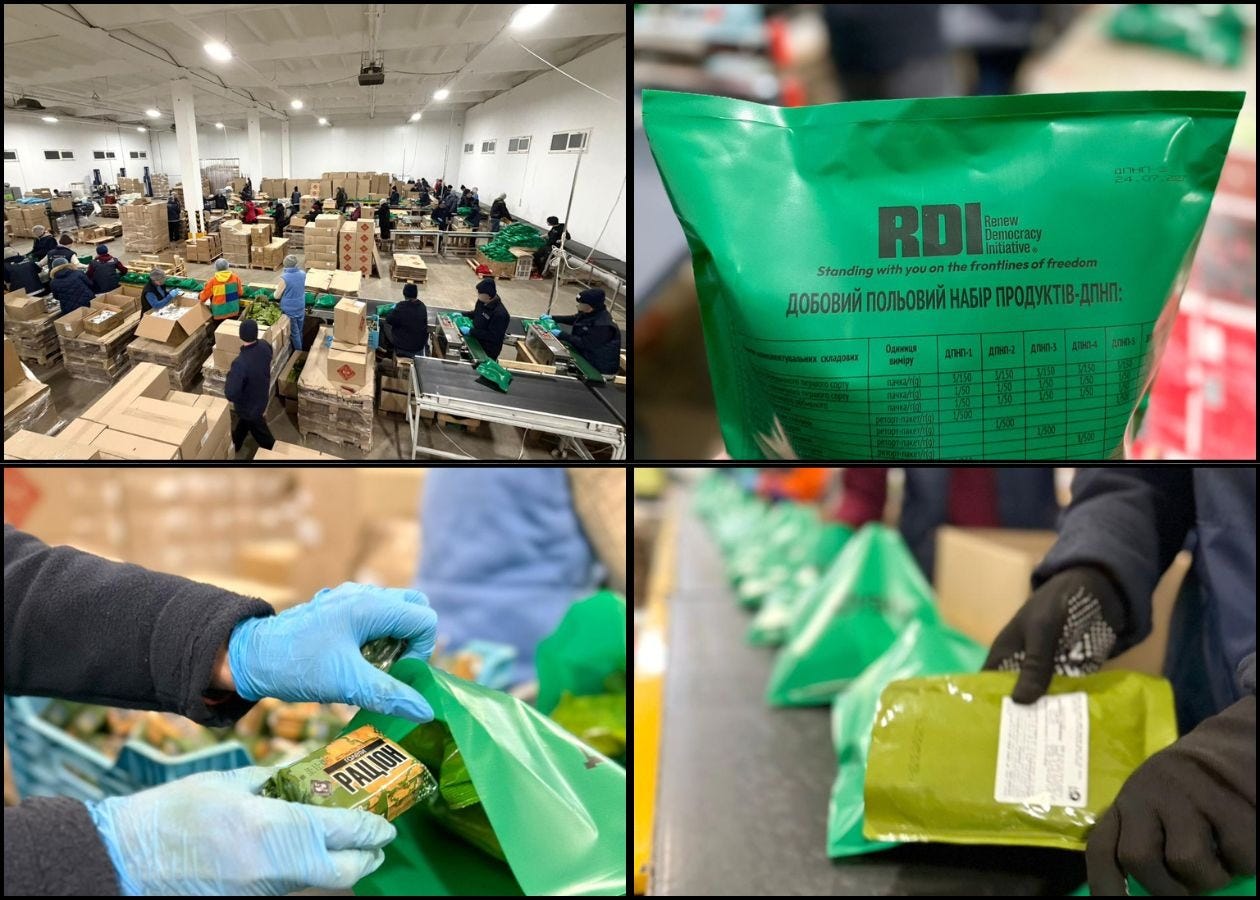
We recently ordered 70,000 meals ready-to-eats (MREs, an acronym familiar to anyone who’s spent time around the military), mostly for the Kharkiv region. Kharkiv is located on the Russian border and is the target of relentless bombardment. The first tranche—21,504 MREs to be precise—were delivered at the end of last month. Roughly half will go to civilians, and another half for the Ukrainian soldiers bravely defending their homeland.
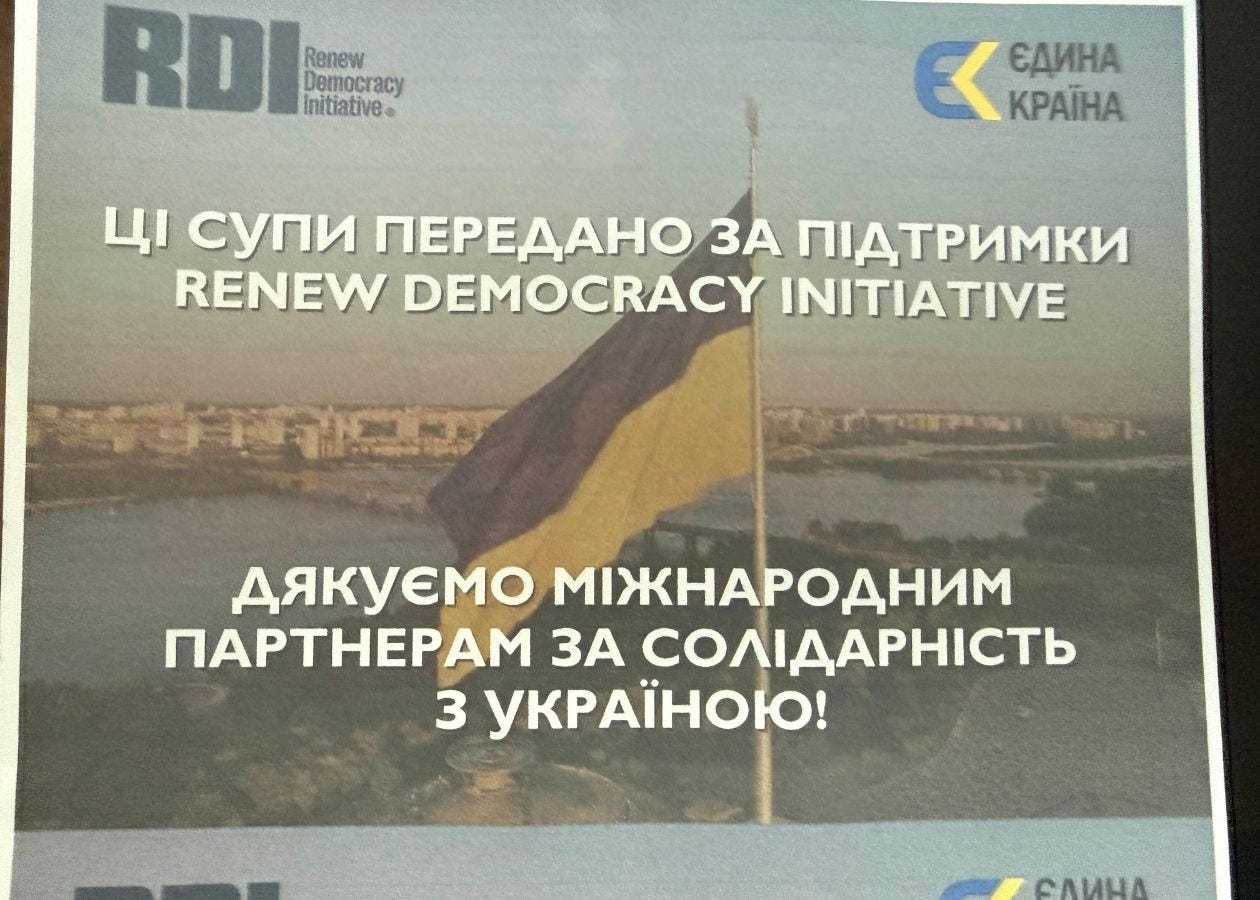
On top of that, the Renew Democracy Initiative recently secured 31,000 warm meals for the capital city of Kyiv, where residents are enduring freezing nights and blackouts. We hope our Ukrainian friends like soup!
You can support RDI’s work by upgrading to join our premium subscriber community. RDI CEO Uriel Epshtein will also be leading a delegation to visit our partners on the ground in Ukraine later this month, so stay tuned for firsthand updates from the front here at The Next Move!


President Zelenskyy is holding the Ace cards and has the winning hand in the ruthless war game that Putin started. Putin keeps playing his "Trump Card" - Donald Trump - to stall the outcome and prolong his war. Putin simply cannot afford to lose! Trump's use of US proxy power is self-serving as his real estate broker deal-makers, masquerading as diplomats, are working for a "PIECE DEAL" and have no interest in peace in Ukraine. Putin will prevail as long as he plays Trump and feeds his need for greed. The love of money truly is the root of all evil for the "Unholy Trinity" Trump, Putin and Netanyahu 😈😈😈
I want to party like it is 1999…When, if I predicted to you, Jay, in those innocent times that that Manhattan playboy, Hugh Hefner meets Morton Downey Jr. in the flesh, Donnie from Queens was going to make like the biggest G.O.P. Crasher from hell and our beloved party was going to nominate Donald J Trump for President of the United States not once, but twice, and then after all his winning, the crony capitalist pig would lose an actual presidential election then rerelease The Art of the Steal (ghost written by this super rich Friends guy Steve Bannon)…and incite a pure white trash and attack upon our sacred Capital, where and when The Dons sicko fans would actually chant, within ear and eye shot of President Duterte, I mean Trump…HANG MIKE PENCE!…and then all of the rioters would become dubbed “PATRIOTS” by a man in the Bada Bing, I mean Oval Office …and all live to be pardoned for it…You would have said, yeah right, and the Greatest American Hero Bruce Jenner is going to declare himself a woman and he will be celebrated again “Caitlin” will be celebrated, again, like a hero at the height of the Cold War.
Alls I would like to have asked Robert Conquest then is what I always wished Churchill would have done BEFORE his Great Wall speech…could we, would we have averted so many murders f Churchill had made like Michael Corleone and just shot Stalin when he met him…and not break bread with a monster, like our mobster Don King Trump is willing with every evil powers that be…because Don King Trump loves to play “lets U.S. make a deal”, and if you don’t play along, The Don will have you whacked…because like Putin, he’s got the biggest, baddest toys to play with…God HELP U.S.! Gotta run on. We the Living in Kakistocracy. Thanks for taking my rant to the next level.