


Jay Nordlinger is a senior resident fellow at the Renew Democracy Initiative and a contributor to The Next Move.
Not long ago, I was in Washington, DC, for a few days. The visit left a bitter taste in my mouth. I have thought a little about this bitterness. Bear with me for a moment.
I am a DC-lover, from way back. I have always loved the American founding, the American story—our project, our adventure. Washington, DC, is a physical manifestation of much that is important about America.
Then there is the personal. Though I was born and raised in Michigan, I am from something fairly rare: an old Washington family. All four of my father’s grandparents were born within city limits. So were his parents, and so was he.
My great-grandfather had his shop at 13th and F, not far from the White House. Walter Johnson, the “Big Train,” was a customer. (He was the great pitcher on the Washington Senators.) I have a letter from FDR to my great-grandfather, thanking him for a pair of cufflinks my great-grandfather had sent him for his birthday.
In college, I spent a semester in Washington, sort of a domestic semester abroad. My program included an internship in the office of Senator Bob Dole (who was elected majority leader by his fellow Republicans that semester). Imagine me, a political junkie, in that atmosphere.
Some years after college, I lived in Washington, and experienced many wonderful things, professional and personal. So, it’s hard for me to separate the city from my own life.
Since moving from Washington to New York in 1998, I have visited DC regularly, and my heart always swelled as I emerged from Union Station and saw the Capitol dome. I hesitate to say that I am a patriot because that’s for other people to say, and the word “patriot” has been grossly abused in recent years—but I am.
A time or two, I have slipped. I remember a day during the Obama years when I saw the White House and felt my lip curl. I was particularly cross at Obama, for a reason I don’t remember. But I quickly corrected myself, uncurling my lip.
Officeholders come and go. Some we like, some we don’t. But it is always America, always our constitutional republic, our way of life.
When I was coming of age, I noticed that some people liked Israel when a Labor government was in charge but not when a Likud government was in charge, and vice versa. I didn’t want to be like that.
ICYMI: Tune in to the latest episode of the Older/Wiser Podcast

On my most recent visit to Washington, I emerged from Union Station without much swelling of the heart. I thought of January 6 and the physical assault on the Capitol, meant to stop a constitutional process. Lots of rotten things happen in America. We’re not a utopia, for heaven’s sake. (“Utopia” means “nowhere.”)
But Donald Trump called the rioters “patriots,” “political prisoners,” and “hostages.” The moment he was sworn in the second time, he pardoned or granted clemency to them all. Is this American? Remotely so?
On the façade of the Labor Department now is a huge banner showing Trump’s face. This strikes me as rather North Korean. Worse, I think, is the banner of Trump hanging on the Justice Department. He has turned a department that belongs to all of us into his personal legal shop.
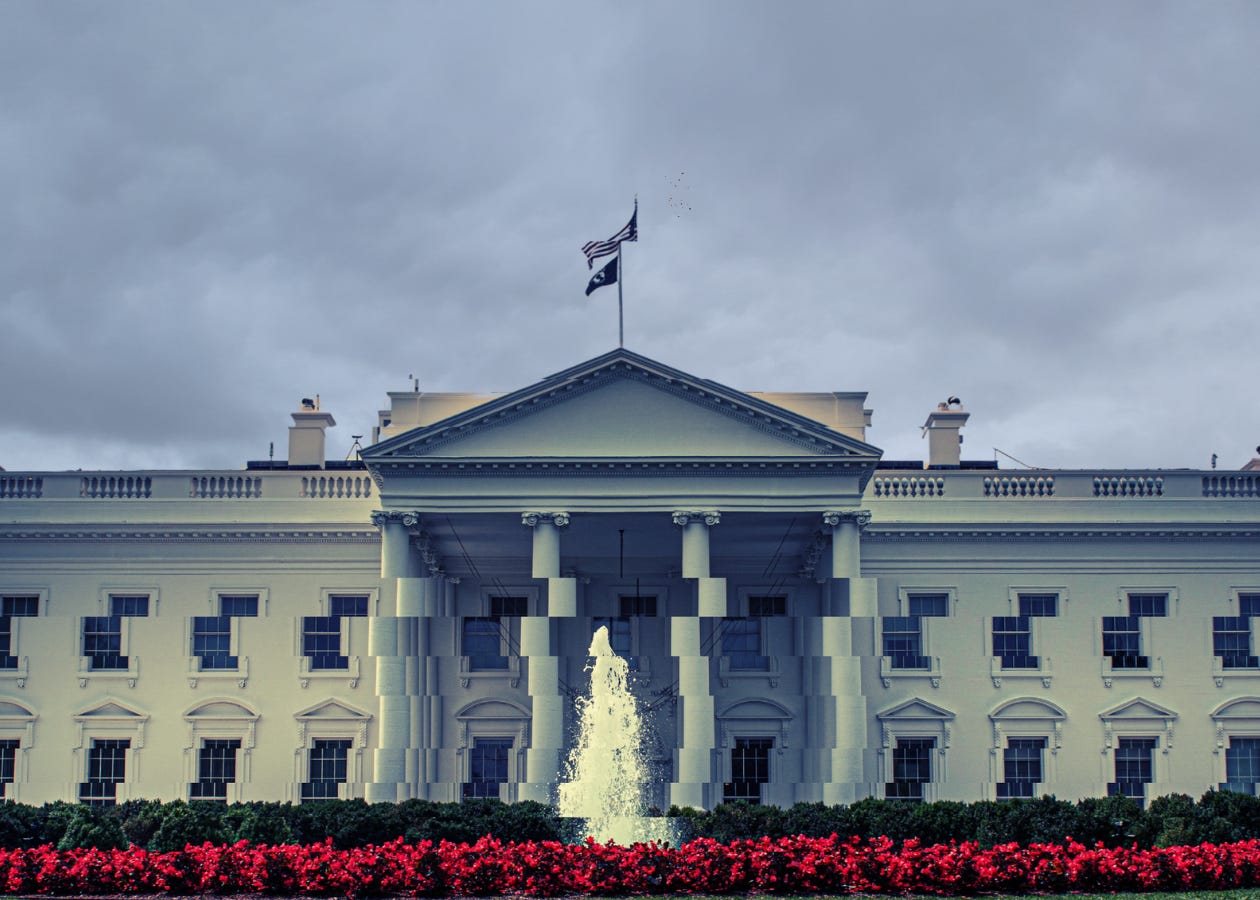
The sight of the White House revolted me. It is being warped, blown out of proportion, disfigured. Trump is “renovating” the house, and renovations to historic buildings are natural. But Trump is acting without any consultations, any commissions, any deliberations—simply on his own impulse and whim. “L’état, c’est moi.”
In the particular disfigurement of the White House, I’m tempted to see a more general disfigurement: of the Republican Party, of the conservative movement—of, hell, America.
I have always loved the White House. It is—or was?—a perfect republican mansion, perfectly suited to our republic. Handsome, stately, but not too grand or show-offy. Versailles belongs in France, not the US. When I was a student, my grandmother gave me a two-volume history of the White House, by William Seale. That was a gift.
On the National Mall, I walked alongside the Reflecting Pool, the subject of one of the craziest controversies of the Trump era. Crazily, Trump claimed that Democratic activists had vandalized the pool in order to make him look bad. He demanded that people be prosecuted.
Here is the headline over a news article last month: “Contractor Blames Its Own Repairs, Not Vandals, for Reflecting Pool Failure.”
Between the Lincoln Memorial and Arlington National Cemetery, Trump is planning a triumphal arch, spoiling the tableau, in my opinion and that of authorities on such matters. The arch has been dubbed the “Arc de Trump.” Last year, a reporter asked Trump about the arch: “Who’s it for?” Trump pointed to himself and answered, “Me.”
Personally, I would rather we won the Iran war than erected this arch.
The Kennedy Center was a painful sight. In January 1964, two months after JFK’s assassination, Congress said that this center would be “the sole national monument to his memory within the city of Washington and its environs.”
I spent many happy nights at the “KenCen,” especially with my grandmother. Afterward, we would usually go to Thomas Sweet in Georgetown for ice cream.
Last year, Trump put his name on the Kennedy Center—put it above Kennedy’s name. What kind of man would do such a thing? This year, a judge ordered Trump’s name removed, ruling that only Congress could rename the center. So now, there is a giant tarp on the façade, covering up the name “Kennedy.” And Trump is threatening to raze the building.
We are in a weird psychological realm here.
I walked past the State Department. Until very recently, there was a Hall of Flags, displaying the flags of all the countries with which we had diplomatic relations. I thought this was pretty neat when I was a student. All of those flags—almost 200 of them—have been replaced by American flags.
Is this patriotism? I think it’s closer to jingoism, and I think it bespeaks an insecurity unbecoming of so great a nation as ours.
Far worse, of course, is our abandonment of the Ukrainians and the administration’s tender regard for Putin. Passing the State Department, I thought of a particular official.
Darren Beattie is a “Senior Advisor for Western Hemisphere Affairs” and he is also the “President of the Donald J. Trump Institute of Peace.” (Trump renamed the US Institute of Peace after himself last year.) During the Biden administration, Beattie did some tweeting:
“Putin>>>>>NATO.” (That means that Putin is five times greater than NATO.) “NATO is a greater threat to American liberty than the Chinese Communist Party.” “Putin is superior to Biden in every way.” “Lloyd Austin can wash Putin’s feet.” (Austin, a retired Army general, was our secretary of defense.)
To me, this is sickening and abnormal.
Around town, I saw National Guardsmen, looking bored, listless, and, possibly, embarrassed. Trump ordered their presence in the capital. What is their purpose? As a rule, I am comforted and cheered by the sight of cops and soldiers. This seemed something else: a presidential display.
Above, I quoted Louis XIV: “L’état, c’est moi.” Trump, more comically, said, “I am the code”—he said this to an architect on his White House renovation, who had warned of fire- and safety-code violations. Last year, Trump tweeted a message that was maybe less comical: “He who saves his Country does not violate any Law.”
This is more a caesar than a president.
I am not a sunshine patriot. We must be patriotic in storms, too, including self-generated ones. But I doubt I will ever see Washington in the same glow as before. “So what?” you say. Why should my views and feelings—my dismay and disappointment—make a difference to anyone else? They shouldn’t. But to borrow from Wordsworth: oh, the difference to me.


With a clown in the White House, the White House becomes a circus.
Patriotism is supporting your country all the time, and your government when they deserve it.
- Mark Twain