


Fatima Abo Alasrar is the founder of the Ideology Machine Project and a non-resident fellow at the Arab Gulf States. Her work has been published by Foreign Policy, the Stimson Center, and other leading publications and organizations.
Iran is pulling out of talks to end the war with the US and Israel as the three countries continue to exchange blow after blow. With hope for a deal between Tehran and the Trump administration quickly diminishing, each party will be gearing up to spin its side of the story to the world.
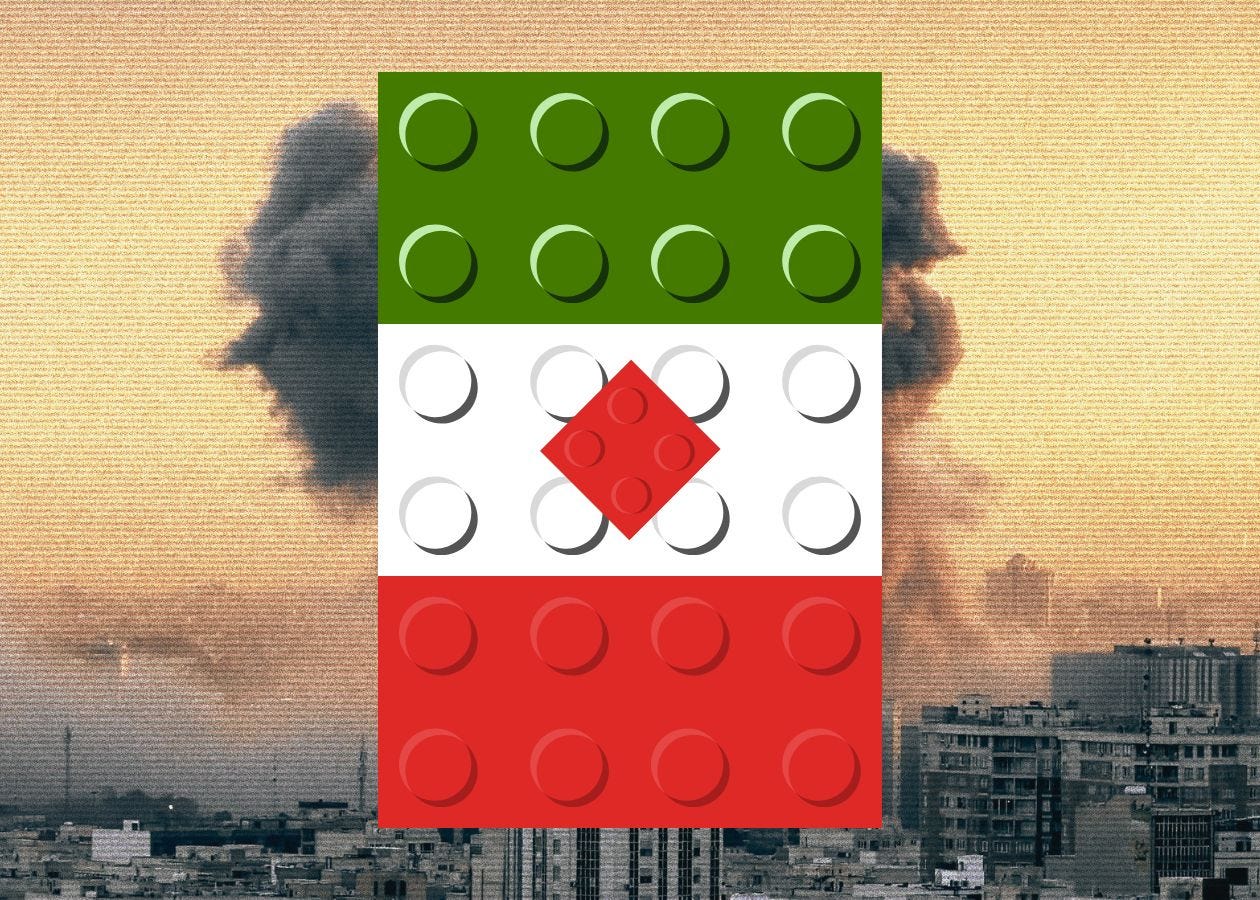
This conflict has made Iran an innovator in shaping the media narrative. Despite severely restricted Internet access, Iran is producing a remarkable amount of viral content. Much of it arrives in Lego form.
One of the main purveyors of this plastic propaganda goes simply by “Mr. Explosive.”
Explosive told the BBC that he spreads his message using Lego because it is “a world language.” The videos set rebellious English-language lyrics and AI-generated imagery to catchy tunes. They’re engineered to travel, portable across borders the Iranian regime cannot otherwise breach, and the toy-brick surface does the cruder work no straight propaganda could.
The images disable the viewer’s judgment by presenting as innocuous fun. A Lego Donald Trump tumbles through a blizzard of Epstein documents while rapped lyrics promise that “secrets are leaking and pressure is rising.”
The regime positions itself on the side of Americans disgruntled with a scandal-ridden administration, inserting the Islamic Republic into domestic controversies that have nothing to do with Iran at all. Beyond the Epstein Files, other homegrown American divides like the murder of George Floyd and Black Lives Matter also feature prominently in Mr. Explosive’s videos. A voice in the background says that Iran—that is, the Iranian government—stands for everyone the American system ever wronged.
Packaging propaganda as entertainment is hardly original, even if the medium of a Danish toy brand is.
Writing from exile in 1944 after fleeing Nazi Germany, philosophers Theodor Adorno and Max Horkheimer argued that the culture industry’s distinctive achievement was to exempt the spectator from any obligation to think—not using brute force to make people support something, but lulling them into submission through pleasure. Authoritarian regimes like Iran’s increasingly understand that mass entertainment neutralizes the critical capacity that propaganda used to have to overcome. The Lego operation is the contemporary form of that exemption, refined by a regime that has the most to lose from a thinking audience.
Pressed by the BBC, Mr. Explosive eventually conceded what he had long denied: the videos were not spontaneous bursts of creative expression, but were commissioned by the Iranian government for state projects.
And it makes sense that the Iranian regime commissions these videos. The images fit into a broader narrative about American hegemony, American injustice, American democracy in decline, and the humanitarian toll of US military action on Iranian civilians.
The critiques that Mr. Explosive and his team leverage at the US and Israel aren’t entirely without merit, but they are curated and distorted in service of an authoritarian state. Mr. Explosive will only ever showcase one side of the problem. That’s the nature of propaganda.
We don’t see minifigures mowed down by regime security forces, who have killed more Iranian civilians than any foreign airstrike. We don’t see brick-built drones holding the global economy hostage. Mr. Explosive doesn’t depict microscale authoritarians choosing to continue their many foreign misadventures—in Syria, Iraq, Lebanon, Yemen—against the will of the Iranian people.
The uncomfortable truth is that the Lego videos trade on Iranian exhaustion, American weariness, and the Western guilt that comes from watching innocent children die as collateral damage. A clip that pins all of the world’s cruelty on Washington wins Tehran sympathy abroad while costing the regime nothing at home.
ICYMI: Tune in to the latest episode of the Older/Wiser Podcast

The clearest foil to Mr. Explosive’s regime propaganda is the Iranian pop star Shervin Hajipour.
In 2022, Hajipour gathered statements from ordinary Iranians on social media, expressing why they marched after a 22-year-old woman named Mahsa Amini brutally died in the custody of the morality police. The singer-songwriter set those bold words of protest to music, and called the result “Baraye,” meaning “for.”
Baraye carried no toy-brick fantasies and needed none. The song attracted listeners from audiences who didn’t speak a word of Farsi, won a Grammy, and kept spreading even after Iranian authorities scrubbed it from the airwaves and from Hajipour’s accounts.
By every metric that propagandists aspire to, Hajipour’s Baraye was a success: more visible, more moving, more fluent in the “world language” than anything Mr. Explosive has ever assembled.
Baraye was the most successful authentic Iranian export in years.
For the dictatorship in Tehran, that was precisely the problem.
The regime arrested Hajipour and an appeals court upheld a sentence of nearly four years. Among the conditions of his sentence, Hajipour was ordered to write a new song about the crimes of the United States. The intent was notably transactional.
Iranian authorities wanted to commandeer an artist who had given voice to the suffering of regular people under the Islamic Republic, and redirect that voice outward, toward the United States instead. The regime ultimately pardoned Hajipour in September 2024 around the second anniversary of Mahsa Amini’s death, but the pardon was a calculated political move.
By that point, the prison sentence had served its purpose—intimidation, and sending a message. At the same time, keeping him in a cell was costing the regime more than letting him out.
Hajipour’s case caught the international spotlight because of his Grammy. Yet as many as 6,500 people have been arrested on spurious charges of treason and spying during the current Iran war. Those numbers come straight from the national police chief. Behind these statistics are thousands of families in limbo, not knowing whether their sons or daughters are coming home. Their mourning is not rendered in plastic, of course. None of it is subtitled for export. The regime confiscates the grief of its victims at the source.
This doesn’t mean that the United States holds the moral high ground, or that it has earned the trust of Iranians who would actually like to see the Islamic Republic go. American policy on Iran has been inconsistent for decades, swinging between engagement and pressure, sanctions and diplomacy, symbolic support for the Iranian people and abandonment of them when the political winds shift direction. Anyone who has staked real hope in the United States as a liberating force has not been paying close attention to the track record.
That history matters here because the regime thoroughly exploits it. Every American hesitation, every reversal, every promise that did not survive a change in administration becomes raw material for the kind of propaganda Mr. Explosive now manufactures in plastic. Washington’s inconsistency itself is Tehran’s content strategy.
And yet, that inconsistency still does not absolve the regime, which finds innovative ways to soften its otherwise brutal image as an authoritarian theocracy crushing its citizens in the name of religion. The next time someone watches a Lego video and marvels at its ingenuity, they should remember to look past the propaganda.
The very hand that armed Mr. Explosive with a megaphone is the one that put Shervin Hajipour in a cell.
After the Iranian regime killed protesters in Iran by the thousands between December 2025 and January 2026, before the intervention, Hajipour released a defiant new song on February 6. He titled it “Iranam”: “I am Iran”. He dedicated it to the dead.
The grief the regime demanded from Hajipour was for Washington. The grief he actually produced was for his own people, whose sorrows the regime still plunders.
The Renew Democracy Initiative, publisher of The Next Move, is pleased to join the Institute for the Study of Modern Authoritarianism, publisher of The UnPopulist, as a media partner for the third annual Liberalism for the 21st Century Conference—LibCon 2026—in Washington, DC on July 16 and 17. Click here for more information and to register. Coinciding with America’s 250th anniversary, the theme of the conference is the Reconstruction Agenda. The conference will assess the damage that authoritarian and demagogic politics have caused to the country’s liberal institutions and propose a path forward to rebuild accountability and confidence in the rule of law. The conference features a stellar lineup, including RDI Vice Chair Linda Chavez, along with Anne Applebaum, Francis Fukuyama, David French, Hong Kong dissident Nathan Law and many more. We’ll be there and so should you.
More from The Next Move:
How Minneapolis Plays in Tehran

American chaos provides a propaganda windfall from Tehran to Sanaa and Beijing.
Surviving Russia’s Biggest Attack on Ukraine in 18 Months

A firsthand dispatch from an American in Kyiv.

A TRUE AND FAIR ANALYSIS
It is great to see someone manage to elucidate criticism for both sides. I think it would be useful to draw up exactly what humanists should be supporting, because it is definitely not either US imperialism or religious dictatorship. A US abject loss would limit imperialist attrocities elsewhere, and arguably could slow the decline in US democracy by undermining imperialist ambitions, but would do nothing for the suffering of the Iranian people.
The best case for the Iranian people is that the US engages meaningfully with reformists in or potentially in government, providing a pathway to stepwise gradual normalisation of relations as moves towards democracy and reduction of corruption take place. Coincidentally that would also be in the best of interests of ... pretty much everyone, apart from the current US and Iranian regimes. This does seem unthinkable at the moment, but taking a step back it is the only reasonable solution.