


A note from Garry Kasparov: Perhaps you recently canceled a subscription to an oligarch-owned newspaper. Might I humbly suggest that you put that money toward supporting mission-driven media like The Next Move? I don’t receive a cent from your subscription fees—everything goes to supporting the work of The Next Move’s parent organization, the Renew Democracy Initiative. RDI is bringing political dissidents to tell their stories to students, business leaders, and public officials. Delivering life-saving humanitarian aid to frontline communities in Ukraine. And, of course, driving the conversation here on Substack. To help make the decision easier, we’re offering 30% off an annual subscription, now through March 4.
Fatima Abo Alasrar is the founder of the Ideology Machine Project and a senior policy analyst at the Washington Center for Yemeni Studies.
International media is tracking unrest in Minneapolis in real time. After federal agents killed two American citizens, foreign dictatorships and terrorist groups seized on a narrative of American decline to delegitimize the United States. The problem is that we in America are giving them material.
The Iranian regime is carrying out a crackdown against sustained protests, and with casualties among demonstrators climbing into the tens of thousands by some estimates. For the Islamic Republic, the Trump administration’s own crackdown in Minnesota was a sudden windfall delivered at the precise moment Tehran needed it most.
After all, American criticism of repression abroad is easier to dismiss when Washington justifies lethal force against its own citizens at home. But the damage goes beyond rhetoric. Political legitimacy is what allows the United States to act abroad with something other than brute coercion, what makes coalitions form willingly, what makes protesters in Tehran look west, and what makes American pressure feel like more than an empty threat. At moments of escalation, events in Minnesota send a signal that actively undermines deterrence.
When Iran-backed Houthi media broadcast Minneapolis protesters condemning “extrajudicial field executions” by federal agents, it gave Tehran something operationally useful: a way to deflect American pressure by pointing back at American streets. One editorial in Houthi media made the argument plain: “From the streets of Minnesota, where federal bullets meet popular anger, to Tehran, where human rights language is invoked to justify escalation, Western double standards are on full display.” The conclusion followed naturally: “He who justifies repression at home loses the right to preach abroad.” Another commentary cast the unrest as evidence of a “structural crisis,” a state “fleeing forward through escalation because it is incapable of offering real solutions,” and asked openly what the world will look like “when American hegemony collapses.” Both outlets present American disorder as proof of American decline. Worse, they hardly have to exaggerate their narratives to make them hit home.
Open societies are structurally vulnerable to this sort of narrative capture in ways closed systems are not. Transparency, dissent, public debate, and criticism of government policy: these are signs of institutional health, but they can also be used as evidence of dysfunction. Tehran can cherry-pick American outrage from open debate surrounding Minneapolis without suppressing information or falsifying records. Anti-American messaging falls into Iran’s lap, and just like that, the story writes itself.
Domestic fractures shape how external actors assess American endurance. Distrust in government erodes public tolerance for sustained confrontation abroad. This is not just theoretical. The administration’s intervention against the Houthis in the Red Sea last year encountered fierce domestic opposition, incoherence exposed by White House officials in Signal leaks, and ultimately a walkback from a military campaign without proper strategic considerations.
Although the withdrawal resulted from both military and political exhaustion, it was the political pressure to disengage that appeared to determine the timing. The Signal leaks revealed the fragmentation among officials contradicting one another in real time, undermining the perception that the campaign had solid political support. The lesson absorbed by state and non-state actors alike was that US stamina can be broken amid political dysfunction.
And while Iran is not Yemen, the structural problem is the same. A regime that has crushed every uprising, detained thousands, and killed its own citizens in the streets will not be dislodged by a single strike. Any American intervention in Iran would require sustained effort. The protesters who have risked everything, from the Green Movement in 2009 to Woman, Life, Freedom in 2022 have never asked for American rhetoric. They have asked whether the United States will commit the resources necessary to secure Iran’s democratic future, or whether they will be left hanging when Washington moves on to the next shiny object. After all, a country divided amongst itself is far less likely to stand united behind a sustained, large-scale effort abroad.
Now, as the administration weighs a larger confrontation with Iran, its handling of Minneapolis has created fresh material for those seeking to deepen the internal political divisions that already forced one retreat. This dynamic is compounded by American media coverage that has minimized the scale of violence in Iran’s streets. Some reporting from Tehran has echoed regime talking points, softening the picture of repression precisely when Tehran is under pressure. Coverage that contradicts what Amnesty International and other independent organizations have documented distorts what is happening, and it lands exactly the moment Tehran needs American audiences to doubt whether Iranian protesters are worth defending.
After witnessing events in Minneapolis, Americans are asking why they should care about protesters in Iran when their own government kills protesters at home. That question does not originate from hostile foreign propaganda. It arises organically, from the contradiction itself. Tehran does not need to manufacture American paralysis. It only needs to wait for it.
And Tehran knows exactly what to do. The Islamic Republic is broadcasting this moment to the world, including to the millions of Americans already skeptical of their own government. Your leaders kill their own people and call it security, so why would you trust them when they come for us? Tehran sees the fire burning in the United States and is bringing gasoline.
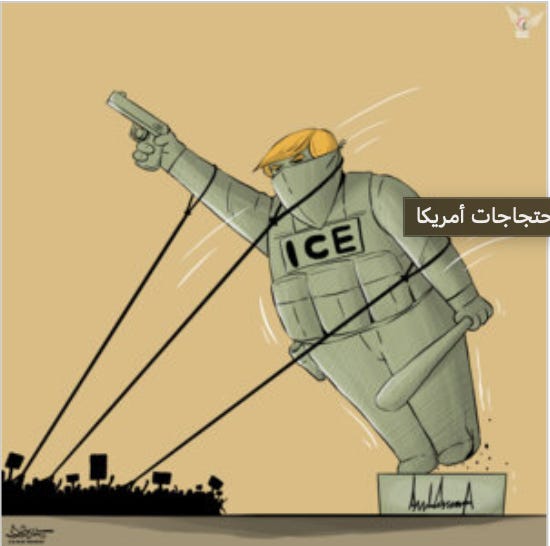
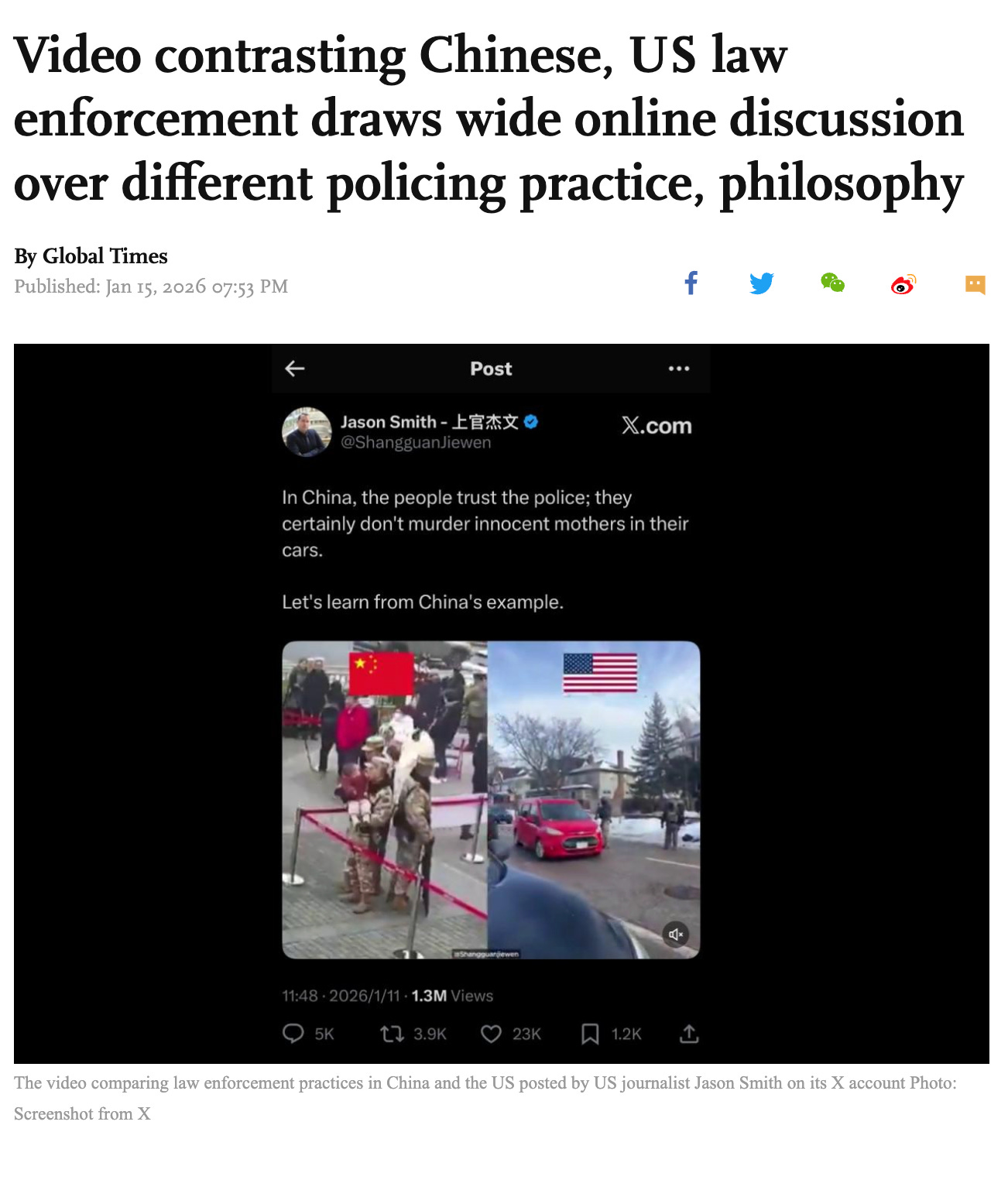
Other powers are joining in on. China’s Global Times showcased footage from a pro-PRC commentator contrasting Chinese and American police behavior: In their framing, order versus chaos. Russia’s RIA Novosti noted that “while the world was being told about the Iranian protests, such unrest broke out within the U.S.,” then proceeded to call Minneapolis a “civil war dress rehearsal.” Houthi media circulated coverage of the protests in the US in negative commentary, and a cartoon of Trump as a toppling statue in ICE gear, gun drawn, being pulled down by crowds, the iconography of regime collapse, repurposed for American consumption. Different systems, different audiences, same function: degrade the coherence of American power.
Together, these countries form an axis that does not hesitate to lambast American actions while doing far worse at home. The same week Iran’s Foreign Ministry criticized the Minneapolis shootings, Iranian security forces were killing demonstrators in the streets. The same Houthi media apparatus that frames American protesters as freedom fighters dismisses Iranian protesters as Zionist agents and American puppets, even as the regime’s body count climbs into the thousands.
The United States is nearing a decision point on Iran. It may act without consensus. But sustaining a confrontation with a regime that has spent decades preparing for attrition requires more than military capacity. It requires political endurance, which ultimately rests on domestic cohesion. And domestic cohesion rests on a basic alignment between what a nation claims to be and what it actually does.
Recent American messaging has sought to reassure Iranian protesters that external support will materialize if repression escalates. At the same time, the Trump administration meets its own domestic protests with threats of expanded executive authority and with language framing dissent as insurrection. That contradiction does not stay put. It travels.
What happens in Minneapolis does not stay in Minneapolis. It is absorbed, indexed, and redeployed by external actors already probing American resolve. It reaches those weighing whether to risk everything on the assumption that the United States might stand behind them. That assumption just got harder to maintain.
More from The Next Move:
What Would a Free Iran Mean for the World?

Five writers, each from a different country, on the global consequences of Iran’s protests.


This was hard to write, but it was necessary to reflect on in light of the current escalation (and now negotiations) with Tehran. In part because what is happening in the US was directed at protesters labeled as domestic terrorists. The thing is, Tehran spent the past few months telling us that the thousands it killed and brutalized were domestic terrorists. The US sounds like it borrowed the script.
Political legitimacy is what allows the United States to act abroad with something other than brute coercion, what makes coalitions form willingly, what makes protesters in Tehran look west, what makes American pressure feel like more than an empty threat. When that legitimacy is visibly shaken, deterrence weakens. American power becomes easier to dismiss, harder to sustain, and harder to take seriously.
Minneapolis was reported abroad in precisely those terms. The Kremlin, the IRGC, and the Houthis have all told the US not to preach abroad when it has problems at home.
American leadership is important, not just for us, but for the world.