


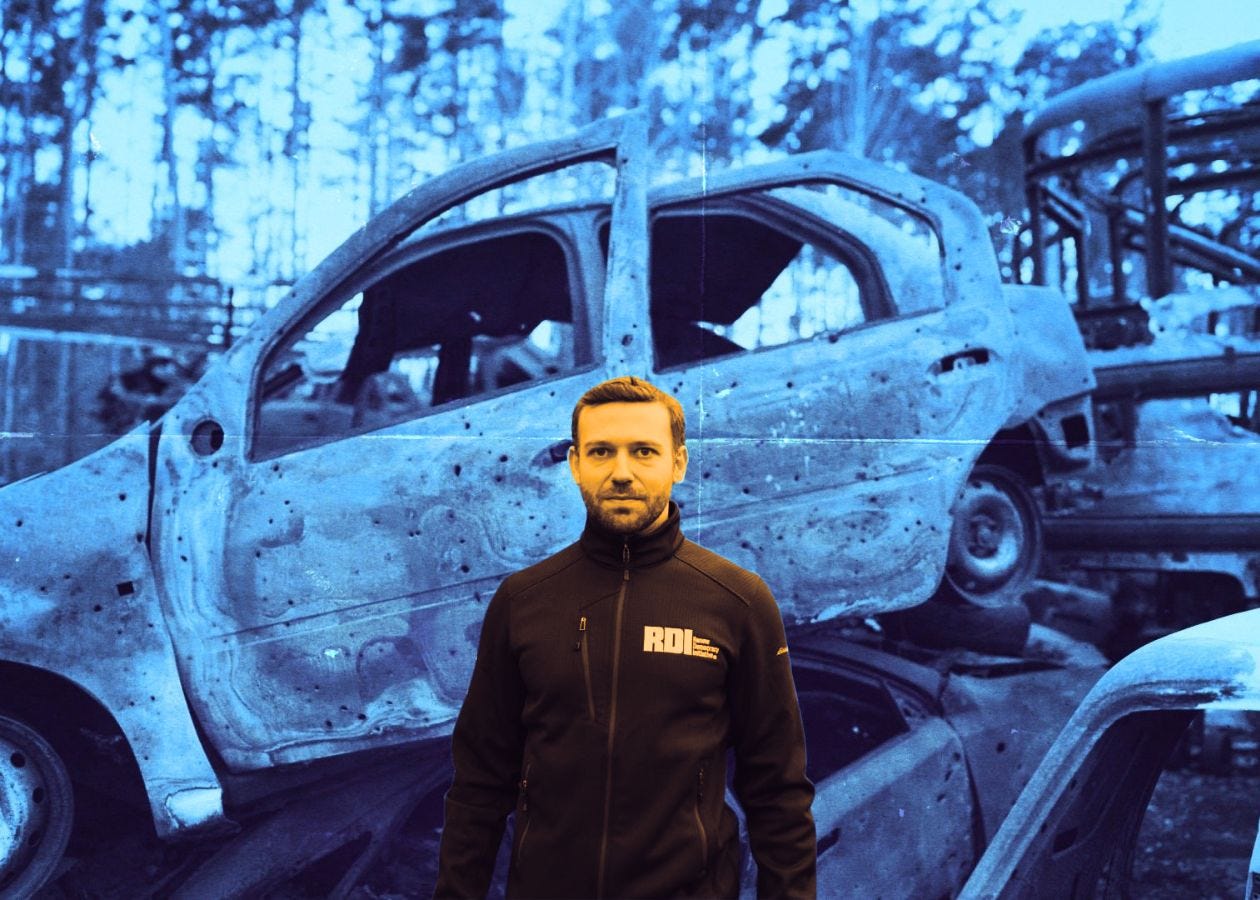
Editor’s Note: The Renew Democracy Initiative—publisher of The Next Move—is in Ukraine! We’ll be sharing daily dispatches from our delegation. Premium subscribers will receive each Ukraine Dispatch 24 hours before anyone else. Be the first to get on-the-ground news from the frontlines of freedom by upgrading to join our premium subscriber community today! All proceeds go to support the work of the Renew Democracy Initiative, including humanitarian assistance to communities in Ukraine.
Uriel Epshtein is the CEO of the Renew Democracy Initiative, which publishes The Next Move.
The first thing we see in Irpin is the bridge. Or, at least, what’s left of it.
Ukrainian forces destroyed the Romanivsky Bridge in the opening days of the war to halt the Russian advance toward Kyiv. Irpin, an affluent suburb, lay directly in the Russians’ path, making it a target in those first chaotic days of fighting.
Destroying bridges as a delaying move is a tactic that’s been around as long as there have been wars to fight and bridges to wreck.
But there’s something jarring about seeing the twisted metal and chunks of concrete here, in Irpin. This isn’t some remote outpost. It is a central artery connecting a wealthy suburb to the capital. Imagine the US Army sending the Key Bridge tumbling into the Potomac to stop an invader from crossing from Arlington into Washington, DC.
The Ukrainians, unwilling to let Russia rip out the heart of their nation, blew up the bridge almost immediately after the invasion began.
Premium subscribers received this entire Ukraine Dispatch a day before everyone else. If you are not yet a member of our premium subscriber community, you can upgrade to be the first to receive updates from our Ukraine delegation.
Civilians still had to get out. Photographs broadcast to the whole world show women, children, and the elderly fleeing on foot, scrambling over rubble, and wading through freezing water beneath the ruined span at the very spot where my colleagues and I are standing.


During that brief Russian occupation, over 70% of Irpin was destroyed. Within a month, the Ukrainian military had liberated the city. Today, much of it has been rebuilt.
However, the bridge remains as it was, preserved as a monument to the Ukrainians’ quick resistance to stop the invasion. The Romanivsky Bridge is one of many scars etched into Ukraine’s landscape, a reminder of what this nation has been through and what it is still going through today.
Not far from the bridge is another monument: the “car graveyard.”
It’s exactly what it sounds like: rows of civilian automobiles, burnt out, rusted, shredded, and pierced with bullet holes. Russian soldiers murdered a lot of the passengers and drivers of those cars.
It is one thing to face enemy troops on the battlefield: kill or be killed. But what were these Russian troops thinking as they emptied their magazines into cars carrying desperate families?
Putin and his henchmen launched the invasion on the pretext that Ukrainians and Russians are one people. While Putin’s narrative is ahistorical propaganda, there were plenty of familial and interpersonal ties between Russia and Ukraine after centuries of Russian and Soviet rule. I know this dynamic well—my dad is from Moscow, and my mom is from Kyiv. The commander of Ukraine’s military, General Oleksandr Syrski, was born in Russia—and, unbelievably, his parents and brother still live there!
So it’s entirely possible that some of the Russians in Irpin were just a few degrees removed from the people they murdered. Perhaps the Russian soldiers’ parents once studied at the same universities or worked in the same factories as their victims.
Is this how you treat people that you claim as your own?
I can’t shake that question as I walk alongside one wrecked chassis after another. I’m sure many Ukrainians are troubled with similar thoughts, but even in the darkest places, you wouldn’t know it. For all that they’ve been through, Ukrainians are incredibly forward looking. In Irpin, many cars are graffitied with “Slava Ukraini” and “victory.” Bright paintings of butterflies and sunflowers cover the husks of ruined automobiles.
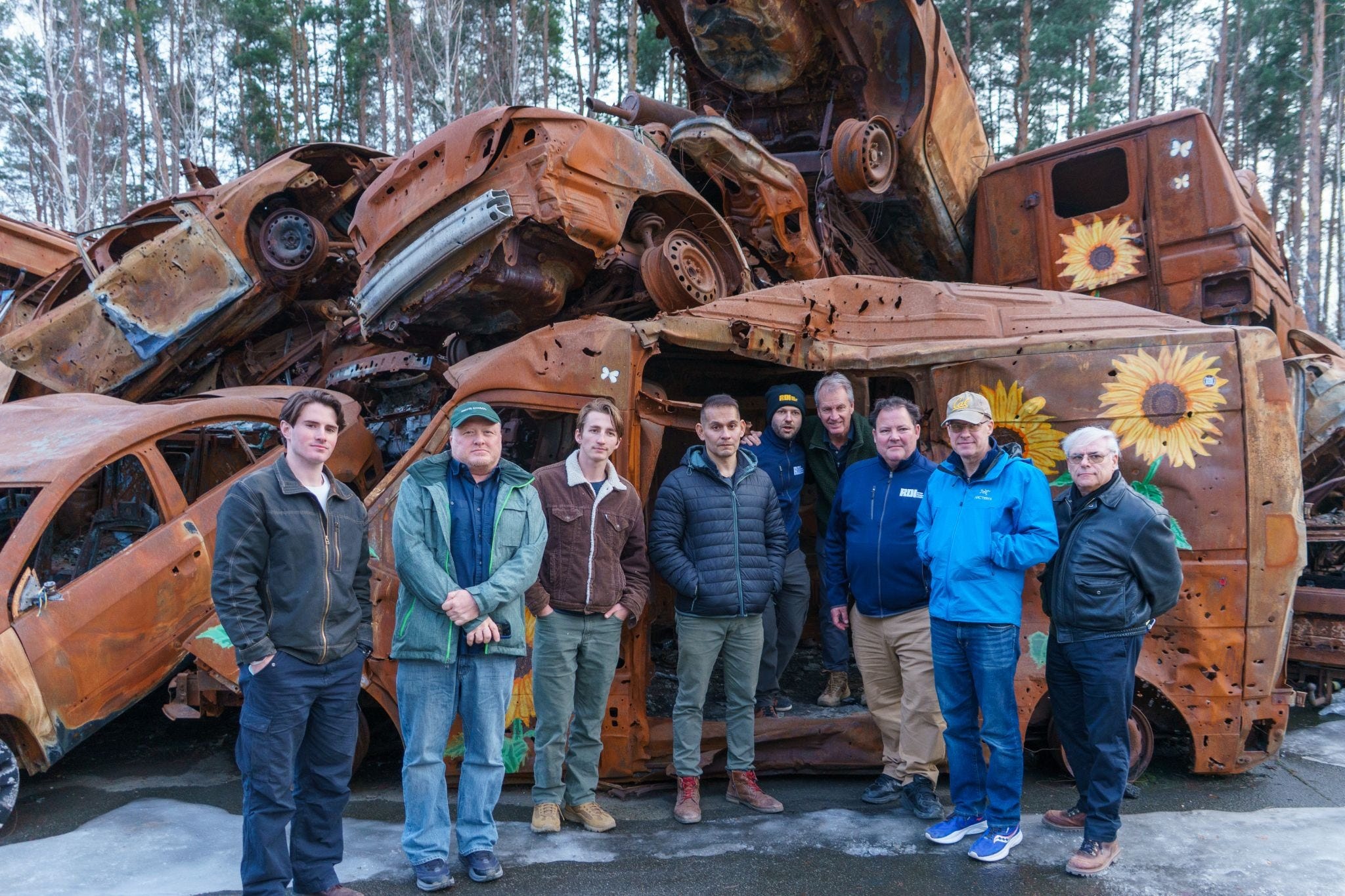
This isn’t the only car graveyard in Ukraine. Wherever Russia left evidence of its crimes, Ukrainians have preserved the scene.
That night, the air raid alerts start up again. The strikes hit civilian infrastructure and neighborhoods. The randomness is part of Moscow’s strategy.
It turns out that I am in Ukraine for one of the largest Russian drone attacks of the war: over 1,000 drones in a 24-hour period. Many are Shaheds—the same model of Iranian UAV now being lobbed at American forces and our allies in the Middle East.
So much for catching up on sleep.
The spirit of resilience I found in Irpin has followed me back to Kyiv. Ukraine wakes up. The drone strikes are still going on. The country is battered and bruised, and still, alive.
I guess, what other choice do they have?
On Tuesday morning, we visit a major hospital in Kyiv. This is Ukraine’s Walter Reed. It’s one of the city’s most important medical facilities.
The Renew Democracy Initiative—publisher of The Next Move—has donated a 2.8-megawatt boiler unit to help keep the hospital running, to make sure heat and basic services remain intact even under strain. If you’ll forgive the pitch, when you support RDI by joining The Next Move’s premium subscriber community, this is what you’re paying for. It makes me proud, and I hope you share that pride.


We meet with hospital leadership and local officials. There was supposed to be a bigger crowd , but the drone attacks are keeping them home.
After a day spent between a military base and the site of a massacre—places inextricably tied to killing and death—it feels strangely… refreshing to be in a place like a hospital. Of course, people die in hospitals. Yet this is also a place where babies come into the world and lives are saved.
Our hosts at the hospital boast that their facility had one of the lowest COVID mortality rates in the country. It’s a real point of pride, but it feels almost anachronistic in the context of this war. Naturally, the nonstop bombardment has Ukraine’s medical system under constant pressure.
There’s a temptation, from a distance, to see war in discrete moments: battles, offensives, headlines. What I see instead is something more continuous. Ukrainian society is absorbing shock after shock and fighting back for the sake of something most of us take for granted: a normal, boring life.


This car graveyard reminds me of the one I visited in Israel after the Oct. 7 massacre. Hundreds of burned out vehicles in a memorial commemorating the lives lost when Hamas terrorists burned or shot Israelis in the worst mass murder of Jews since the Holocaust. Decent people should never forget what was done that day. Those who criticize the subsequent wars in the Middle East sometimes forget how they started.
Freedom And The Nazi Republican Trope
Tim Snyder and Heather Cox Richardson get together to discuss freedom of which Snyder has written about in books On Freedom, On Tyranny, The Road to Unfreedom(https://bit.ly/487CWYS)
Snyder talks about how Americans talk about freedom as something they have because they haven’t lost something(freedom from something) But he points out that the positive aspect of freedom is much more powerful and creative It means that WE the People have the freedom to create which is a much more expansive way of seeing freedom
But Cox raises the familiar Nazi Republican trope that less government means more freedom Snyder argues that when there is less government you set the stage for oligarchic rule which we seeing played out in real time with Cheeto and his Nazi allies But government provides the structures/institutions and grants WE the People the positive aspects of freedom, eg clean air, safe food, good health care
The Nazi Republicans self servingly persuaded weak minded evangelicals that the government is the boogeyman They want Americans to believe that their fascist ideas of freedom will promote a better life and that’s true if you’re a wealthy oligarch who will profit from less government while the rest of us suffer with loss of the positive aspects of freedom and lose our creative potential as a free society