


Jay Nordlinger is a senior resident fellow at the Renew Democracy Initiative and a contributor at The Next Move.
Last week, Hamidreza Mohammadi told Radio Farda that his sister was “on the brink of death.” This was because of the torture and other abuse she had endured.
His sister is Narges Mohammadi, the Iranian political prisoner and Nobel peace laureate. She is a heroine of our time, a woman of almost super-human bravery and integrity. Now 54, she has been in and out of prison throughout her adult life—mostly in.
She was in prison when she received her Nobel prize in 2023. She had predecessors, in Nobel history.
Carl von Ossietzky was a prisoner of the Nazis when he received the peace prize for 1935. He died, still a prisoner, in 1938, at age 48. Liu Xiaobo was a prisoner of the Chinese Communist Party when he received his prize in 2010. He died, still a prisoner, in 2017, when he was 61.
Narges Mohammadi symbolizes the struggle of Iranian citizens against their dictatorship, and particularly the struggle of women—who have been in the forefront of the country’s democracy movement.
She was born on April 21, 1972, in Zanjan, where she is imprisoned, and near death, today. Her education in the brutal realities of the country began early.
“At the age of nine, when I heard my mother’s cries of mourning after the execution of her niece, a university student, and my grandmother’s lamentations after her son had been tortured, my childhood dreams were shattered.”
Mohammadi gave that testimony in 2023, after her Nobel was announced. She also said this:
“I was a 19-year-old girl when I was detained because of wearing an orange coat. At the detention center, breathless with disbelief, horror, and shock, I saw grim-looking men in black uniforms with whips in their hands who relentlessly lashed the bodies of four women …”
In 2003, when she was about 30, Mohammadi went to work for the Defenders of Human Rights Center, founded by the lawyer Shirin Ebadi. That same year, Ebadi won the Nobel Peace Prize. She would serve as Mohammadi’s mentor.
Mohammadi helped families of prisoners and campaigned against torture—including rape—and execution. Of course, she would often need such help herself.
She was in prison—Tehran’s unspeakable Evin Prison—in September 2022, when a movement erupted. A 22-year-old woman, Mahsa Jina Amini, had been killed by the “morality police.” This gave rise to a slogan, a chant: “Woman, Life, Freedom!” And those words became the name of the movement.
When the Norwegian Nobel Committee announced its award to Mohammadi a year later, the committee said that it was honoring this movement as well.
ICYMI: Tune in to the latest RDI podcast:

The new laureate herself was able to communicate some stirring news. When women in Evin Prison heard about the Nobel to Mohammadi, they responded with a cry that resounded throughout their cells: “Woman, Life, Freedom!”
Mohammadi said, to the world at large, “Victory is not easy, but it is certain.”
Like Carl von Ossietzky and Liu Xiaobo before her, Mohammadi was not released from prison to collect her prize in Oslo. (That prize is bestowed in a ceremony each December 10.) Her family was there in her stead.
Mohammadi has always refused to go into exile. Her husband, Taghi Rahmani, and their twin children, Ali and Kiana, live in France.
From Ali, we have an interesting story. When the prize for his mother was announced in October, he was in school—checking his phone under his desk. “I couldn’t shout in class,” he said, “but I was so happy.” He further said: “We are afraid for my mom every day. The Nobel prize is a sign for her to continue straight on and not abandon the fight.”
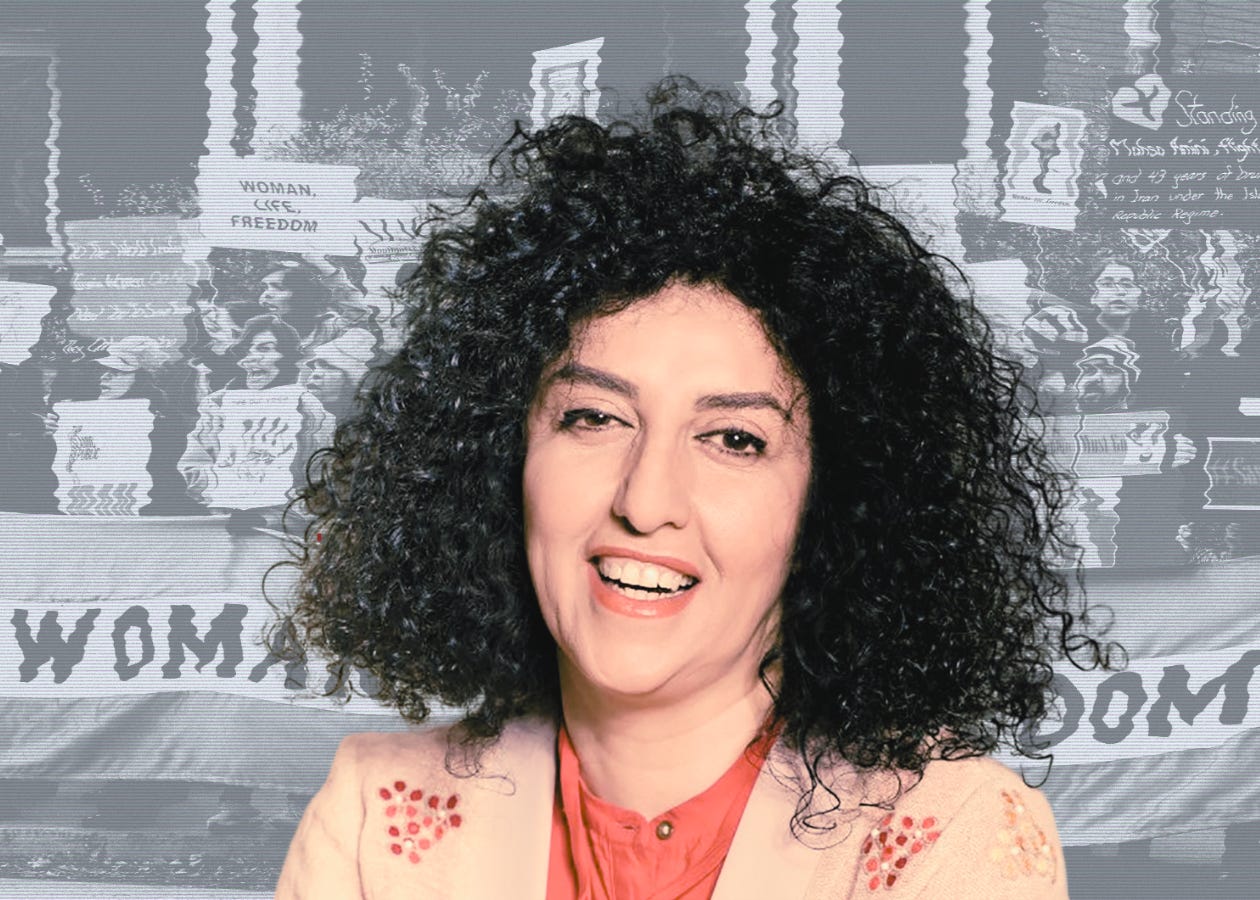
At the ceremony in Oslo, the laureate’s absence was symbolized by an empty chair. On the chair, her Nobel medal and diploma were placed. Behind the chair, there was a picture of her—a picture selected by the prisoner-laureate herself.
The committee chairman, Berit Reiss-Andersen, said, “She has asked us to use this particular photograph, which expresses how she wants to lead her life—looking happy in colorful garments, exposing her hair, and with a steady gaze towards us.”
“Exposing her hair”? Mohammadi is a firm opponent of compulsory hijab, which she says is a tool of tyrannical control, not piety.
From Evin Prison, Mohammadi was able to write or dictate a Nobel lecture, which was read by her children in Oslo. Here is one passage:
“Democracy, thanks to its inherent capacity for freedom and equality, has been a fundamental demand of Iranian society, and, almost unanimously, civil society calls for fundamental changes and a transition to democracy…”
Possibly, the Iranian regime did not want this Nobel peace laureate to die in prison. In 2024, they gave her a medical furlough, for her health was failing (as why would it not?). But they rearrested her on December 12, 2025, horrifically.
She had attended and spoken at a funeral—that of Khosrow Alikordi, a human rights lawyer. The authorities said he had died of a heart attack; his colleagues and supporters said—credibly—that he had been murdered.
Arresting Mohammadi, agents beat her to a pulp, repeatedly kicking her in the genitals. If you can bear further details, you can find them in a bulletin from the Nobel committee, here.
Since the start of the war with the United States and Israel on February 28, the Iranian regime has cracked down on internal dissent with extra ferocity. Last week, they hanged a 21-year-old athlete from Isfahan, Sasan Azadvar Junaqan. His offense? “Moharebe,” i.e., “enmity against God.”
Whether Narges Mohammadi will still be alive by the time you read this, I don’t know. I do know this: in virtually every time and place, dictatorships imprison, maim, and kill some of the best people in their grasp.
A further taste of who Narges Mohammadi is can be had in an incident described by Berit Reiss-Andersen, when she was speaking about the laureate at the ceremony in Oslo:
“Recently, she was offered much-needed medical help at a hospital on the condition that she wear a hijab when leaving the prison. She refused and initiated a hunger strike. Finally, she was taken to the hospital for a brief examination under tight security—but not wearing a hijab. Her resolve is unshakable.”


This is brilliant writing and reporting.
I am moved to both tears, and rage.
I pray, that within my lifetime, the people of Iran and Cuba will again be free.
This is a must-read. Anyone who is frustrated by civic and political challenges where our fights seem to go nowhere need to read this and realize how many people have suffered and given their lives for the common good. It takes courage and stamina to stand up to evil.