


Jay Nordlinger is a senior resident fellow at the Renew Democracy Initiative and a contributor at The Next Move.
As presidents do every November, Donald Trump issued a Thanksgiving proclamation last week. We will get there in due course.
You may remember an established notion in American life: “The president is the president of all the people—not just his party, not just his supporters.” That notion may now seem quaint.
Certainly Bush the Elder took it seriously. He was like that. On Election Night 1988, when he had defeated Michael Dukakis, the governor of Massachusetts, Bush said, “I mean to be a president of all the people, and I want to work for the hopes and interests not only of my supporters but of the governor’s and of those who didn’t vote at all.”
Bush continued, “To those who supported me: I will try to be worthy of your trust. And to those who did not: I will try to earn it, and my hand is out to you, and I want to be your president, too.”
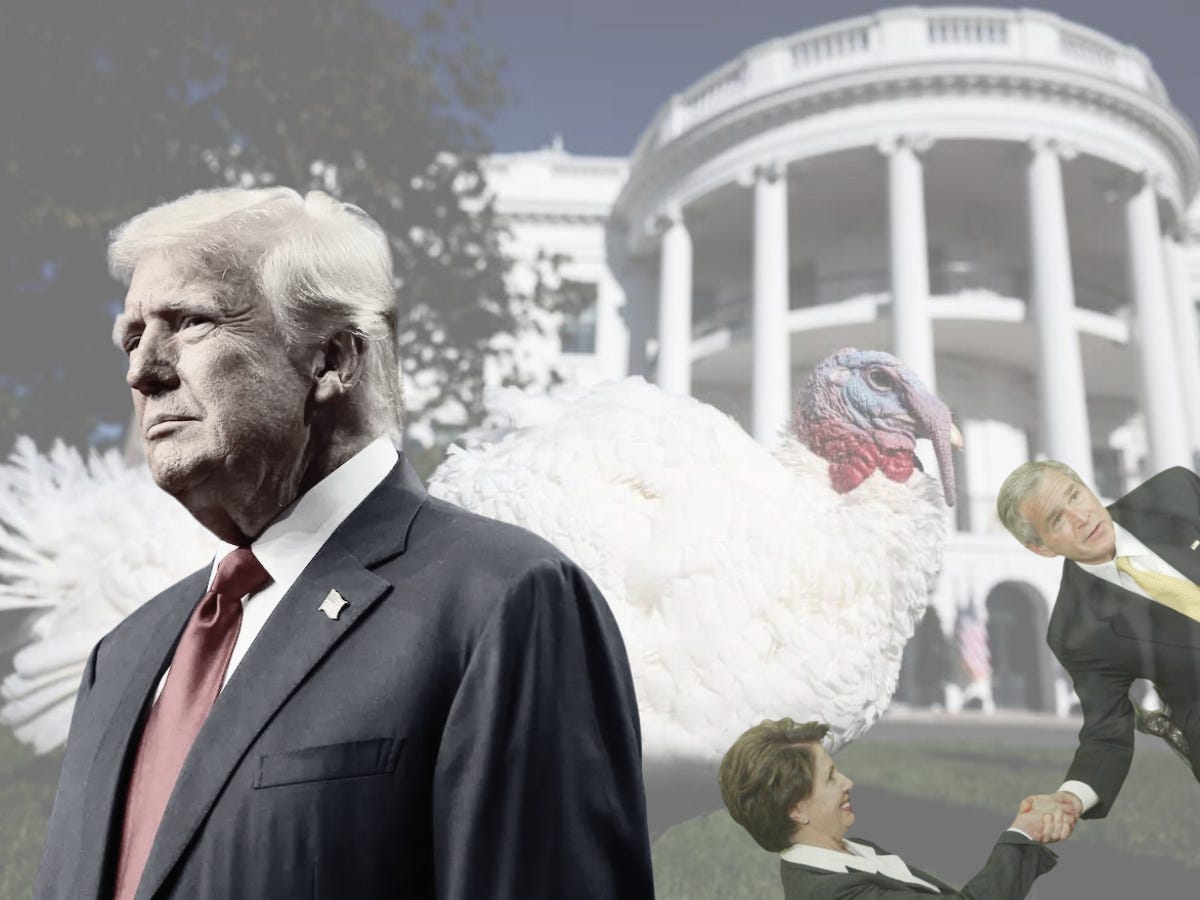
A certain graciousness was instilled in that family. You recall the tradition at the State of the Union address. The speaker of the House introduces the president by saying, “I have the high privilege and distinct honor ...” In January 2007, Nancy Pelosi was in the speaker’s chair, having become the first female speaker in history.
The president, Bush the Younger, said, “I have a high privilege and distinct honor of my own—as the first president to begin the State of the Union message with these words: ‘Madam Speaker.’”
American politics has never been a lovefest, because that is not the nature of politics, and our democracy is raucous. But certain standards were acknowledged (even if not met).
In 2012, at an event marking her 25th year in Congress, Pelosi said something that jolted some of her supporters: George W. Bush is “really a lovely man.” Which is true.
Last month, Pelosi announced that she would retire from Congress at the end of the current term. Asked to comment on this, President Trump said, “I think she’s an evil woman. I’m glad she’s retiring.”
“Evil.” There is no stronger word in the English language, at least on the negative side. I regard Vladimir Putin and his assault on the Ukrainians as evil. Have you ever heard Trump say that? Can you even imagine it?
Earlier this year, when he was a senior official in the executive branch, Elon Musk called the National Endowment for Democracy an “evil organization.” My view is different: that NED is a point of light (to borrow a phrase from the first Bush).
This Thanksgiving, President Trump issued not only a proclamation but also a tweet. In it, he inveighed against immigration and “Sleepy Joe Biden’s Autopen.” He ended, “HAPPY THANKSGIVING TO ALL, except those that hate, steal, murder, and destroy everything that America stands for—You won’t be here for long!”
The State Department issued a Thanksgiving tweet of its own. Is that a thing? Does the State Department do this? The current one did, saying, “This Thanksgiving, we’re grateful for President Trump.” That’s a helluvan opener.
State’s tweet went on to say, “Because of his bold and visionary leadership, our nation commands respect on the world stage.”
You and I can debate this: whether the United States “commands respect on the world stage,” because of Trump’s “bold and visionary leadership.” But what a claim for the State Department to make, on Thanksgiving Day!
The U.S. State Department is not a branch of the Republican National Committee, remember.
Weighing in himself, Secretary of State Marco Rubio tweeted,
It is truly a privilege to live in the greatest nation on Earth under a leader who always puts God and country first.
I am thankful for President Trump and the incredible work he is doing to usher in peace and prosperity. May God continue to bless him and the American people.
We can argue whether Trump puts “country first” (rather than, say, his personal enrichment). But God first? Would even Trump claim that?
But the more important point is: Why is the secretary of state talking like this? Can you imagine Colonel Stimson talking about President Hoover like that on Thanksgiving Day? John Foster Dulles talking about Eisenhower? Colin Powell talking about George W. Bush?
To some of us, it’s creepy, tending toward the North Korean.
Presidential Thanksgiving proclamations are an interesting subject, and I have long been a student of them. In November 1995—has it really been 30 years?—I wrote an article about them for The Weekly Standard, where I was then working. It can be found here.
Over the generations, Thanksgiving proclamations have not been untainted by political partisanship. But listen to Trump’s, last week:
This year, God has bestowed abundant blessings all across our land and indeed the entire world. As we give thanks to Him, we continue to advance our Nation through strong leadership and commonsense policy. As a result, the American economy is roaring back, we are making progress on lowering the cost of living, a new era of peace is sweeping around the world, our sovereignty is being swiftly restored, and the American spirit is coming back greater and more powerful than ever before.
We can debate the veracity of these claims—whether the economy is “roaring back” and so on. But what is a campaign-style statement doing in a Thanksgiving proclamation?
A lot of people like to snicker at “norms”—traditions, customs, ways of being. Ways of doing things. Standards and practices that are not written down but followed nonetheless.
For example, you attend your successor’s inauguration, even if you’ve lost the election. Bush the Elder did it. Trump, of course, refused.
Since the summer of 2015, a great many events and changes have occurred. But the fundamental question in our politics has remained the same: Is Donald Trump fit, in mind and character, to be president? Millions say yes, millions say no. And here we stand, shakily.
More From The Next Move:

The Privatization of American Power

Garry Kasparov on what happens when power becomes privatized for personal gain—and the United States’ troubling shift towards it.
 | A guest post by
|