


Is NATO dead? Find out on our next premium subscriber Zoom call, featuring former NATO Secretary General and Prime Minister of Denmark Anders Fogh Rasmussen. The conversation—exclusively for premium subscribers—will take place on Wednesday, May 27 at 9am ET. For more information and registration, click here.
Garry Kasparov is the founder and chairman of the Renew Democracy Initiative, which publishes The Next Move.
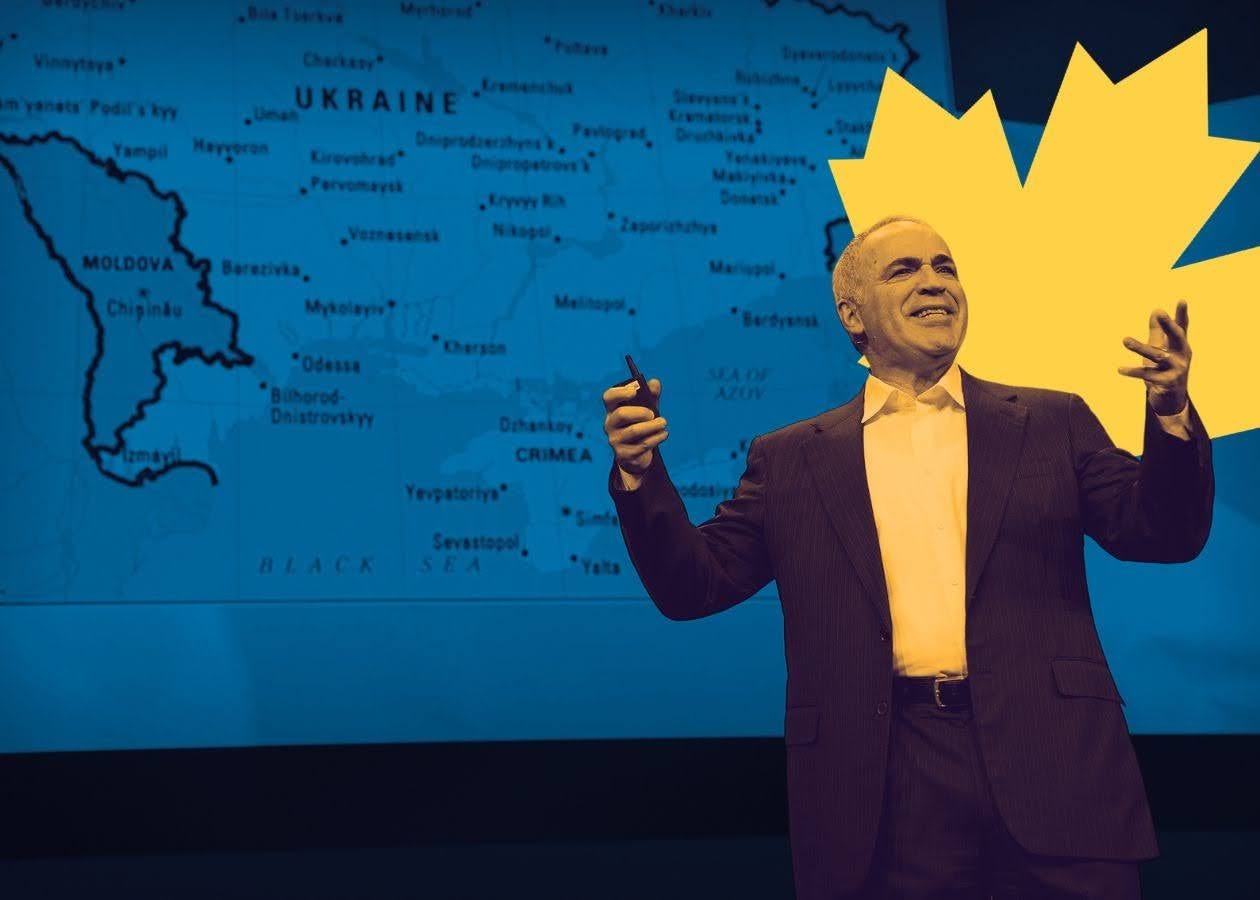
Last Thursday, I received the Friend of Ukraine Award at the Tryzub Awards Gala in Toronto. Here are my remarks from that evening:
Good evening.
To begin with, I’d like to thank our hosts, the Tryzub Gala Foundation, for their invitation, and for this prestigious award.
Dyakuyu.
Of course, the real heroes are the men and women of Ukraine, who are fighting every day and every night, not only for their nation, but for the entire Free World.
The war in Ukraine is like chess: it’s black and white. Anyone who can’t tell you who is good and who is evil there is willfully blind.
But unlike in chess, there can be no tie in this war. It is a contest of good versus evil, and you do not accommodate evil—even halfway.
This war demands moral clarity, not politically correct slogans cooked up by a committee. So let me say, loudly and clearly enough that they can hear me from across Lake Ontario:
Ukraine. Must. Win.
And there’s another part to it—something that even the most pro-Ukrainian politicians in Ottawa, Washington, and Brussels aren’t comfortable saying.
Russia. Must. Lose.
The Russian. Empire. Must. Fall.
Under the banner of the organization I founded in 2016, the Free Russia Forum, it is written: Victory for Ukraine, freedom for Russia. And it must happen in that order. Anyone who wants to seriously oppose Vladimir Putin must adopt that as their north star, and also declare, without stuttering: Crimea is Ukraine.
But this war is not just Putin’s war. It is Russia’s war. Nothing less than the Ukrainian flag flying over Sevastopol will extinguish the imperial virus that, for centuries, has plagued Russia and brought ruin to its neighbors.
So I will repeat: The Russian Empire must fall.
But saying all of this is the easy part. The more difficult challenge is one of strategy. Looking at the Russian invasion of Ukraine, you must survey the entire board, not just individual pieces.
The state of play is indeed complicated, especially from where we sit here in Toronto.
For decades, Canada’s strategy was based upon its status as—let us be blunt—a junior partner of the United States of America. You prospered under the protection of a benevolent giant to the south.
Well, as your prime minister noted in Davos just a few months ago, things are certainly different now.
The giant is not so benevolent anymore. The giant is orange in the face, prone to mood swings, and curiously aligned with the Russian way of thinking… and you’re starting to get flashbacks to 1812.
The answer to all of this is not to trade your role as a subordinate of one great power for another, swapping your arrangement with the US for, god forbid, China—one of Russia’s leading accomplices in its genocidal devastation of Ukraine.
ICYMI: Tune in to the latest episode of the Older/Wiser Podcast

The responsibility you shoulder now is to lead—as an equal partner with your allies across the Atlantic, who are navigating a similar challenge too.
For inspiration, you must look to your kin in Ukraine.
There is actually an interesting parallel in the relationship between Russia and Ukraine, on the one hand, and the US and Canada, on the other.
For centuries, Ukraine was chained to the Russian and Soviet empires. Because of this history of Kremlin colonialism, Ukraine shared many cultural, linguistic, political, and economic ties with Russia.
While Canada’s ties with the US weren’t forced upon you, you too share a common heritage with a larger neighbor, a natural choice guided by shared history and geography.
For centuries, Ukraine lived under Russia’s shadow, as you lived under America’s.
Yet, since 1991, Ukraine has proved that history and geography are not destiny. And since that fateful day in February 2022, Ukraine has been the spiritual leader of the Free World.
While Boris Yeltsin was shelling the Russian parliament and launching a genocidal war in Chechnya, Ukrainians held free elections and a peaceful transfer of power.
While Vladimir Putin was murdering political opponents, Ukrainians were doing the hard work of building democracy.
While Russia slid into the embrace of China and other authoritarian states, the Ukrainian people braved bullets and batons on the maidan and demanded their nation turn West.
And when Russia invaded Ukraine solely with the aim of destroying, Ukraine continued to build. Ukraine built a modern military powerhouse, raised the strongest army in Europe and became an innovator in drone warfare.
My organization, the Renew Democracy Initiative, has been delivering life-saving aid to Ukraine since day one of the full-scale invasion—$15 million worth in the last four years. Just this spring, RDI led our second delegation to Ukraine—going to the frontlines in Kharkiv.
My colleagues also saw firsthand how Ukraine is punching above its weight. They met with the commander of Ukraine’s most effective drone unit. If the president of the United States were actually a successful businessman, he might take note of the fact that Ukraine is inflicting eleven-figure damages on Russian targets using UAVs that cost just a few thousand dollars each.
The lesson Ukrainians have for all of you in this room is that global leadership is not reserved for empires. Your past… your geography… these are not excuses to abdicate your responsibility as a founding member of the democratic alliance.
If the people of Ukraine, just 35 years after the fall of the USSR, with missiles, and drones, and rockets raining down upon them, abandoned by the US administration, if the people of Ukraine can lead—then Europe must lead, and your gameplan must be for Canada to lead too.
It would have been nice if Canada and the world’s other democracies had time to grow into this leadership role, gradually, without having that role violently thrust upon them by buffoons like Donald Trump and JD Vance. But… how does the serenity prayer go? “Give me the grace to accept what I can’t change, and the courage to change what I can.”
Well, here we are. Time to muster that courage.
Slava Ukraini.
P.S. While I was in Toronto, I had the opportunity to meet Canadian-American journalist and past Tryzub awardee Diane Francis. She recently gave a great interview about where things stand between Moscow and Kyiv. I encourage you to give it a watch:


Awesome speech!
Putin Is Losing His War And Authoritarian Cheeto Is F**ked
As Ukrainian drone strikes continue to pummel Russian oil and gas infrastructure deeper and deeper into Russian territory it's clear that Putin's economy under this attack is gradually collapsing Putin is becoming more and more paranoid and hunkered down in his bunker while there are schisms happening within his corrupt government And with its May 7 military parade no vehicles or armaments are set for the celebration parade and men are being pulled off the Ukrainian front lines to participate in the parade
The war events are happening fast and it is now apparent that Putin's regime cannot sustain nearly 1.5m casualties, untold loss of military armaments, weather economic sanctions without consequences that imperil his oligarchic dictatorship The end is coming clearer into focus as Putin considers how to capitulate
Meanwhile Putin's main ally Cheeto took a bet on the Russian authoritarian state and it's not looking good for the orange demented one He lost an ally in Orban who lost his re-election last month, will lose the fascist Zionist Netanyahu based on public opinion, and in the near future will lose his favorite Russian counterpart But one thing WE the People can count on, Cheeto will perversely double down until the electorate renders him impotent with the 2026 midterms