


Issac Luna (Olvera) is a former US Marine Corps officer who fought for the Ukrainian military after the full-scale Russian invasion. He is the author of the book Reckoning Dreams and Fire, a memoir about his experience in Ukraine and other battles. Mr. Luna remains based in Ukraine. Follow him on X.
In March of this year, a few dozen people gathered in Moscow to protest. They weren’t speaking out against Russia’s criminal war against Ukraine; they were demonstrating against Internet restrictions in their own country. This act of self-expression was short-lived: 13 people were taken into custody
Meanwhile, for the last two weeks, in Kyiv and in every other major Ukrainian city, thousands have been protesting. Police stand nearby, calmly keeping watch. No one is arrested. In fact, many off-duty police officers are among the protesters.
Ukrainians are showing up to demonstrate against the removal of Mykhailo Fedorov, a young, reform-minded politician, from the post of minister of defense.
All of this is taking place under martial law, which grants governments expanded emergency powers needed to confront a declared threat. In Ukraine this means men aged 23 to 60 are barred from leaving the country, mass conscription, and curfews in most cities, including Kyiv. Ukrainians have endured these extraordinary restrictions for a reason: to protect their democracy. That’s why a US Marine veteran like me volunteered to serve in the Ukrainian military in the very first days of the full-scale invasion. Now Ukrainians are hitting the streets en masse for the same reason—to safeguard their freedom—and I had the privilege of joining them.
The ousted defense minister, Mykhailo Fedorov, is 35. A former tech entrepreneur, he’s spent nearly a decade in government, charismatic and untainted by the oligarch politics or scandals that have dogged Volodymyr Zelenskyy’s administration. Some protest signs even depict Fedorov as a saint, Byzantine-style.
Fedorov rose to prominence leading Ukraine’s digital transformation, moving services like passport applications, birth registrations, and marriage licenses online, providing a lifeline for millions displaced by war, and a system that cuts down on bribery by removing face-to-face contact and leaving an auditable digital trail.
Fedorov then got an unlikely promotion: minister of defense. With no military experience, and just old enough to be battalion commander, many were skeptical, myself included.
In Ukraine, many top commanders came from civilian careers, bringing ideas that often challenge the military orthodoxy. Robert “Magyar” Brovdi is one such individual: a man with a distinctively unkempt beard. He was a grain trader until 2022, but joined the military when Russia invaded. He pioneered Ukraine’s drone program and leads the equivalent of a brigade as a major. The deputy commander of Ukraine’s Air Force is a colonel with only five years of military experience. He was a TV producer before that. So the decision to put Fedorov in the top military job was less radical than in countries where business-as-usual rules apply.
Still, Fedorov’s appointment unsettled some in the traditional military establishment. He reportedly clashed with the commander-in-chief, Oleksandr Syrskyi, a general associated with the Soviet old guard that often favors costly conventional ground assaults.
ICYMI: Tune in to the latest episode of the Older/Wiser Podcast

On paper, the Soviet-style doctrine disadvantages a smaller, less-well-equipped country like Ukraine. On the other hand—to be fair to Syrskyi—I am a NATO-trained former infantry officer, and I recognize that an old-school ground assault is often the only option.
Syrskyi pulled off incredible feats: the defense of Kyiv, the Kharkiv counteroffensive, and even an incursion into Russia. The front has been mostly stable. His imperfect approach deserves credit, but he does not enjoy the popularity and sterling reputation of Fedorov (a high bar).
During my service with the US Marine Corps, my instructors often said, “Don’t send a Marine where you can send a bullet first.”
Fedorov embraced a similar philosophy: don’t send a soldier where you can send a robot first.
With that mentality, he moved quickly, which is what the situation demanded. He coordinated with Elon Musk to block Russia’s access to Starlink. He also accelerated the deployment of cheap drones and ground robots, an asymmetric strategy that spared Ukrainian lives while killing Russians faster than Moscow could replace them. After uncovering overspending, he introduced polygraph testing for employees and implemented a more competitive and transparent procurement process.
Many credit Fedorov for turning the tide in the war. During his tenure, Ukraine recovered more land than it lost, disrupted Russian logistics in Crimea, intensified strikes against Russia’s energy infrastructure, triggering a fuel crisis, and decimated Russia’s shadow fleet in the Sea of Azov.
The pace of reforms was not fast enough for Fedorov, but it was too jarring for the establishment. Fedorov accused Syrskyi of slow rolling key reforms and urged Zelenskyy to replace him. Instead, six months into the job, President Zelenskyy fired the tech visionary and kept the military traditionalist.
The decision caused an immediate public uproar. Thousands of Ukrainians, carrying cardboard signs, marched toward the presidential complex along the well-worn path Ukrainians have used to express mass anger: in the revolutions of 2004 and 2014, and most recently in 2025, when crowds demanded the independence of anti–corruption institutions.
Many rank-and-file soldiers opposed Fedorov’s dismissal. In most countries soldiers can’t publicly protest against their chain of command. Ukraine is different because the situation here is unlike any in the world.
Many of Ukraine’s nearly one million soldiers were civilians not too long ago, and they remain engaged in issues that affect their very survival. They often show up to protests in civilian clothing. The military doesn’t try too hard to prevent it.
This was different. A Ukrainian friend, Alex, was an IT manager, until he was drafted over a year ago. He had planned to attend the protest but he heard soldiers who joined might face punishment, so he stayed home
Nevertheless, his interests were well represented. My fiancé’s sign featured a popular slogan: “I am here for those who are there [on the front].”
It is more than a slogan. I asked a young woman behind me why she had come. She opposed the president’s decision, and she was particularly motivated because her own father is fighting. It’s a strangely beautiful symbiotic relationship. The protesters were fighting for those who fight for them.
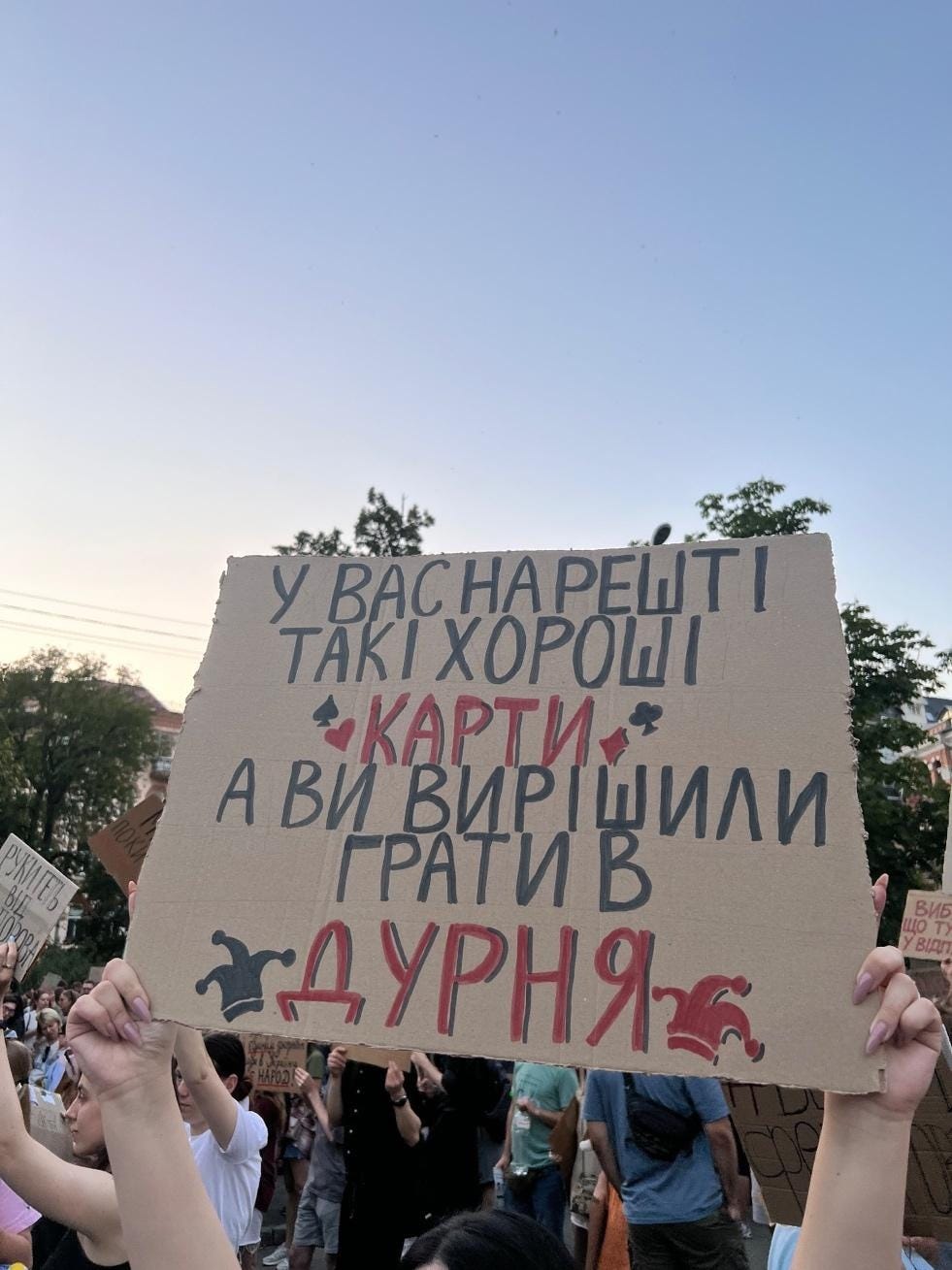
The crowds gathered daily and haven’t stopped. Their signs captured the mood: “You finally have such good cards, and you decided to play the fool.”
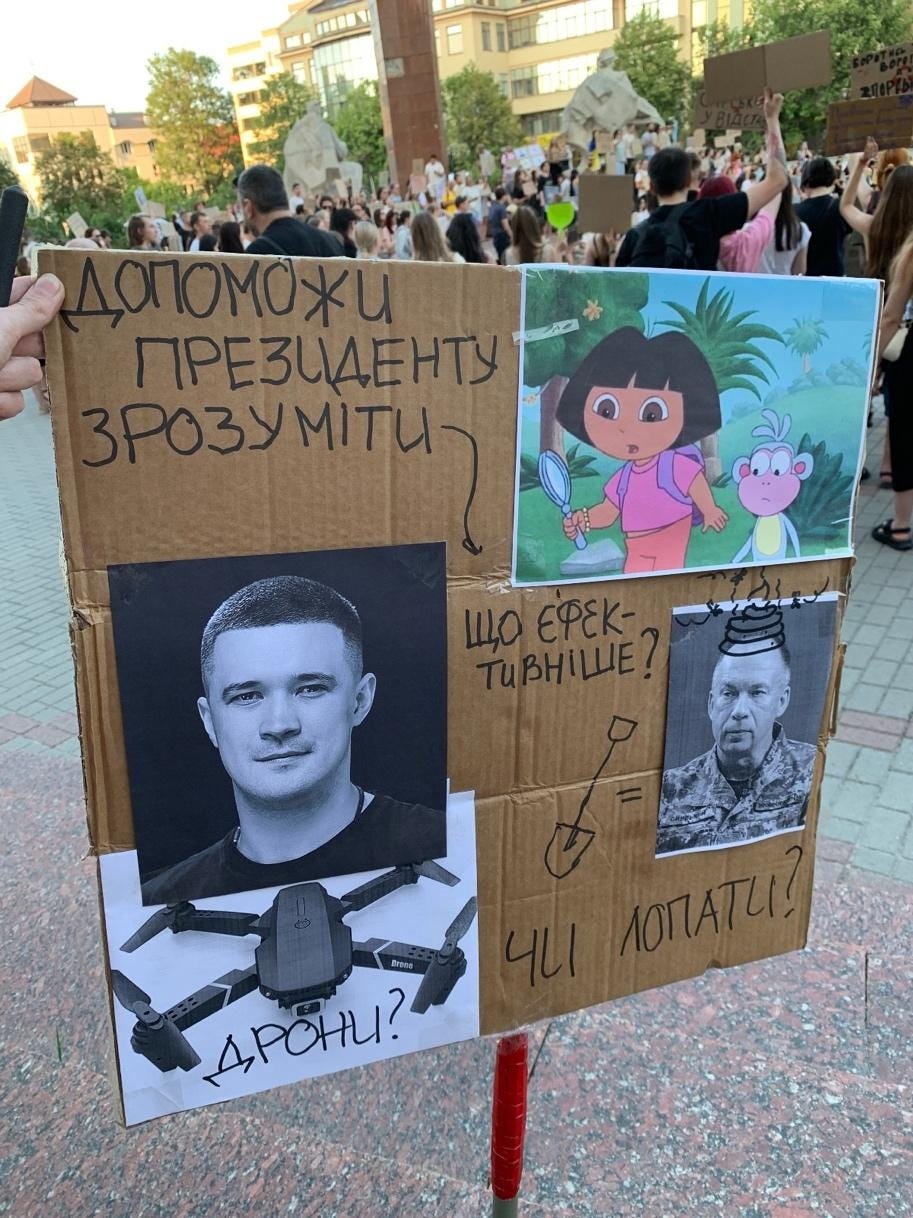
Another said “Help the president understand what is more effective: drones or shovels?” with a photo of Syrskyi next to a shovel.
The consensus was unambiguous: yes to Fedorov, no to Syrskyi.
I’m not Ukrainian so I’m not entitled to make demands, but I’m not indifferent to the events or its outcome.
In 2022, I left my life in the United States to fight in the Ukrainian army because I believed Ukraine deserved support as it defended its democracy against an autocratic invasion. And I’ve been inspired by their resolve since then.
Democracy is an active verb, so I came to the square to see if the country is moving in the right direction. And I am inspired once again. No one is being shot by the Ukrainian security service. No one is being arrested. In the middle of a war, under martial law, between air raid alarms, brigades of mostly young Ukrainians marched toward the president’s compound to make demands. That would not happen in Russia.
And it is working. Ukraine is no dictatorship. Its president is responsive to public demands under the most trying circumstances. After six days of the protests, Zelenskyy dismissed the unpopular general, Syrskyi. Stepping into the role of commander-in-chief of the Armed Forces of Ukraine is Mykhailo Drapatyi, a respected 45-year-old who started this war as a battalion commander. Unlike Syrskyi, with no connection to the Soviet legacy and the old guard.
It was another massive victory for the Ukrainian people, just as they won when they protested last year to restore the independence of a government anti-corruption watchdog.
The story isn’t fully resolved, though. Fedorov hasn’t been reinstated. Zelenskyy offered him other roles, including something akin to a national security adviser post, which he reportedly declined (along with offers from Palantir and the Italian government). Negotiations continue, but Ukrainians themselves are the catalysts and the brokers of this process.
More photos from the protests:


More from The Next Move:
Surviving Russia’s Biggest Attack on Ukraine in 18 Months

A firsthand dispatch from an American in Kyiv.


You right on point, thank you
I understand and support the protesters - fighting for your beliefs takes courage under any system.
I understand and support Zelenskyy - he had the authority to ban the protest, but chose not to.
I understand and support Zelenskyy - he dismissed Syrskyi to defuse the situation.
I understand and support Fedorov - he is standing up for his truth.
But I also remember that it was Zelenskyy who once appointed Fedorov.
I also remember that it was Zelenskyy who stayed on Bankova in February 2022.
So, with all due respect to Fedorov and Syrskyi, I will support Zelenskyy so that he can preserve and build on their contributions.