


Sabina Cherner is a communications intern at the Renew Democracy Initiative, which publishes The Next Move. She is a student at Tufts University, where she is studying international relations and economics.
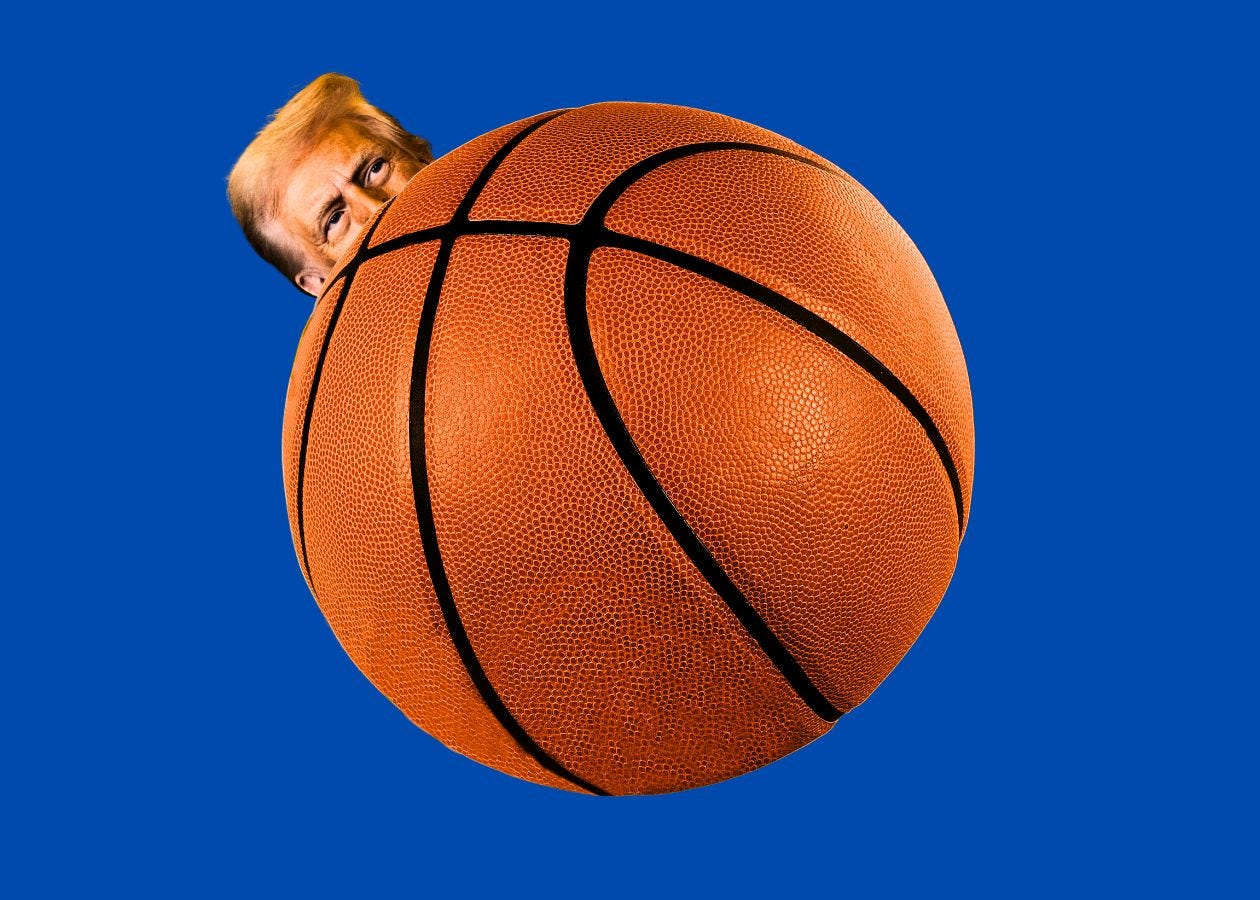
The New York Knicks won their first NBA championship in 53 years last night, beating the San Antonio Spurs and capping off a near-perfect playoff run. Is it any coincidence that their only loss in the Finals was the one game that Donald Trump attended?
To suggest that Trump was responsible for last Monday’s slip-up at Madison Square Garden might be delving a little bit too much into sports astrology. But the president’s appearance certainly brought down the mood.
Sports, like the presidency, can be a unifying force—in brief moments, they collapse Americans of wildly different backgrounds into a singular rooting interest.
Unity is not Donald Trump’s style.
Last Monday night, Trump became the first sitting president to attend an NBA Finals game, seemingly over the objections of an entire city.
That evening, the Knicks didn’t have to just beat the Spurs on the court—they had to overcome the chill that seemed to follow Trump into the arena.
The city felt the difference. Ticket holders were asked to arrive upwards of three hours early to account for security checks. All bags were banned per request of the Secret Service—to the particular dismay of a devoted cohort of Knicks fans who see the orange clutch of Karl-Anthony Towns’s wife as an essential good-luck token.
The beloved watch party outside the Garden—a neighborhood ritual throughout the playoff run—was canceled and displaced to Bryant Park.
Trump arrived at the game via motorcade from a helicopter landing near Wall Street. The president claimed his seat in a bulletproof glass-walled suite flanked by his granddaughter Kai, son-in-law Jared Kushner, and Knicks owner James Dolan, among others. Surveying the nearly 20,000 fans below, armed with a bucket of fries and a Diet Coke bottle, the commander-in-chief had the distinct appearance of a man trying to look at home somewhere he hasn’t been in quite a long time.
When Trump first appeared on the Jumbotron during the national anthem, the Garden erupted. The White House press pool described the reaction as “thunderous,” a cascade of boos that pivoted to roaring cheers only when the camera cut to Knicks Captain Jalen Brunson on the court.
The Knicks lost the game, 115-111. Their 13-game winning streak, the second-longest unbeaten playoff run in NBA history, was over.
Donald Trump grew up in Jamaica, Queens, made his name in Manhattan real estate, and built a persona so synonymous with the city that for a period of years it was difficult to imagine one without the other. Monday night was, in a sense, a sort of homecoming—but it was not a smooth one.
Trump has often found himself spurned in the city of his birth. The loud-mouthed outer-borough upstart was often rejected by Manhattan’s more-refined upper crust. In the 2024 presidential election, Trump received fewer than 839,000 votes in New York City, compared with more than 1.9 million for Kamala Harris. His approval ratings now hover around 35% nationally, nearing the lowest of his political career. The city that made him could not bring itself to vote for him, and that sentiment was audible during Game 3.
Unpopularity alone, though, doesn’t entirely explain what felt so unsettling about Trump’s attendance. It wasn’t just that Trump had shown up to a hostile audience. It was that he was so determined to show up at an event that his predecessors understood it was better for the president to avoid.
Barack Obama understood that distinction. A lifelong basketball fan who even had the White House tennis court converted for basketball, Obama deliberately avoided the NBA Finals while in office. In a recently resurfaced podcast conversation, he explained: the motorcade, the Secret Service, the whole apparatus is such a disruption that rather than enjoying the game, he worried he’d be “making it a less pleasant experience for everybody else.” He stayed home. This instinct, to weigh the cost of one’s own visibility, has historically crossed party lines.
ICYMI: Tune in to the latest episode of the Older/Wiser Podcast:

Trump’s approach, of course, has been notably different. Since returning to the White House in January 2025, he has attended the Super Bowl, the Daytona 500, multiple UFC fights, a FIFA Club World Cup Final, and the US Open—more high-profile sporting appearances than any president before him. Now, whether these appearances are acts of civic participation or performances of it, is a question Monday night did little to resolve.
Madison Square Garden itself was entirely enclosed by a makeshift wall (a wall that Trump actually finished!).
New York adapted as New York does. Mayor Zohran Mamdani, who paid out of his own pocket for a standing-room spot at the game, organized watch parties for his constituents—another pointed contrast with the president’s approach. Sports bars threw their windows open to the street, crowds spilled onto sidewalks, strangers craning their necks at the projected screens. People projected the game onto building walls, and set up makeshift projector sheets in backyards and playgrounds.
That’s how I watched Game 3: outside on a projected image, in a cluster of people I didn’t know. Trump’s arrival had certainly disrupted the city, but the sense of collective investment, the impulse to gather—the “New York” of it all did not falter.
The game was monumental: the Knicks’ last Finals appearance was in 1999 against the very same San Antonio Spurs—a run that ended in defeat for New York.
Now, this was New York’s moment: their team, their night, and it had been complicated, rather visibly, by one man’s desire to be in the room.
Representative Hakeem Jeffries put it plainly on CNN: “Why does Donald Trump always have to ruin a good thing?”
Both the institution of the presidency and the New York Knicks can survive one bad night at the Garden. The Knicks recovered with a historic comeback win on Wednesday culminating in a Game 5 victory in San Antonio.
What’s more disturbing is the erosion of the instinct that kept previous presidents out of the NBA Finals—an understanding that the office is not a personal entitlement to be in any room, but an obligation to each room that the president enters.


Trump is Satan.
That’s why everything he touches dies.
No one can be that ugly smell that bad where a diaper be that evil start wars without a second thought, cheat on women, abuse women, Rob, steel cheat in business I mean, how do you bankrupt a casino right?
And yet people fall to the floor at his feet and kiss his ring, willing to lose their law licenses and go to jail. Willing to fight and kill other people for this nasty human but is he human?
He is just like in that song “Sympathy for the Devil “ by The Rolling Stones.
He is Randolph Flagg from “The Stand” by Stephen King.
It’s possible the antichrist exists and it is Trump.😢
The GOP or his minions and Republicans has followers. It’s a fighting against good versus evil and rich versus poor.
Las Vegas or Colorado?
You have a horrible case of TDS.