


We are pleased to bring you this article from Anders Fogh Rasmussen, former NATO secretary general and prime minister of Denmark. Read on, then join The Next Move on Wednesday, May 27 at 9am ET for our next premium subscriber Zoom call, featuring Prime Minister Rasmussen in conversation with Renew Democracy Initiative Chairman Garry Kasparov.
For more information and to register, click here.
Anders Fogh Rasmussen served as secretary general of NATO from 2009 to 2014 and as prime minister of Denmark from 2001 to 2009. He is the founder of the Alliance of Democracies.
The post–World War II order has ruptured.
An Axis of Autocracies is consolidating, visible on the Ukrainian battlefield through North Korean soldiers and Iranian drones. United States foreign policy has turned erratic, with tariffs at levels not seen since the 1930s. China weaponizes economic dependence to extract political compliance from democracies one at a time, from Australia to Lithuania, South Korea to Canada. Democratic middle powers now face coercion, protectionism and multilateral institutions that can no longer protect them.
Middle powers may appear to face a binary choice: pursue unattainable self-sufficiency or accept a performative sovereignty as satellites of a great power.
This article sets out a third path.
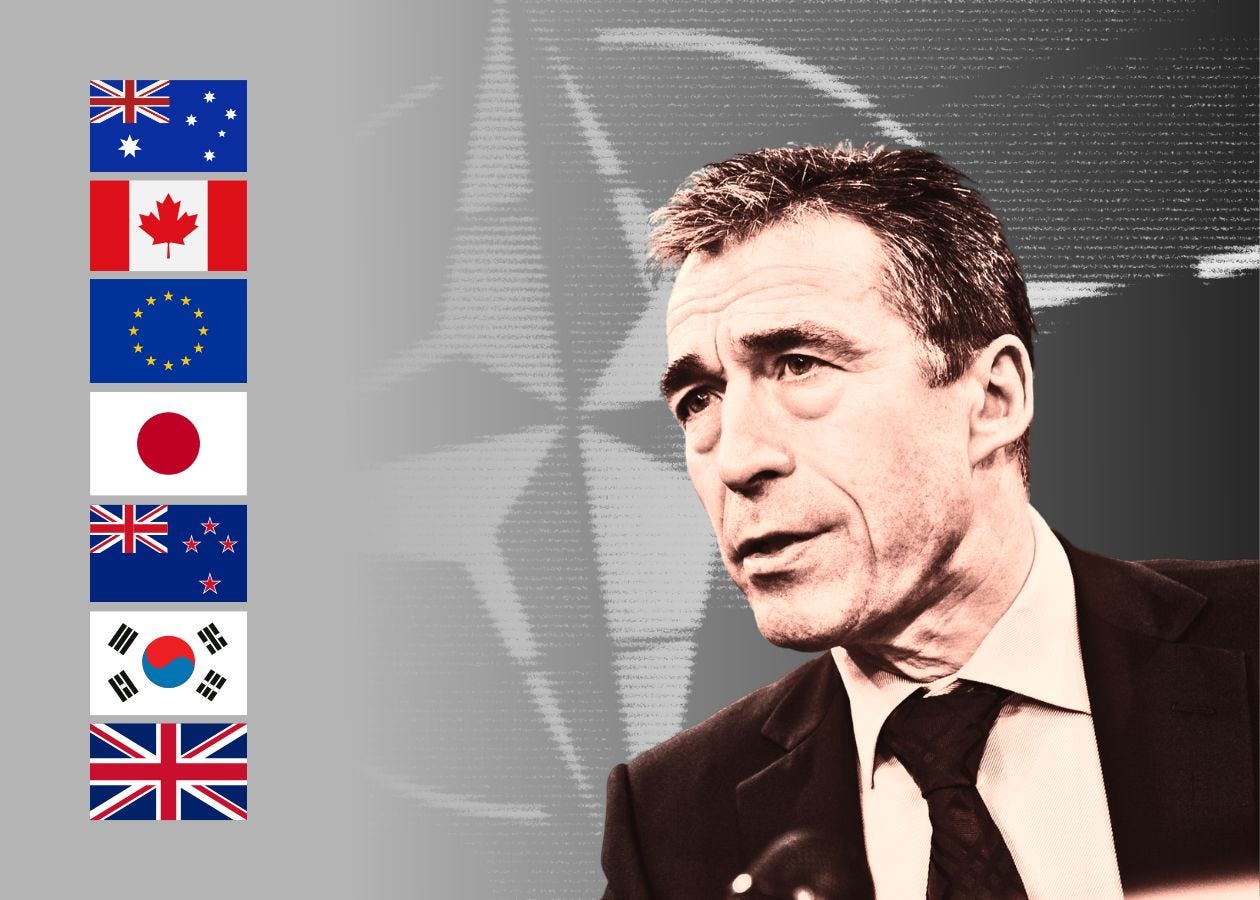
At its center is a Democracies-7—a D7—consisting of Australia, Canada, the European Union, Japan, New Zealand, South Korea and the United Kingdom as founding members. Together they represent roughly $36 trillion USD in combined GDP, around 30% of the global total. They hold the economic weight to deter coercion, even from global hegemons.
The D7 would act as a vanguard, not a boundary, with concentric tiers of Associates and Partners engaging on specific initiatives creating variable geometries. At its outset we identify six areas of potential focus:
A plurilateral trade alliance to keep rules-based open trade alive as WTO reform stalls.
An Economic Article 5 to create a collective front of defence against coercion.
A Democratic Technology Initiative to shape standards, align export controls and invest jointly in AI, quantum and space.
A critical raw materials strategy to break China’s grip on rare earth processing.
A defense pillar, taking inspiration from Ukraine and the Coalition of the Willing.
Coordinated global investment as a credible alternative to China’s Belt and Road.
Governance of the D7 should be light: annual leaders’ summit, super-majority voting, and a lean secretariat to focus on outputs rather than bureaucratic self-aggrandizement. The door should remain open to the United States alongside others who wish to assume the mantle of global democratic leadership.
Democratic multilateralism can be forged through a growing web of bilateral and plurilateral arrangements between democracies, from those countries whose democracy is fully embedded through to emerging and imperfect democracies.
The approach has been demonstrated by the Coalition of the Willing on Ukraine, launched by UK Prime Minister Keir Starmer and French President Emmanuel Macron in March 2025, now encompassing 34 countries (35 including Ukraine). It operates outside of NATO’s consensus structure, which would have been blocked by (Orbán’s) Hungary and potentially others, yet it draws fully on NATO infrastructure, personnel and planning.
The architecture proposed here is designed to function without US participation—it is needed precisely because American leadership has been withdrawn.
But the door must remain open. The United States could participate as an Associate in specific coalitions, or eventually join as a D7 core member, if its political trajectory changes. In the meantime, D7 members will need to manage the tension between building an architecture that can withstand US economic coercion and preserving bilateral relationships with Washington that remain vital on security and other fronts.
On China, D7 members have very different economic exposures and political appetites. South Korea and Japan are deeply integrated into Chinese supply chains. The EU is China’s largest trading partner. Australia has experienced the sharpest deterioration in relations. These differences are real, but they are precisely what variable geometry is designed to accommodate. A coalition of five acting together is still more powerful than any member acting alone.
The premise is simple: those willing to act should be empowered while maintaining interoperability within a broader alliance. That principle can be replicated even in multilateral settings across trade, technology, raw materials, defence and development. What has been missing is a convening force.
The post-war order as we knew it is gone. The institutions that served democracies for 70 years are diminished, co-opted, or actively undermined by the great powers they were designed to constrain.
Nostalgia is understandable—but it will not bring that order back. The architecture proposed for the D7 is ambitious but realistic. It does not require utopian consensus. It requires a critical mass of democracies willing to act together on concrete problems—issue by issue—building trust and institutional capacity as they go.
The Ukraine Coalition of the Willing has demonstrated that this approach works. If democracies can do it for defense, they can do it for trade, investment, technology and critical minerals.
The collective economic, hard and soft power of the world’s democracies remains formidable. What is lacking is the political architecture to convert this competitive advantage into effective collective action.
The window of opportunity is narrow. Every act of unanswered economic coercion normalizes the practice. Every uncoordinated response to protectionism weakens democratic solidarity. The time to act is now, not with a single grand gesture, but with practical steps toward a new way of working together.
This article is adapted from a paper from the Alliance of Democracies. Read the full report here.
Want to continue the conversation with Prime Minister Rasmussen?
Join The Next Move’s premium subscriber community to get access to our exclusive conversation with Anders Fogh Rasmussen and Garry Kasparov, taking place next Wednesday, May 27 at 9am ET.
Already a premium subscriber and want to bring a friend to our next Zoom call?
Consider gifting a premium subscription—the recipient gets all of the same benefits as you, including access to next week’s Zoom call.
The Next Move is a project of the Renew Democracy Initiative. Your support advances RDI’s work, including life-saving humanitarian aid to Ukraine, dissident-led civic education, and shaping the conversation around democracy here on The Next Move.


I love this idea. It's the ultimate irony that by trying to undermine NATO, Europe, and Ukraine, Trump has inadvertently created an environment for rapid innovation. Europe seems to be filling the gap in supporting Ukraine and is coalescing around standing up for itself. The idea of taking the next step, and creating a new alliance from a position of strength, is smart. For those of us in the U.S. who care about bringing our country back to the path of leadership among democracies, a D7 would act as a lighthouse and incentive for future American leaders to get back in the game.
Great article! In this alternate universe unity of the like minded is essential.