



Max Mottola is a communications intern at the Renew Democracy Initiative, which publishes The Next Move. He is a student at the University of Chicago, where he is studying political science and economics.
Hanna Liubakova is a Belarusian journalist and political analyst. She is a nonresident senior fellow for the Atlantic Council’s Eurasia Center. Liubakova was sentenced in absentia to ten years in prison by the Belarusian regime for her journalistic work and is wanted across the Commonwealth of Independent States.
Belarus has frequently been described as the “last dictatorship in Europe.” The country, wedged between Poland, Ukraine, Russia, and the Baltics, doesn’t make the news as often as its neighbors, but it’s the site of an ongoing fight for freedom between an embattled opposition and the three-decade regime of Alyaksandr Lukashenka. The government violently suppressed protests after a disputed election in 2020 and has joined Vladimir Putin as an accomplice in the invasion of Ukraine.
Yet since July 2024, Belarus has released approximately 850 political prisoners, including Maria Kalesnikava, Nobel Peace Prize laureate Ales Bialiatski, and activist Siarhei Tsikhanouski, whose wife, Sviatlana Tsikhanouskaya, ran against Lukashenka in the 2020 election.
The US brokered several prisoner release deals in exchange for sanctions relief on Belavia, Belarus’s national airline, and on potash, a key ingredient in fertilizer. These deals mark a thaw in diplomacy between Belarus and the West after years of isolation.
The prisoner releases present a human rights mirage, obscuring the Belarusian regime’s continued repression. Instead of an opening in the country’s political system, the Lukashenka government has created a revolving door of political persecution, releasing some critics while imprisoning others. Today, human rights groups estimate that over 1,100 opposition figures remain behind bars.
Will Western democracies fall for this ruse? US President Donald Trump, who called Belarusian President Alyaksandr Lukashenka “well respected” and “a powerful leader,” reportedly reached an agreement with the strongman for the release of up to 1,300 prisoners. That was in August 2025. Belarus has still not met its obligations.
To cut through the noise, I spoke with Hanna Liubakova, a Belarusian journalist and political dissident wanted by the regime.
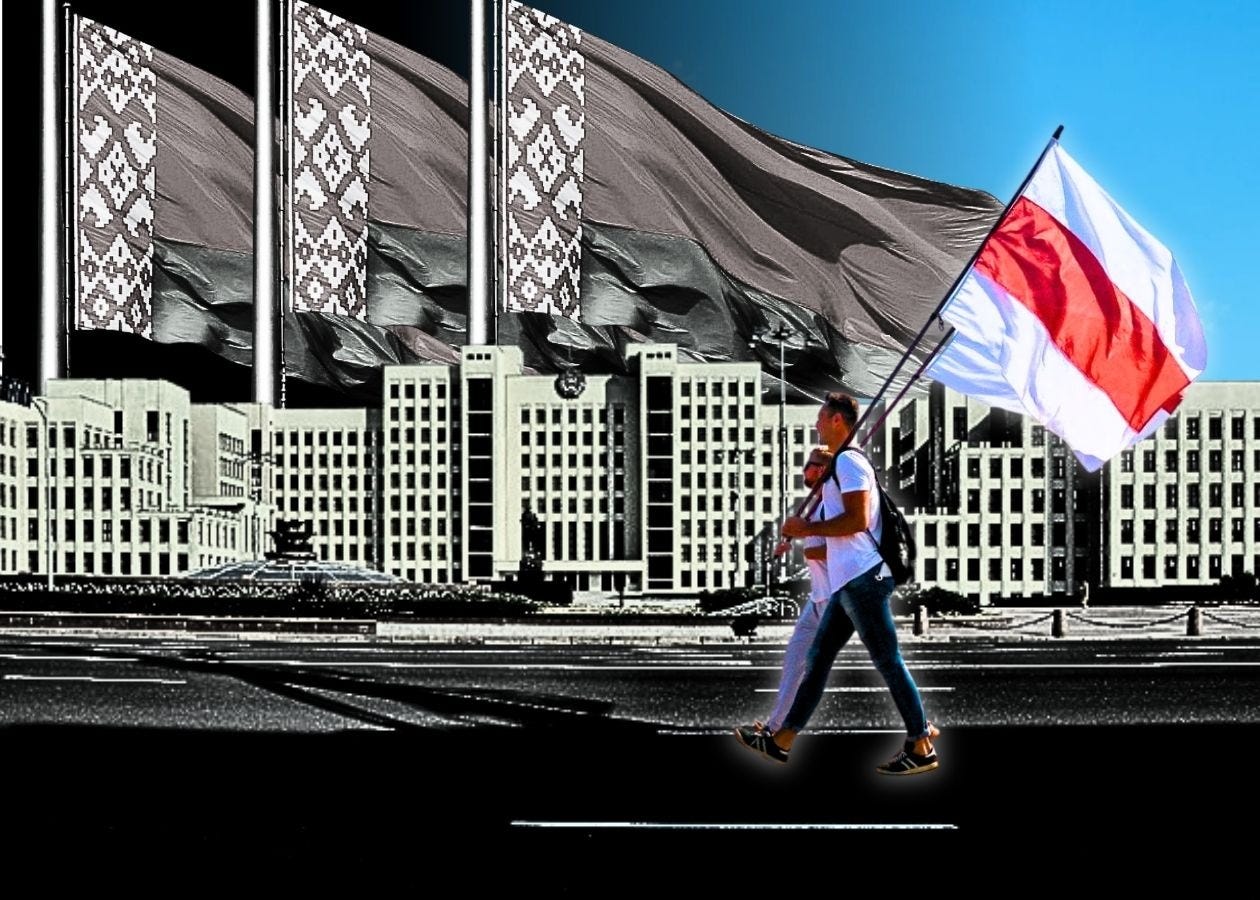
Before we dive into the conversation, a note on language. At the interviewee’s request, the Belarusian President will be referred to by his Belarusian name, Alyaksandr Lukashenka, rather than Alexander Lukashenko, the Russified version more commonly used in Western outlets. This reflects the will of the Belarusian resistance movement, whose members vehemently oppose Lukashenka’s crackdown on the use of the Belarusian language. Belarusian was the sole official language of Belarus when it became independent of the USSR and remained so until 1995, when Lukashenka called a referendum to give the Russian language official status. While Belarusian and Russian are nominally co-equal, the Belarusian language has been largely sidelined in many spheres of daily life, while Lukashenka has criminalized other symbols of Belarusian nationalism. In the same referendum that elevated the Russian language, Lukashenka also revoked the white-red-white Belarusian national flag in favor of a near-exact copy of the flag of the Belarusian Soviet Socialist Republic—only with the communist hammer and sickle removed.
Max Mottola, The Next Move: Belarus has freed thousands of dissidents in exchange for lifted sanctions in a series of deals with the US. Why has Lukashenka opened negotiations with the Trump administration?
Hanna Liubakova: First, it is important to acknowledge the results. The American delegation, including Special Envoy John Coale and State Department representatives, has helped secure the release of hundreds of political prisoners. That is a significant achievement, and it is deeply appreciated by everyone.
As for why Lukashenka has become more open to negotiations with the US, I think there are several factors.
First, the Belarusian regime likely sees the current administration as more pragmatic and transactional, and therefore more open to making deals. Second, there is a history of engagement with the first Trump administration. Before the 2020 Belarusian presidential election, former Secretary of State Mike Pompeo visited Minsk, demonstrating that dialogue between Washington and Minsk was possible. That experience may have made Lukashenka more willing to engage again.
We should also look at the broader context. After the large prisoner exchange between Russia and the West in the summer of 2024, we saw similar discussions begin involving Belarus. At the same time, the regime has had to adapt to changing geopolitical and economic realities. Lukashenka has always sought to balance different centers of power and reduce his isolation when possible.
In many ways, this approach is not new. Throughout his political career, Lukashenka has repeatedly used political prisoners as bargaining chips in exchange for political benefits, sanctions relief, diplomatic engagement, or broader international recognition.
TNM: Do you think that these deals and Trump’s praise boost Lukashenka’s reputation and global standing?
HL: As for whether these contacts legitimize Lukashenka, I think the answer is more complicated.
Of course, many Belarusians are uncomfortable with language that refers to Lukashenka as a “president” or a “well-respected person.” Many of us do not call him president because he has remained in power through repression and electoral fraud.
At the same time, I do not think the primary purpose of such language is to legitimize him. My assumption is that it is part of a broader negotiation strategy aimed at securing the release of political prisoners.
The more important question is whether engagement produces results. So far, it has led to the release of hundreds of people. That is a real and tangible outcome.
At the same time, we should not lose sight of the bigger picture. Political prisoners continue to be arrested, repression continues, and the regime has not fundamentally changed its behavior. Any engagement with Lukashenka should remain focused on concrete results and should not be mistaken for political normalization.
TNM: Lukashenka came in as a virulently anti-Western figure. In neighboring Ukraine, Russian hostility has forced significant cultural, economic, and political realignment, as seen in Kyiv’s efforts to join the EU. Is a rapprochement with the West possible in Belarus with the country constrained by a Putin-friendly regime?
HL: I do not believe that Lukashenka will fundamentally change his ideological position. There is a common myth that he has been “balancing” between the West and Russia as a way of staying in power. In reality, he has also been balancing within his dependence on Russia—using limited engagement with the West primarily as leverage for his deals with Moscow.
Before 2020 and before the waiving of sanctions, Belarus did maintain relatively open relations with the US, the EU, and Ukraine. However, when Lukashenka faced his most serious political crisis during the mass protests in 2020, he turned to Russia for support. Putin provided it at a critical moment for his regime’s survival.
There have been cycles in this relationship: periods of tactical engagement with the West, followed by repression and sanctions, and then renewed reliance on Russia when Lukashenka feels threatened. This pattern has been consistent for decades. The difference now is not the logic itself, but the constraints. Since 2020—and especially since Russia’s full-scale invasion of Ukraine—the regime has far less room to maneuver. Its dependence on Russia has deepened, and its ability to pursue any meaningful balancing strategy has significantly narrowed.
At the same time, Lukashenka’s outreach to countries like China is both an economic necessity and a political attempt to signal that Belarus is not entirely without alternatives, even if those alternatives remain limited. This is also done to improve his position in conversations with Putin.
Ideology also matters. Lukashenka and Putin may not be best friends, but they are allies. The 1999 Union State Treaty was not imposed on Lukashenka. It was a choice that laid the groundwork for deeper long-term integration with Russia.
Given this trajectory, I do not see the current regime voluntarily pivoting toward the EU in any meaningful sense, except in a purely transactional way—if limited engagement helps reduce sanctions or unlock economic benefits. But this is not democratization or liberal reform. After more than 30 years in power, the system is structurally resistant to change. We should not expect a late-stage ideological transformation.
That said, it is important not to overlook Belarusian society. Even under repression, public moods matter. Many Belarusians want their country to be more open, less isolated, and more economically connected to Europe. This creates a form of internal pressure that the regime cannot fully ignore, even if it cannot be expressed politically. The West should keep this societal dimension in mind when assessing Belarus: the regime is constrained not only by Russia, but also by the long-term preferences of its own population.
TNM: How have Lukashenka’s efforts to direct migrants toward Lithuania, Poland, and other Eastern European countries, in what has been dubbed “migrant warfare,” affected European integration?
HL: The migration crisis was clearly orchestrated. The peak came in 2021, when thousands of migrants appeared at the EU’s borders with Belarus. Multiple investigations have documented efforts by organizations linked to the Belarusian regime to bring people into the country and facilitate their movement toward the borders of Lithuania, Poland, and Latvia. Given the level of control exercised by the Belarusian authorities, it is difficult to believe that thousands of people could have been transported to border areas without the regime’s knowledge. The regime was clearly aware of what was happening.
The goal was to pressure and blackmail the EU into easing sanctions and re-engaging with Lukashenka politically. He wanted the EU and Western governments to see him as both a troublemaker and someone they would ultimately need to talk to. He expected phone calls, meetings, and renewed diplomatic engagement as a way out of his international isolation.
There were, in fact, two phone calls from former German Chancellor Angela Merkel. However, she was already preparing to leave office, and the calls did not result in any meaningful political rehabilitation for Lukashenka. While he may have viewed the contacts as a success, the broader strategy failed. The EU did not lift sanctions. On the contrary, it adopted additional sanctions packages in response to the crisis.
That was the correct response. The EU demonstrated that it would not be blackmailed.
The situation has not completely disappeared. Attempts to cross the EU’s eastern borders from Belarus continue, with numbers fluctuating from month to month. What is striking is how closely these flows appear to correspond with political developments. For example, periods of communication between Belarus and Poland have sometimes coincided with a decline in attempted crossings. This suggests a high degree of control over the movement of migrants and the ability to redirect pressure toward different borders when desired.
What makes the situation especially cynical is that human beings are being used as instruments of political pressure. People have suffered, and some have died along the border. Given the regime’s extensive control over the country, I find it difficult to believe that the appearance of migrants was beyond its control.
We also have evidence that organizations connected to the regime promoted Belarus as a transit route to the EU, helped facilitate visas, and encouraged people to travel there under false expectations. In my view, this amounts to state-enabled human trafficking being used as a tool of political coercion.
TNM: Over the years, the West has tried to support pro-democracy opposition figures in Belarus. Does that possibility still remain?
HL: The Belarusian pro-democracy movement was not “created” by the West or built around a pre-selected leader. It emerged from a domestic political crisis in 2020, when a presidential candidate became a focal point for mass protest and was later forced into exile. Since then, Western support has primarily gone to institutions—independent media, civil society, and democratic representation abroad—rather than shaping leadership itself.
For ordinary people in Belarus, the issue is about basic conditions of life: stability, safety, and the ability to travel, earn, and live without fear. In that sense, the political debate is often less about ideology and more about whether the state can deliver normality and predictability.
Since 2020, Sviatlana Tsikhanouskaya has become a central coordinating figure for the democratic movement in exile, recognized internationally and working with a range of political and civil society actors. That role is real, but it exists alongside ongoing internal diversity and disagreement within the broader opposition ecosystem. But what is important is that there is a broad consensus within the Belarusian democratic movement on the end goal: a democratic, independent Belarus with free elections, rule of law, and accountable institutions.
TNM: What are the chances that Russia will try to replace Lukashenka with a more pliant figure?
HL: I don’t think there is anyone in Belarus who is more useful to Russia than Lukashenka. Putin knows who Lukashenka is and how to work with him. Lukashenka maintains control over the economy, the security apparatus, and the political system, and from the Kremlin’s view, he delivers what Russia needs.
I think it’s a myth that we’ve been talking about for decades that Putin is willing to have somebody else. What are the signs of that? Lukashenka meets with Putin more than anyone else and vice versa so there is a connection that exists there. There are no signals that Putin would like to replace him.
Some continue to speculate about Russian pressure on Belarus to send troops into Ukraine. Russia is certainly using Belarusian territory, infrastructure, and military assets to support its war effort. However, there is little evidence that the Kremlin is actively pushing for a large-scale deployment of Belarusian troops to the front.
Both Putin and Lukashenka understand the risks. The Belarusian military lacks recent combat experience and is not configured for sustained offensive operations in Ukraine. More importantly, Belarusian public support for direct participation in the war remains low. Significant combat losses could create domestic tensions inside Belarus.
For that reason, the arrangement that has existed since 2022—Belarus providing territory, logistics, training grounds, and strategic support while avoiding direct combat involvement—has served the interests of both Moscow and Lukashenka. Putin gains access to Belarus without assuming the political costs of Belarusian casualties, while Lukashenka avoids a potentially dangerous domestic backlash.
ICYMI: Tune in to the latest episode of the Older/Wiser Podcast

TNM: You mentioned the Union State earlier. On the political level, this institution has helped create inextricable military and economic ties between Russia and Belarus. However, that doesn’t reflect how the Belarusian population views this partnership. How has popular Belarusian sentiment toward Russia changed since the start of the Ukraine war?
HL: I will refer both to research and to what I hear from people on the ground. There is also solid public data—for example, Chatham House research—that is widely available and easy to check. What that research consistently shows is that an overwhelming majority of Belarusians do not want their country involved in Russia’s war against Ukraine. One widely cited figure is that around 97% of Belarusians oppose participation. And this is not just the opposition or politically active groups—it also includes people who support Lukashenka or work within the state system. In that sense, this really is not “their war.”
For some Russians, their country is fighting and they may feel patriotic. For people inside Belarus, that’s certainly not the case. That doesn’t mean everyone fully rejects Russia’s narrative—propaganda does have an effect, and some people don’t connect all the dots. But they are a minority.
Despite years of propaganda—especially since 2022, but even since the annexation of Crimea and the Donbas war—that did not change the mentality of Belarusians. They don’t want to go and fight for Russia. We can certainly say that there is a clear understanding that Belarus is and should remain an independent country. Only a very small minority, usually a few percent depending on a survey, would say they would fully support joining Russia.
Where it gets more complicated is what people want instead. A lot of Belarusians will say something like: “We just want to have good relations with everyone.” With Russia, with the EU—ideally both. Of course, in reality that’s not really possible in today’s geopolitical situation, but it reflects something important: a desire to avoid confrontation, isolation, and war.
There is also a kind of realism in how people think about the West. Even if Belarus changed tomorrow, most people understand that EU membership is not something that would happen quickly. So expectations are shaped more by caution than by big political visions.
One more thing you notice in everyday life is how interactions with Russians in Belarus have changed. There are more Russian visitors now, and while Belarusians are generally open and welcoming, it sometimes creates tension in small, everyday ways—around language, behavior, even things like currency or assumptions about the country. For some people, it reinforces the feeling that “we are not the same.” Belarusians increasingly see themselves as separate from Russia. And despite years and decades of propaganda, the core position is consistent: they do not want to be part of this war, and they want Belarus to remain independent.
TNM: There have been recent reports of thousands of Russian troops closing in on or stationed in Belarus. To what extent does this pose the threat of a Russian invasion?
HL: There are Russian troops in Belarus—at least around 2,000, based on current assessments. Could Russia try to occupy Belarus? In theory, yes. But what would that achieve?
Occupying a country that does not want to be part of Russia would be extremely difficult. Russia has not succeeded in doing that in Ukraine. It annexed Crimea, but it has never managed to occupy an entire sovereign country. I do not see how it could do so in Belarus.
Belarus is not a divided country. There is no significant constituency arguing that Belarus should join Russia. Most Belarusians speak Russian, but they also want Belarus to remain an independent state. That distinction is important.
More importantly, Putin does not need to occupy Belarus. He already has a loyal partner in Lukashenka, who maintains control over the country. From the Kremlin’s perspective, Belarus already serves many of Russia’s strategic purposes. It functions as a military staging ground from which Russian forces can threaten or attack Ukraine. It has also been used to help destabilize neighboring EU and NATO countries, whether through the manufactured migration crisis or other forms of hybrid pressure, including incidents involving Lithuanian airspace.
An outright occupation would likely provoke resistance inside Belarus. I am not necessarily referring to military resistance—the Belarusian Army has limited combat-ready capabilities—but other forms of resistance would almost certainly emerge. I do not believe Belarusians would accept such a move quietly. That is why I do not see a Russian occupation as the most likely scenario.
That said, there are deeply concerning developments that should not be overlooked. One is the announced deployment of Russian nuclear weapons on Belarusian territory. This increases Belarus’s vulnerability by making it a potential target in the event of a broader conflict involving NATO or Ukraine.
It also raises a longer-term sovereignty issue. If Russia establishes a permanent nuclear presence in Belarus, removing it would be extraordinarily difficult, even if Belarus were to become democratic and fully independent in the future.
Another example is the planned deployment of Oreshnik missiles in Belarus. These developments demonstrate that Russia does not need to formally occupy Belarus in order to erode its sovereignty. Military integration, dependence in foreign policy, economic ties, and security cooperation already give Moscow substantial influence over the country.
In other words, the greatest threat to Belarusian sovereignty is not necessarily a Russian invasion. It is the gradual expansion of Russian control without the need for formal occupation.
TNM: How can the international community support the pro-democracy movement in Belarus?
HL: Belarus remains under severe repression. Hundreds of political prisoners are still behind bars, independent media have been forced into exile, and civil society organizations have been dismantled inside the country.
At the same time, democratic forces have not disappeared. Independent media continue to reach millions of Belarusians every month, civil society remains active despite enormous pressure, and many Belarusians continue to support democratic change. The democratic movement survives, even under some of the harshest conditions in Europe.
I would highlight three priorities of what can be done to help Belarusians.
First, maintain pressure on the regime. The Belarusian authorities respond to pressure, not goodwill gestures. We can see this today in the ongoing releases of political prisoners, which have often been linked to international pressure and negotiations. Sanctions are not an end in themselves, but they remain an important tool. They should be used strategically and should not be lifted prematurely. While prisoner releases are welcome, repression continues. New arrests are taking place, and the number of newly recognized political prisoners remains comparable to the number of those being released through US mediation. We should keep this in mind.
Second, support independent media and civil society. These organizations continue to reach people inside Belarus and provide access to information that the regime tries to suppress. The demand for independent information remains strong. Yet many Belarusian media outlets and civil society groups are facing growing financial difficulties. The reduction of international assistance and shifting donor priorities have created serious challenges at a time when the need for support is greater than ever. Sustained funding is essential if these organizations are to continue their work.
Third, continue accountability efforts. There are ongoing initiatives to bring Lukashenka and other officials to justice for international crimes. These include investigations related to transnational repression, the forced displacement of people (the ICC launched an investigation), Belarus’s role in Russia’s war against Ukraine, and the transfer of Ukrainian children to Belarusian territory. Democratic countries should continue supporting these efforts.
Accountability matters not only because justice is important, but because it sends a clear message that those responsible for serious abuses will eventually face consequences. If the international community remains focused on these three priorities—pressure, support for democratic institutions, and accountability—it can help contribute to Belarus’s democratic future.
The Renew Democracy Initiative, publisher of The Next Move, is pleased to join the Institute for the Study of Modern Authoritarianism, publisher of The UnPopulist, as a media partner for the third annual Liberalism for the 21st Century Conference—LibCon 2026—in Washington, DC on July 16 and 17. Click here for more information and to register. Coinciding with America’s 250th anniversary, the theme of the conference is the Reconstruction Agenda. The conference will assess the damage that authoritarian and demagogic politics have caused to the country’s liberal institutions and propose a path forward to rebuild accountability and confidence in the rule of law. The conference features a stellar lineup, including RDI Vice Chair Linda Chavez, along with Francis Fukuyama, Anne Applebaum, David French, Hong Kong dissident Nathan Law and many more. We’ll be there and so should you.
More from The Next Move:
‘Don’t Forget Belarus’: A Political Prisoner’s Wife Speaks Out

Natallia Pinchuk calls her husband, Nobel peace laureate Ales Bialiatski, an ‘extraordinary individual’ and shares hope for her nation: ‘We will definitely be free.’
A Cynical Game: How Belarus’s Pro-Russia Dictator Plays the West

Lukashenko is getting good press and sanctions relief. A Belarusian politician explains how the dictator does it—and how the Free World can stop losing.

