


Garry Kasparov is the chairman of the Renew Democracy Initiative, which publishes The Next Move.
Coming out of yesterday’s primary races, there’s one Democratic candidate I’m particularly concerned about. His name is Adam Hamawy.
In New Jersey’s twelfth district, Adam Hamawy is poised to finish with just under 30% of the vote, topping a field of 13—yes, 13!—candidates who filed to run after the incumbent Democratic representative announced her retirement.
Hamawy’s most alarming attribute is his affiliation with the late Omar Abdel-Rahman, the so-called “Blind Sheikh” convicted for his role in a series of terrorist plots following an investigation into the 1993 World Trade Center Bombing.
Hamawy stood by Rahman when the latter proclaimed his innocence in the aftermath of the February ‘93 attack, and later served as a defense witness for the infamous Sheikh.
Why does this matter? As a moral question, if Democrats are going to condemn Republicans for instigating chaos and political violence, they ought to be consistent. There would be much justified outrage if a Republican candidate was found to have been involved in January 6—OK, unsurprisingly, several Republican candidates actually have been insurrectionists, and I think most readers of The Next Move recognize this as a bad thing.
You might say Hamawy was young, misguided. Yet, of his association with Rahman, Hamawy recently told one journalist: “I don’t know how I could have regret.”
One need only look at Hamawy’s closing rally to see how little he has changed since the heady days of the early 1990s. The rally headliners included pro-China “Orthodox Jews are inbred” streamer Hasan Piker and Chris Rabb, a Pennsylvania congressional nominee who shared a social media post describing the massacre of Jews at Bondi Beach, Australia as a Zionist false flag. (Rabb’s claim that the post was the work of a rogue staffer doesn’t pass the smell test.)

This is not someone who has seriously reckoned with extremism. You can tell a lot about a person by the company that they keep, and it is fair game to question Hamawy’s judgment and worldview accordingly.
Now, perhaps you don’t find the moral case compelling. So hear this strategic consideration: Far-left candidates benefit Trump and MAGA by giving them convenient foils to distract from the administration’s many transgressions.
Take the example of Maureen Galindo, a Texas congressional primary candidate who called for imprisoning and castrating “American Zionists”. There’s evidence that Galindo was actually backed, in part, by Republicans.
In another packed New Jersey primary field, AIPAC helped defeat my friend Tom Malinowski, a moderate liberal Democrat, opening the door for a leftist candidate to win. That looks like an own goal for the pro-Israel lobby—but since AIPAC has been captured by the MAGA right, it actually suits their objectives quite nicely, advancing a politically convenient image of Democrats as a party of Jew-baiting far-left extremists. The DSA is the best fundraiser for MAGA, and MAGA is the best fundraiser for the DSA.
Hamawy won in a deep-blue district and is likely to win the general election in November. That’s all well and good for Hamawy, but it doesn’t bode well for mainline Democrats in red or purple areas fighting to flip Congress—candidates like James Talarico in Texas, Alex Vindman in Florida, and any number of contenders in competitive House races.
However, it bears repeating that Hamawy was one of 13 candidates. The far-left is most successful when it can eke out a quarter to a third of the vote in a crowded field. We saw this in the special election for New Jersey’s eleventh district earlier this year, and we saw it in NJ-12 last night.
One of the most infuriating images out of NJ-12 shows three candidates—who earned 9%, 3%, and 5% of the vote, respectively—standing arm in arm on election day. Their smiles say “I just hope everyone has fun!” as if primary elections are a game and not a serious debate over the future direction of the party.
Any one of these candidates could have dropped out earlier and thrown their support behind someone representing a more mainstream liberalism. Instead, they ran to the end, like lemmings off the side of a cliff. For what? Vanity? Sunk-cost fallacy?
There’s an interesting parallel to the path that Republicans took in 2016 that’s worth noting here. Donald Trump waded into a packed primary and scored his first victory with just 35% of the vote, facing off against nine other candidates. The rest of the Republican field failed to coalesce around a single anti-Trump leader, and one by one they fell—and fell in line.
To anyone who wants to call me a sore loser, let me be clear: both these far-left candidates and Donald Trump won fair and square. But they also benefited from critical strategic failures on the part of their rivals.
It’s not all doom and gloom, of course. In New Jersey’s seventh congressional district, moderate Democrat Rebecca Bennett scored a convincing win with nearly half the vote in a four-person race. She has a chance to flip the district from red to blue—that is, assuming Hamawy’s reputation in neighboring NJ-12 doesn’t scare swing voters away from the Democratic Party.
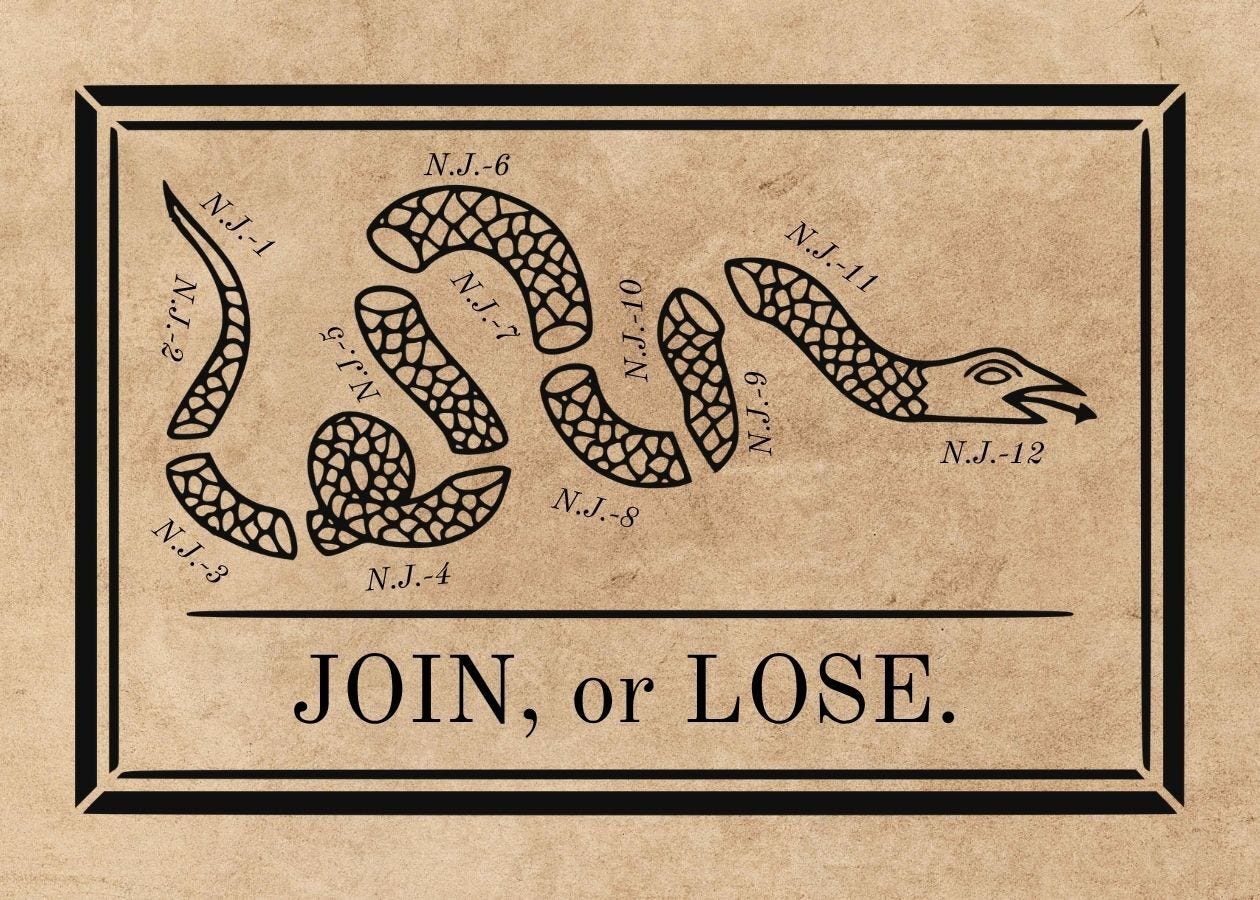
For now, the lesson for American liberals and moderates is clear: join or lose. Extremists of all stripes ride to victory through the divisions in your ranks.
The Renew Democracy Initiative, publisher of The Next Move, is pleased to join the Institute for the Study of Modern Authoritarianism, publisher of The UnPopulist, as a media partner for the third annual Liberalism for the 21st Century Conference—LibCon 2026—in Washington, DC on July 16 and 17. Click here for more information and to register. Coinciding with America’s 250th anniversary, the theme of the conference is the Reconstruction Agenda. The conference will assess the damage that authoritarian and demagogic politics have caused to the country’s liberal institutions and propose a path forward to rebuild accountability and confidence in the rule of law. The conference features a stellar lineup, including RDI Vice Chair Linda Chavez, along with Anne Applebaum, Francis Fukuyama, David French, Hong Kong dissident Nathan Law and many more. We’ll be there and so should you.
More from The Next Move:
New Jersey's Next Governor and the Death of Leftism

Think this is a ridiculous headline? You’re right!
Trump’s Mamdani Math and the Mikie Sherrill Alternative

A tale of two elections: NYC and New Jersey.
To STOP the lurch left or right preferential voting is essential- Do it NOW- don’t waste your vote, make it count so that if your first preference vote fails your second preference vote will not… ranked choice voting enhances democracy
We are operating under a fallacy that we should play by a set of rules. I’m not saying Hamawy isn’t a problem on his own, I’m simply saying the rules have completely changed. If democrats want to actually win back the House/Senate, the Presidency, change the makeup of the Supreme Court and stop the slide to authoritarianism, we have to think differently. Republicans run on a single issue, they are laser focused on one enemy, Democrats, they blame Schumer, Pelosi, Biden and Obama. They have done exceptionally well staying on message and executing that strategy, they control all branches of the government. Democrats on the other hand tend to create narratives that sow divisions amongst themselves, that lack in focus and it has shown and proven to be utterly flawed and unwinnable.