


A note from Garry Kasparov: Perhaps you recently canceled a subscription to an oligarch-owned newspaper. Might I humbly suggest that you put that money toward supporting mission-driven media like The Next Move? I don’t receive a cent from your subscription fees—everything goes to supporting the work of The Next Move’s parent organization, the Renew Democracy Initiative. RDI is bringing political dissidents to tell their stories to students, business leaders, and public officials. Delivering life-saving humanitarian aid to frontline communities in Ukraine. And, of course, driving the conversation here on Substack. To help make the decision easier, we’re offering 30% off an annual subscription, now through March 4.
I spent the last week in Munich for the city’s famous security conference. Every February since 1963, dignitaries from around the world have descended on the Bavarian capital for a who’s who of heads of state, diplomats, lawmakers, generals, and journalists.
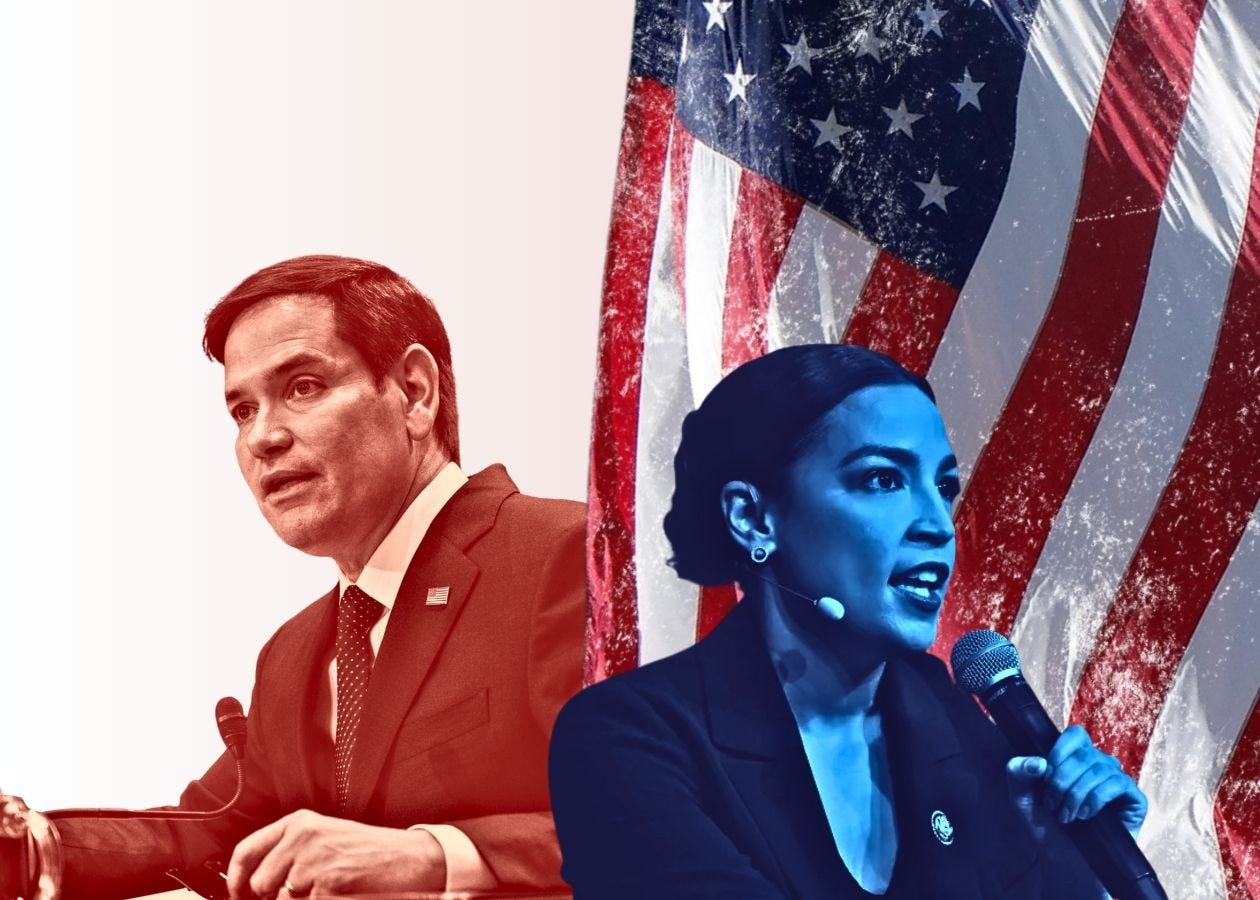
This year’s forum was graced by two American guests whose words about their nation’s global role generated a lot of buzz. I’m talking about US Secretary of State Marco Rubio and Representative Alexandria Ocasio-Cortez. It’s important to take a close look at what both said because there is a distinct possibility that each will be seeking their respective party’s nomination for president in just two years.
First, Rubio.
Marco Rubio addressed the assembled dignitaries with a speech that can be best described as putting lipstick on Trumpism. It’s still Trumpism.
Rubio began with his boss’s typical grievance politics, complaining about how the US has been taken advantage of. He leaned into America’s Western tradition—which could have been a good thing. The West gets a lot right and we shouldn’t shrink from saying so! Except Rubio wasn’t talking about the democratic Western tradition of the Enlightenment. It was the exclusionary tradition of blood and soil. His was a backward-looking, ahistorical narrative. Rubio even said that the West has been “contracting” since 1945, as if the centuries of war and absolutism before the creation of NATO represented the continent’s glory days.
And actions speak louder than words. Where Rubio got things sort of right (such as in suggesting that European allies invest more in their own defense), his statements clashed with the reality of Trump’s actions (undermining European security). As a US senator, Rubio signed a letter raising the alarm about how “democracy in Hungary has significantly eroded.” More pretty prose. Yet, right after his Munich address, the secretary of state jetted off to Budapest to deliver a campaign speech for Viktor Orbán, the most pro-Putin leader in Europe. Stumping for a tiny Central European country’s corrupt leader! Such are the priorities of America’s “top diplomat.”
Meanwhile, Ukraine received scant mention—a footnote in Munich and, and a subject that Rubio failed to address at all in Budapest. This was no oversight: it is American policy under Trump to assist Russia’s efforts to destroy Ukraine.
Next, there’s Alexandria Ocasio-Cortez. The congresswoman joined a couple of panel discussions alongside other officials. If this was supposed to be her foreign policy debut, it was a bit of a dud. AOC cycled through her usual made-for-social media soundbites about domestic socio-economic issues. She stumbled through non-answers when confronted with thorny foreign policy questions like a Chinese attack on Taiwan or the possibility of strikes on Iran.
The New York representative fell back on America’s faults and limitations as a crutch. If Rubio is too proud of the West’s imperial heritage, AOC has no pride in the good that America and its allies have contributed to the world. Governor Gretchen Whitmer spoke about the US role as the arsenal of democracy in World War II. Is AOC interested in that history, or is she judging her own country through a narrow ideological lens?
More than anything, AOC’s remarks illustrated the absence of a positive answer to Trump and Trumpism. AOC is against Trump. Against authoritarians (but unsupportive of the tough action needed to confront them). Against the oligarchs. Fine. What is she for? As one of the congresswoman’s co-panelists, European Parliament Member Manfred Weber, observed, the key “to win against populism is to give proper answers [to] their concerns.”
Is it hypocritical to criticize someone for criticizing things? It brings to mind a Monty Python quote: “I think all right-thinking people in this country are sick and tired of being told that ordinary, decent people are fed up in this country with being sick and tired. I’m certainly not! And I’m sick and tired of being told that I am.”
So you’ve heard enough about me being sick and tired here. In fairness to Rubio and AOC, it’s easy to wag your finger—far harder to offer an alternative. So while I could tear into their remarks more, I will instead take my best stab at what a real American leader might have said at Munich. A healthy dose of Western democratic pride, with an appropriate side of self-reflection (not self-flagellation). A call to collective action.
Here goes.
Imagine an American leader saying the following in Munich:
Friends, let’s salute the greatest invention in human history—an innovation with roots on both sides of the Atlantic: liberal democracy.
In 1992, many saw Francis Fukuyama’s The End of History and never read past the title. Fukuyama was not arguing that history was over, but that in liberal democracy, humanity had found the best and final form of government.
It was a bold declaration—and he was right.
What other invention has that kind of longevity? The ability to choose our leaders—one person, one vote, the individual as the master of their destiny. Name a better system. I don’t think you can.
Even our enemies know that democracy is a hot commodity. Vladimir Putin behaves like a tsar, but styles himself a “president.” He could wear a crown, but he instead puts on the theater of sham elections. That isn’t an accident. Dictators know the power that comes from the very word ‘democracy.’
Liberal democracy began as a European tradition. The European Enlightenment was the blueprint for the American Republic. It is the connective tissue of the Transatlantic relationship.
But democracy is not exclusive to Europe. It belongs to all people. After World War II, the United States helped to rebuild Japan as a model democracy. Today, the people of Taiwan and South Korea carry the banner of freedom on the other side of the world.
For the better part of a century, the democratic world enjoyed unprecedented peace and prosperity. American leadership put longtime enemies like France and Germany on the same side, to the benefit of all.
More from The Next Move:

Eighty years after the last titanic conflict between freedom and fascism, and nearly forty years after the fall of communism, democracy is again challenged. Autocrats and their imitators abuse our openness. Deliberation and debate are the hallmarks of a free society, but indecision and excessive self-doubt are a dictator’s opportunities. Weak leadership and poor results make voters curious about authoritarian alternatives.
This is how Russia was able to invade democratic Ukraine in 2014, expanding its assault in 2022. Some—including my own predecessors and well-meaning friends in this room—failed to give Ukraine everything it needed to defeat Russia. They heard the warnings of escalation. They desperately wanted to avoid the smear of “warmonger.”
Without minimizing Ukraine’s immense sacrifice, the Russian invasion is relatively small in world historical terms—but a dictator never stops when he is appeased. Europe learned that lesson the hard way after the old Allies made disastrous concessions to Adolf Hitler in this very city in 1938. The point of supporting Ukrainian victory, of fortifying Taiwan, of standing tall now, is to prevent an exponentially more devastating war later.
Ukraine can still win. It does not have to fight alone.
This is Europe’s opportunity to unlock its full potential. Since 1945, American leadership in the realm of international security allowed the countries represented here to thrive. Now, every nation must step up its commitment to our collective security. Let me be clear: We are not leaving you behind, we are calling upon you to stand beside us as equals. To contribute all that is needed to Ukraine’s cause, and to your own defense.
That also means revisiting our international institutions. Cold War realities forced compromises that elevated dictators and aggressors at global forums. We lent despots the UN’s veneer of baby blue legitimacy. Yes, we will keep an open line of communication to any world leader, but it is not our job to do PR for autocrats. If Russia, China, and their ilk use the United Nations to burnish their reputations, then we must build something new: a League of Democracies, as proposed by the late Senator John McCain, to draw a sharp line between good and evil and to tell our shared, democratic story on our own terms.
Friends, we associate liberal democracy with the end of history because it is an accomplishment worth celebrating for the rest of history. And it is our shared responsibility to protect it today and always.
That’s what a real American leader could say.
Of course, I’m not American—but most of you are—and I want to know what you think of the discourse in Munich—of Rubio, and of AOC. I’ll be reading your comments closely—and I look forward to continuing the conversation on Wednesday, March 4 when we hold our next premium subscriber call, featuring a discussion on a half-century of American foreign policy with Ed Luce, US editor of the Financial Times and author of Zbig: The Life and Times of Zbigniew Brzezinski, America’s Great Power Prophet.
More from The Next Move:
How Our Leaders Stopped Leading

A new podcast. An older, wiser perspective. For our first episode, we follow the road to Trumpism from inside the White House.
Board of Peace, Global Grift?

The US offers dictators a new opportunity to launder their reputations.

This would be a terrific speech.
"Democracy is not exclusive to Europe. It belongs to all people." And this: "Today, the people of Taiwan and South Korea carry the banner of freedom on the other side of the world."
Thanks for keeping your eye on the prize: preserving democracy and fighting authoritarianism.
So Marco Rubio spoke about blood and soil in Munich? Has he no knowledge of history or is he trying to lay the groundwork for Hitler 2.0?
To answer your question, from what I saw of AOC at the conference, she excelled in expressing herself clearly, despite having difficulty making up answers to gotcha foreign policy questions about which she knows little or nothing. She's interested in social democracy in Europe and, of course, in the United States where it's under daily extreme assault by Trumpian know-nothings. (correction: they do know about money, not earning it but squeezing it out of individuals and corporations that have it in abundance).
Putting aside foreign policy questions about which she knows little or nothing, AOC does have a fine understanding of what it means to not be a millionaire, much less a billionaire, in a society that is being speedily re-engineered on a racist white supremacy basis to exclude everyone else. Hence her natural affinity for the victims of Russia's imperialistic invasion of Ukraine.
And AOC is far more genuine than Marco, and that does come across to anyone who cares to listen.