


Paul Gross is a writer on Israeli and global politics, based in Jerusalem. He has been published in outlets in Israel, the US, and the UK. He is the author of the recently published book: To Be a Free People in Our Land: Zionism, Liberal Democracy, and Israel’s Hinge Election.
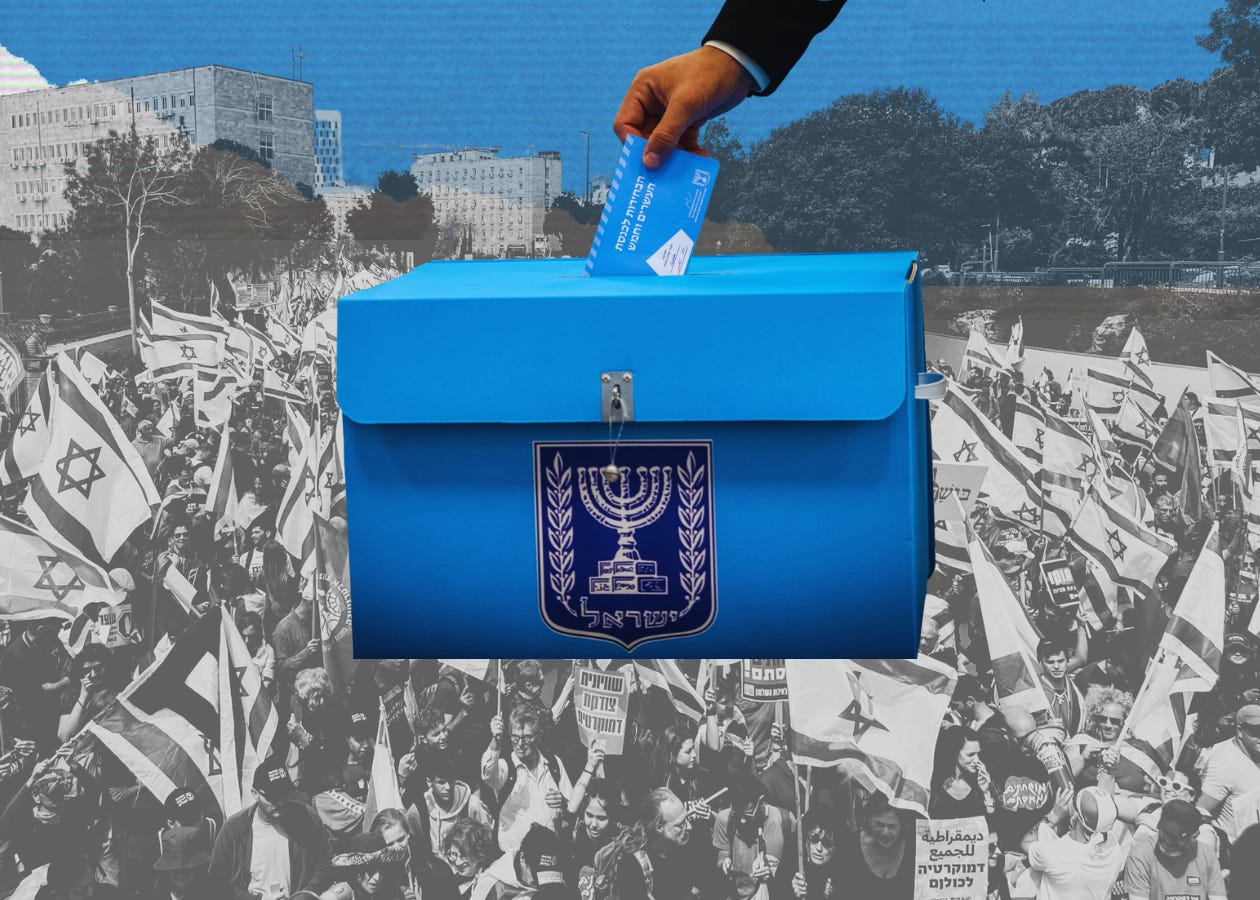
Israelis go to the polls on October 27—one month from today—with their country’s future as a liberal democracy at stake. That is not hyperbole, any more than it would have been if a Hungarian had written those words ahead of the election that brought Viktor Orbán’s Fidesz party back to power in 2010.
When Orbán declared Hungary an “illiberal democracy” in 2014, he offered a template that other populist leaders would study closely: pack the courts with loyalists, neutralize the election commission, and above all, capture the media.
I moved to Israel nearly two decades ago. Watching Israeli politics in that time, especially over the past few years, it is hard not to see Benjamin Netanyahu’s Likud party very consciously working from the same playbook—and not only because of Netanyahu’s oft-demonstrated bromance with the former Hungarian prime minister. One Orbán ally remarked that the two men “belong to the same political family.” In 2023, a member of Poland’s own populist government (itself consciously aping Orbán’s) confirmed that Israel’s new administration had consulted Warsaw on how to “reform” the judiciary.
And that judicial “reform” (the government’s preferred parlance) was this Israeli coalition’s opening act, announced a couple of weeks after Netanyahu had successfully brought the necessary coalition of parties together following the country’s last national election in November 2022.
Much like the Republican Party in the US, Netanyahu’s Likud was once a mainstream center-right party; as with America’s Republicans, it’s now committed to an illiberal agenda.
Alongside his own Likud, Netanyahu invited in far-right religious nationalists with an explicit disregard for the rule of law, bent on expanding and solidifying the Jewish presence in the West Bank; and ultra-Orthodox parties with a narrow sectarian agenda of ensuring public funding for their educational institutions and keeping their community exempt from military service.
All the parties’ varied ambitions required that Israel’s powerful Supreme Court be effectively neutered, and so all were united in their desire to “reform” the judiciary in such a way that it would be effectively powerless to check or balance the executive.
The comparison with Hungary does break down in one crucial respect. Hungary’s illiberal transition proceeded for over a decade with only modest domestic resistance; it took the exhaustion of the public with flagrant corruption and a collapsing economy to finally topple Orbán this year.
Israel’s experience has been the opposite. When Justice Minister Yariv Levin unveiled the judicial overhaul, it triggered nine months of sustained mass protest—hundreds of thousands of Israelis, week after week, joined by hi-tech leaders, air force pilots, and even a cabinet minister who was fired and then reinstated after his warning was vindicated.
Polish and Hungarian scholars who came to witness the protests—and whom I interviewed—declared Israeli civil society as a model for their own countries, where a spontaneous civic uprising for liberal democracy failed to materialize.
Israel’s civic resistance drew its language and symbolism not from abstract liberal theory but from the country’s own Declaration of Independence. In the absence of a written constitution, the Declaration of Independence has functioned as a statement of the Israeli founders’ intent. Though it has no formal status in Israeli law, it has nevertheless been invoked by Israel’s Supreme Court as evidence that Israel was established as a state adhering to the fundamentals of liberal democracy, such as freedom of the press.
That founding text brings us to a signpost of what was to come, five years before the 2023 attempted overhaul.
ICYMI: Tune in to the latest episode of the Older/Wiser Podcast

In 2018, Israel’s parliament, the Knesset, passed the Nation-State Law. Pitched by its architects as the preamble to a future constitution, the Nation-State Law—a Basic Law with quasi-constitutional status—was intended to be an authoritative statement of “what the State of Israel is,” effectively superseding the Declaration.
The “what” outlined by the new law is the nation-state of the Jewish people, but without any qualifying language alluding to democracy or equal rights for all citizens—including non-Jews. The Nation-State Law further demoted Arabic from an official language to a language with “special status”—an insult to Israel’s Arab minority, and especially to the Arabic-speaking Druze who send their children to serve in the Israeli military.
What is so revealing about its authors’ agenda is not primarily its legal substance, which was modest, but what it omitted. An alternative draft had been proposed that explicitly folded in the Declaration’s language on equality and rights “irrespective of religion, race or gender.” It was rejected. Then-Justice Minister Ayelet Shaked declared that “Zionism will not continue to bend its neck to a system of individual rights,” while the principal promoter of the Nation-State Law, Yariv Levin (the same figure who would later lead the judicial overhaul), boasted of having kept the word “equality” out of the final text altogether. The Nation-State Law was the ideological rehearsal for the institutional assault to follow.
(The Knesset member who had proposed the draft incorporating the Declaration’s commitment to equal rights was not a member of the left-wing opposition, but the veteran Likudnik Benny Begin, son of the first Likud prime minister, Menachem Begin. His father self-defined as a “liberal-nationalist” and was a lifelong believer in a strong judiciary, empowered to guard against tyranny of the majority—an indication of just how far today’s illiberal Likud has traveled from its roots.)
To be clear, criticism of Israel’s Supreme Court and calls for its reform are entirely legitimate, and have historically come from both left and right. Israel’s system genuinely is unusual: as stated, no written constitution; a legislature with almost no independence from the executive; and a party-list system that leaves individual Knesset members almost entirely beholden to their party leader rather than to voters.
The Court has de facto stepped into the breach as the principal check on executive power, leaning on a Basic Law passed in the early nineties, intending to protect “Human Dignity and Liberty”. But there is a crucial distinction between narrowing judicial power and dismantling it; or between rebalancing a system with a too-powerful judiciary and replacing it with an all-powerful executive.
Every one of the 2023 “reform” proposals—replacing apolitical legal advisors with government loyalists, an override clause requiring only a bare 61-seat majority in the 120-seat Knesset, immunizing Basic Laws from review while leaving them just as easy to pass as ordinary legislation—removed an existing check without adding a new one.
A government genuinely committed to liberal democracy would approach reform differently. Ideally, Israel would finally complete the constitution its own Declaration promised in 1948, entrenching rights and institutional limits beyond the reach of any parliamentary majority. Short of that, restraining the Court’s powers could be defensible, but only as part of a package that strengthens other checks in tandem, not as a unilateral transfer of unchecked power to the executive.
A serious, comprehensive Israeli reform could include: a second parliamentary chamber the government does not automatically control with a majority; and an electoral system that gives individual members of parliament independence from party leadership and genuine accountability to voters.
If a written constitution proves impossible, reform might focus on changes to how Basic Laws are passed and amended in the Knesset—and only then, measured restrictions on judicial power. Reform without those counterweights is not reform at all. It is simply the road to an Orbánist regime, paved with the same intentions.
Israel’s patriotic protest movement, inspired by the Zionist dream of a Jewish and democratic state, understood very well that the government’s plans were a betrayal of the country’s founding values. This looming election will tell us whether a majority of the country shares that appreciation of what’s at stake.


