



Aaron Lea and Boruch Taskin are analysts and essayists working at the intersection of geopolitics and political economy. They have published in The Moscow Times, Kasparov.org, La Razón, desk.russie, and other outlets. Their book, “Special Operation Donald Trump: The Machinery of Democracy’s Replacement,” is forthcoming in 2026.
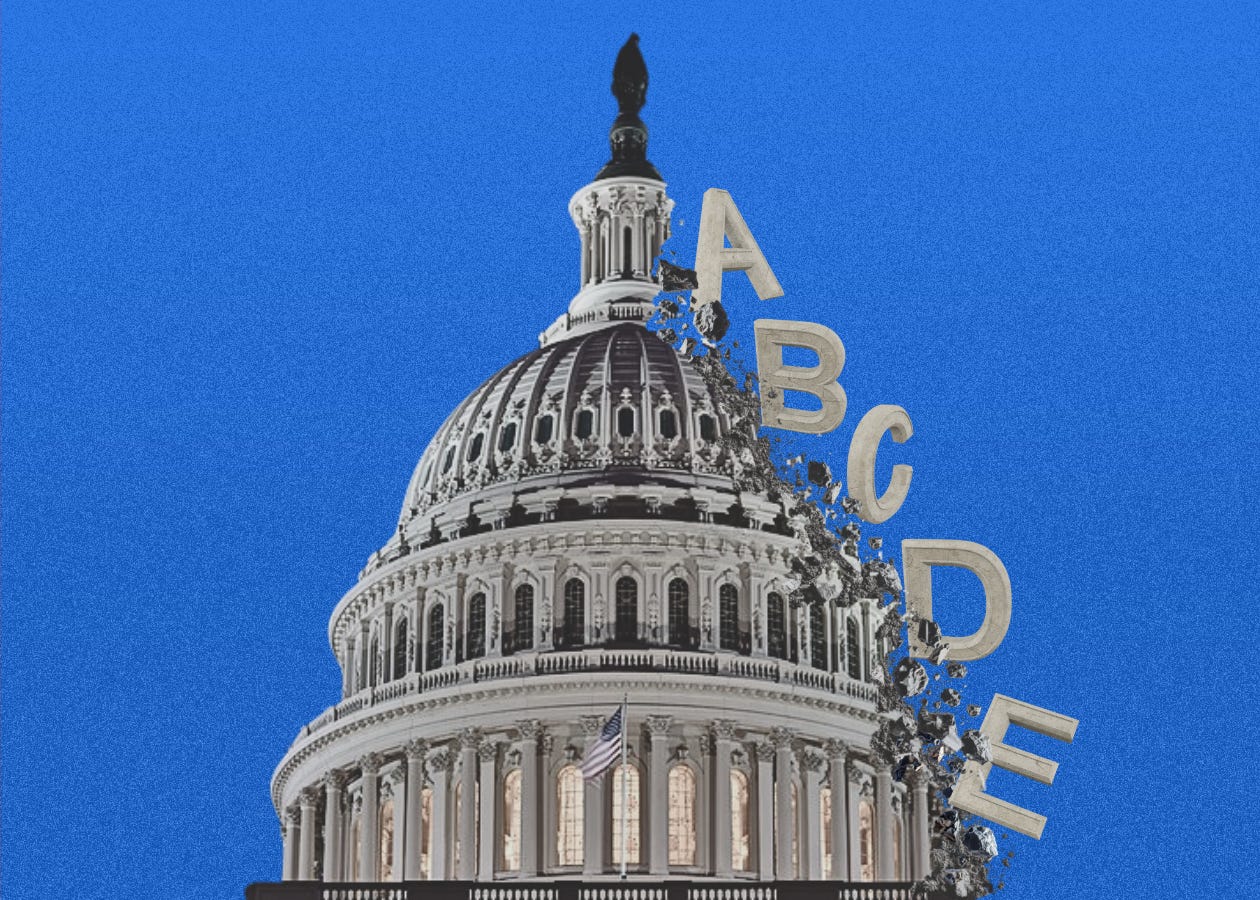
From A to Z: a partial inventory of the tactics and tools President Donald Trump is using to undermine American democracy.
America did not lose itself suddenly—it voluntarily surrendered its shame. When impunity became the norm and cynicism became a license for power, the internal prohibition disappeared. This psychological shift became the catalyst for systemic transformation. Behind the rhetoric of liberation (”now we can do anything”—straight from Fyodor Dostoyevsky) followed deliberate engineering: a set of specific legal, budgetary, and administrative instruments that allow constitutional traditions to be circumvented without formally breaking the law.
This inventory contains no moral judgments—only mechanisms documented in public sources, court decisions, executive orders, and administration reports. Each entry is a neutral category of actions Trump employed across his first and second terms. Some entries describe mechanisms already implemented; others document potential risks and announced initiatives of the second term. The goal is not moral condemnation but systematic mapping—to show how individual measures, from personnel purges to district redraws, combine into an architecture of democratic subversion. This is not a “conspiracy theory.” It is a description of institutional dynamics in which legality is formally observed while the spirit of procedures—independence, accountability, adversarial competition—is systematically destroyed. And these deliberate actions are only the opening chapter of the era of America’s dismantling: its transformation into a pure and unadulterated form of Trumpocracy—or, in other terms, electoral totalitarianism.
Democracies do not die from a single blow. They die from a political alphabet. This one, for example.
A — Attack on Independent Agencies
Instrument: firing regulatory commissioners without cause, undermining their institutional autonomy.
First term: the firing of FBI Director James Comey (2017) as an attempt to obstruct the Russia investigation.
Second term: the firing of FTC Democratic members Rebecca Slaughter and Alvaro Bedoya in March 2025 without lawful cause; a federal court ruled the firings illegal. The Supreme Court is now considering Trump v. Slaughter, which could grant the president unlimited authority to remove independent agency heads at will.
B — Budgetary Weaponization (Impoundment)
Instrument: reinterpreting the Impoundment Control Act to allow the White House to withhold congressional appropriations without legislative approval.
Second term: Russell Vought’s OMB refused to execute appropriations lying within Congress’s exclusive authority, illegally withholding funds already approved by the legislature.
Second term: the administration withheld approximately $26 billion in budgetary obligations for fiscal year 2025, threatening funding for federal institutions and programs.
Second term: in April 2026, the White House notified Congress of the withholding of $19 billion in foreign assistance under the guise of “closing terminated programs.”
C — Career Service Purge (Schedule F)
Instrument: reclassifying up to 50,000 civil servants as political appointees, stripping them of whistleblower protections.
First term: the Schedule F executive order (October 2020) reclassified tens of thousands of civil servants as political appointees, removing their protections (later reversed by Biden).
Second term: in February 2026, the administration finalized the “Schedule Policy/Career” rule, classifying approximately 50,000 employees as at-will workers who can be dismissed without cause.
D — Delegitimization of Electoral Processes
Instrument: preemptively declaring election results “fraudulent” when outcomes are unfavorable.
First term: after the 2020 elections, Trump repeatedly pressured Vice President Pence not to certify results, calling them “stolen” without evidence.
Second term: after Republicans lost a Virginia referendum in April 2026, Trump declared the vote “rigged.”
Second term: Trump threatened “serious legal and criminal review” over California’s redistricting initiative.
E — Epistemic Fragmentation
Instrument: supporting platforms that construct hermetically sealed information realities (Truth Social, algorithmic polarization).
Second term: in 2025-26, Trump published approximately 6,200 posts on Truth Social, using the platform to spread disinformation about elections, immigrants, and the Iran war.
Second term: Truth Social became a vector for manipulative videos, conspiracy theories, and health disinformation, frequently without labeling of AI-generated content.
Second term: researchers described Trump as the “first generative AI president” for his deployment of deepfakes to mock opponents.
F — Federal Grants as Leverage
Instrument: conditioning the distribution of funds (representing up to 36% of state revenues) on the political loyalty of governors.
Second term: in January 2026, the White House demanded compliance reports on federal grants from 14 Democrat-led states (California, New York, and others) under the guise of fraud prevention.
Second term: federal bureaus notified 13 Democrat-led states of delays in homeless housing grant payments due to their “sanctuary” status.
G — Gerrymandering
Instrument: the systematic redrawing of electoral districts to lock in structural advantage for one party (REDMAP, the post-Rucho reality).
2010s (REDMAP): the Republican Party invested tens of millions of dollars in state legislative races ahead of the 2010 census, gaining control over mapmaking for a decade.
Second term: the Supreme Court permitted Texas to use a new district map giving Republicans up to five additional House seats.
Second term: Florida’s Governor DeSantis drew a map converting 24 of 28 districts into Republican seats, despite a direct constitutional prohibition.
Robinson v. Callais (April 29, 2026)—six to three—partisan justification now fully shields racial gerrymandering from challenge. Tennessee/Memphis as the immediate consequence.
H — Hubris Syndrome: Arrogance and the Hypertrophy of Executive Power
Instrument: the expanded use of executive orders to circumvent the legislative process.
Second term: in February 2026, Trump threatened to impose national voter ID requirements and enact election law by executive order if Congress failed to act.
First term: the administration planned to sell $7 billion in weapons to Saudi Arabia, bypassing Congress to avoid a legislative block.
I — Immunity for Loyal Structures
Instrument: exempting the defense-industrial complex and private prisons from independent audit and competitive bidding requirements.
Second term: private prison company GEO Group received a $426 million security contract through Donald Trump’s Super PAC and filed a Supreme Court petition seeking immunity from lawsuits over its use of forced prison labor.
J — Juridical Selectivity
Instrument: using the Justice Department to prosecute opponents and protect allies.
Second term: the Justice Department reopened criminal proceedings against former FBI Director James Comey over an Instagram post featuring seashells reading “86 47”—allegedly an implicit incitement to kill Trump.
Second term: Republican Senator Thom Tillis called the case “political retribution” and “deliberate persecution.”
K — Negative Selection of Personnel
Instrument: appointing to key positions on the criterion of personal loyalty rather than competence.
Second term: the firing of Attorney General Pam Bondi for a “passive approach to prosecuting political opponents.”
Second term: the appointment of Trump’s personal attorney Todd Blanche as acting Attorney General (April 2026).
L — Legitimization of Impunity
Instrument: mass pardons for participants in political violence (January 6, 2021).
Second term: on the first day of the second term (January 20, 2025), pardons issued to nearly 1,600 participants in the January 6 Capitol assault.
Second term: the pardon of businessman Paul Walczak after his mother attended a closed MAGA Inc. fundraising dinner, paying $1 million for access.
M — Media Pressure
Instrument: public discrediting of independent media, construction of alternative information channels.
Second term: Trump called CNN “losers” and “fake news” for questioning claims about uranium removal from Iran.
Second term: FCC Chairman Brendan Carr ordered ABC to undergo an early license review of Disney and its employees, following Trump’s demands for the firing of Jimmy Kimmel.
N — Normative Erosion
Instrument: replacing unwritten norms of restraint with the demonstrative violation of taboos as a loyalty signal.
First term: refusal to release tax returns (2016-2020), breaking a forty-year transparency norm.
First term: public demands for “loyalty” from FBI Director Christopher Wray in 2020.
Second term: Marjorie Taylor Greene acknowledged that their “side was trained to never apologize, never admit when you’re wrong.”
O — Circumventing Professional Associations
Instrument: threatening to revoke the licenses of doctors, lawyers, and experts for holding “incorrect” views.
Second term: executive orders declared law firms “national security threats,” blocking their access to government buildings and federal contracts.
Second term: the Trump administration threatened to revoke the accreditation status of law schools affiliated with the American Bar Association.
P — Pattern Import of Authoritarian Governance
Instrument: adapting authoritarian governance models (loyalty hierarchies, personality cults) to the American context.
Second term: an AP-NORC poll in January 2026 found that 25-30% of Americans agreed that “we need a president willing to break some laws and rules to restore order.”
Second term: the criminal case against James Comey rests on an ambiguous interpretation of a social media post, creating a chilling effect on political dissent.
Q — Quasi-Judicial Mechanisms
Instrument: using administrative procedures to build parallel accountability structures answerable to the administration.
First term: creation of the Presidential Advisory Commission on Election Integrity (2017) to delegitimize electoral processes under the guise of “protecting elections.”
First and second terms: pressure on state election commissions through threats of criminal prosecution for “technical errors.”
Second term: use of impoundment as a de facto quasi-judicial lever—the White House overrides GAO rulings on impoundment violations, effectively arrogating to itself the judicial function of deciding which congressional laws are “valid” and which are not.
R — Rhetorical Dehumanization of Opponents
Instrument: the systematic use of language that excludes the legitimacy of political competition.
Second term: Trump described political opponents as “vermin” to be “rooted out,” as well as “terrorists,” “liars,” “losers,” and “perverts.”
S — Selective Law Enforcement Instrument: cases such as the Epstein file as precedents for the effective unaccountability of elite-constructed networks.
Second term: President Trump claimed to be “fully exonerated” in the Epstein matter, despite never having faced charges.
T — The Transactionalization of Foreign Policy
Instrument: concluding international agreements bypassing diplomatic channels and allies.
Second term: Saudi Arabia granted major non-NATO ally status following $600 billion in investment commitments and F-35 sales.
Second term: threats to withdraw from the G-20, annex Greenland, accusations that NATO allies were shirking combat—foreign policy as a deal.
The Trump family earned $4 billion from the presidency (The Atlantic, April 2026). The G20 summit was held at his hotel. Pardons for donations. Syria sanctions lifted when a golf course bearing his name was proposed. Outrage fatigue as a goal, not a byproduct.
U — Unification of the Judiciary
Instrument: accelerated appointment of conservative judges to secure a long-term ideological supermajority.
Second term: 26 judges confirmed in the first year of the second term; many under 40, nominated by the Federalist Society.
Second term: appointment of former Trump personal attorney Emil Bove to the U.S. Court of Appeals for the Third Circuit, despite objections from 900 former prosecutors.
V — Vice Signaling: the Visual Normalization of Vice
Instrument: the public display of privilege and violations as a marker of membership in the new elite.
Second term: Trump posted Christmas messages about “radical left scum,” describing missile strikes on Nigeria as a “Christmas gift.”
Second term: open boasting of ties to crypto-oligarchs, pardons for Capitol rioters, and a million-dollar immunity market.
Kristi Noem’s husband, submerged in bambification.
W — Weaponization of Federalism
Instrument: using presidential control over the National Guard and state legislatures to override state authority.
Second term: August 2025: federalization of the National Guard in Los Angeles, Chicago, and Portland using out-of-state units without the consent of governors, triggering lawsuits.
X — Export of Epistemic Fracture
Instrument: promoting narratives that make compromise impossible by generating incompatible versions of reality.
Second term: ahead of the 2026 congressional elections, 89% of Americans anticipated high levels of political conflict, and nearly half attributed political violence to rhetoric rather than “mentally unstable individuals.”
Y — The Legal Paradox: Racial vs. Partisan Gerrymandering
Instrument: the divergence between protections against racial (Allen v. Milligan) and partisan (Rucho) gerrymandering, which effectively legalizes manipulation on partisan grounds.
Second term: the Supreme Court ruled that partisan gerrymandering is a “political question” not subject to judicial review, while racial gerrymandering remains prohibited.
Z — Substitution of Internal Restraint
Instrument: the erosion of shame and conscience as informal mechanisms of civic accountability, replaced by calculation and fear of consequences.
Second term: the doctrine of “never apologize, never admit when you’re wrong”—the institutionalization of cynical shamelessness, displacing internal moral barriers.
“I don’t think about Americans’ financial situation. I don’t think about anybody.”—Trump, May 2026. The institutionalization of indifference as state doctrine.
This list is not exhaustive. The alphabet ran out. The dismantling of democracy has not.
In conclusion, a dialogue from Fyodor Dostoyevsky’s Demons*:*
“...in essence, our teaching is the negation of honor, and by the open right to dishonor it is easiest to lead a Russian man after you.—Excellent words! Golden words!—cried Stavrogin.—Right to the point! The right to dishonor—why, everyone will come running to us, not one will remain on the other side! And tell me, Verkhovensky—are you not from the secret police?”
It turns out, an American can be led by the right to dishonor no less easily. Golden words indeed.
And Trump—he is not from the Moscow police, and his alias is not Krasnov. Is it Verkhovensky?
More from The Next Move:
King Trump’s Press Ban

Banning CNN, MS NOW, and Politico is straight out of the 1776 playbook—the British Crown’s playbook, that is.
What to This Russian Is the Fourth of July?

The America of my Soviet upbringing was both distant and extremely close.
