


Issac Olvera is a writer, investor, and former US Marine officer based in Ukraine. Following Russia’s invasion, he fought in the Ukrainian military as a foreign volunteer. He wrote about that experience in his book Reckoning Dreams and Fire. He now manages StrategiX Ventures, a fund that invests in Ukraine. Connect with him on X.
Gdansk, Poland, is a postcard city: modern buildings and restored Baltic Gothic originals stand side by side along placid canals. The signs are multilingual, the streets are immaculately clean and noticeably quiet—most cars in the city center are electric.
The uninformed observer might struggle to imagine that just a few generations ago, this picturesque city lay in ruins.
Gdansk, and Poland more broadly, didn’t just recover from the devastation of World War II and decades of Soviet domination. Poland has soared to the front of the pack; today, it boasts the sixth-largest economy in the European Union. That transformation made Gdansk the perfect venue for a high-level summit on rebuilding Ukraine. In the summer, I joined diplomats, policymakers, CEOs, and academics to see how we might replicate Gdansk’s remarkable recovery.
First, it’s worth briefly relaying how I ended up in this Baltic Sea port city. I’m an American, but I live in Ukraine. In early 2022, I was a management consultant in Texas. When Russia invaded, I walked away from that life and joined the Ukrainian military. I had no ties to the country, but I was inspired by its brave stand against authoritarianism. As a US Marine Corps veteran, I thought I could help.
Thousands of foreign volunteers made the same choice. Today, I’m no longer fighting on the front lines. Instead, I support the cause by running a small investment fund focused on Ukraine. Victory depends on weapons and capital. I did what I could with the former; now I’m trying to contribute with the latter.
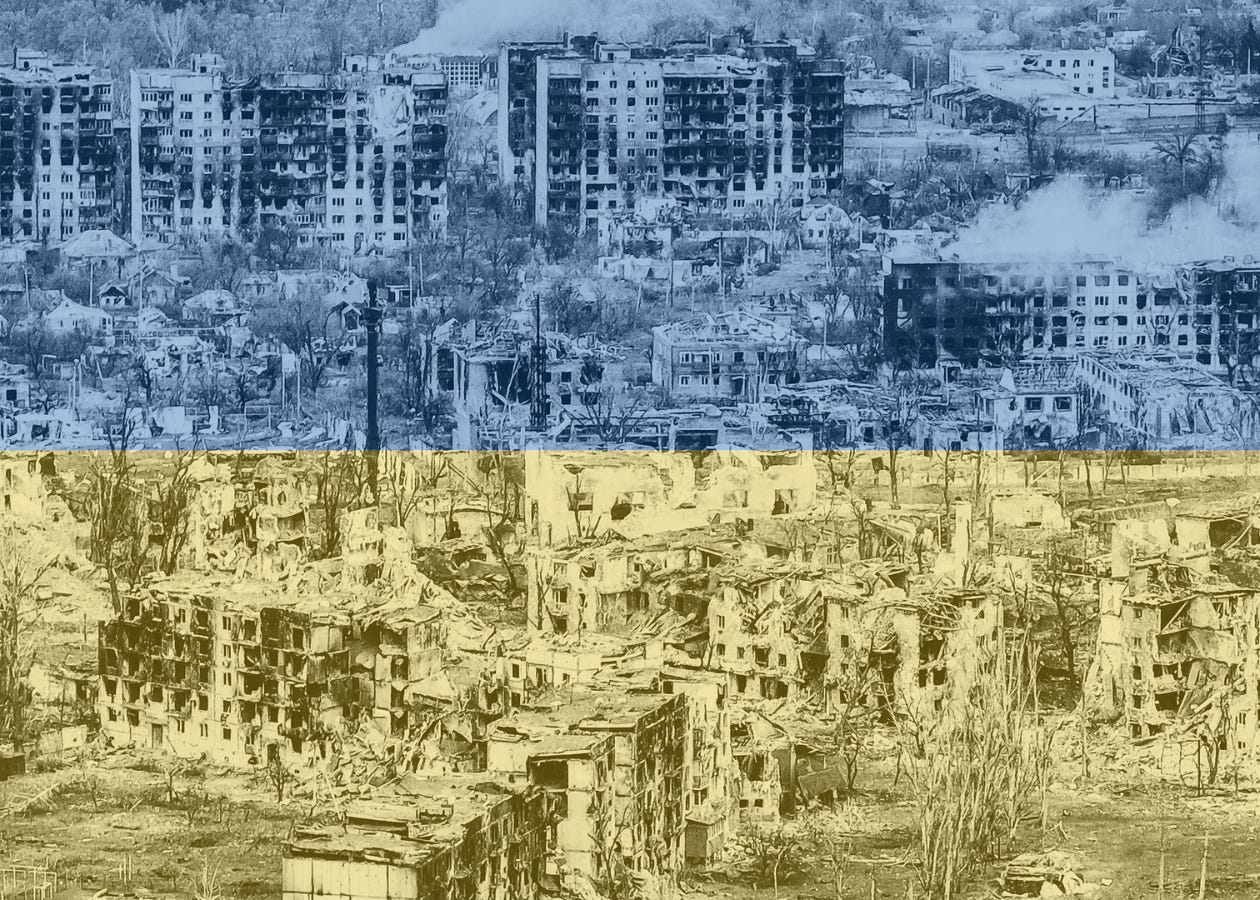
Rebuilding Ukraine’s economy and society will be almost as tall an order as winning the war itself. World Bank estimates put war damage—to the extent it can be measured—at $580 billion. As many as 150,000 Ukrainian soldiers have been killed, and nearly 10 million have been displaced.
But I left the Gdansk conference hopeful. I feverishly scribbled notes as I listened to the visiting dignitaries, paying close attention to their arguments, plans, and proposals. Here’s why I’m optimistic about Ukraine’s capacity to bounce back:
The precedents: Japan, Germany, South Korea
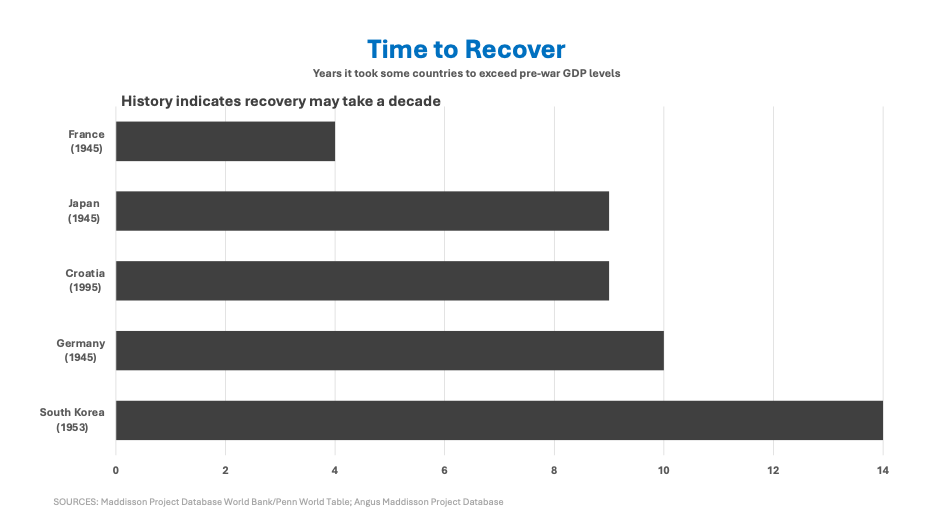
Poland isn’t the only country to bounce back after a terrible war. Three of the world’s leading economic powerhouses—Japan, Germany, and South Korea—suffered far-reaching destruction in the last century.
By 1945, nearly three million people had died in Japan. Adjusted for inflation, the country had endured $500-$700 billion in damage, in the same ballpark as Ukraine’s estimate. On the other side of the world, Japan’s German ally had a similar story: seven to eight million dead, a collapsed economy, and $400-$600 billion in damage.
Not even a decade later, South Korea’s situation was even worse, at least economically. At the end of the Korean War, the country had suffered $500 billion in damage. Half of its industrial capacity was destroyed.
Despite the vast destruction, each country got another chance. Seven years after Hiroshima and Nagasaki, Japan had returned to its prewar economic levels. West Germany and South Korea reached the same milestone nine years after the guns went quiet.
In all three cases, the end of war marked the beginning of an astounding economic transformation. By 1960, Japan became the world’s seventh largest economy, while West Germany rose to third place, behind only the US and the Soviet Union. South Korea took three decades to become a major economy, but today it ranks fifteenth. In each case, the turnaround was so statistically unlikely that economists called it a miracle.
If those countries could do it, maybe Ukraine can too.
ICYMI: Listen to Issac’s story on the Older/Wiser Podcast

The case for a Ukrainian transformation
The aforementioned success stories share some common characteristics. Despite the devastation, human capital survived, and strong institutions survived (or emerged, in South Korea’s case).
In the case of Ukraine, the noise and fog of war obscure the advantages it still has. Ukraine retains one of Europe’s most educated populations, including in highly technical fields. Ukraine built the most innovative defense ecosystem in the world, and its government is setting the pace in digital transformation (in fact, Ukraine has an entire ministry dedicated to this endeavor).
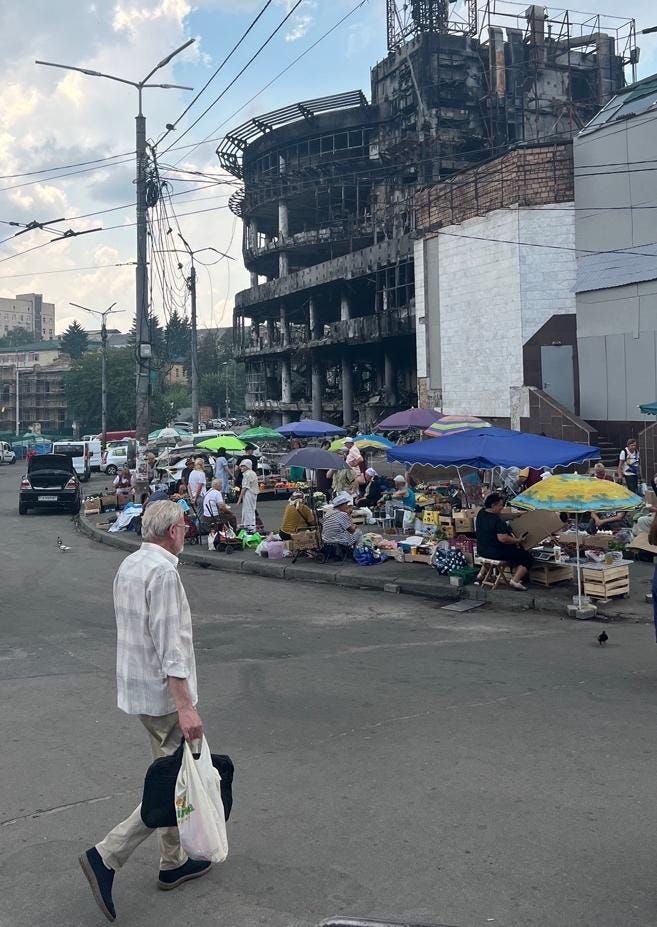
Kyiv, Ukraine, 2026. Russian drones and missiles destroyed an indoor market. A week later, business resumed outdoors. (Photo: Author. The site has been struck again since this photo was taken).
Rebuilding at war
There is one important caveat: Germany, Japan, and South Korea enjoyed opportunities to rebuild in peace. Ukraine is still at war.
One South Korean official I spoke with was unfazed by this. My-hyuck Lee is a representative of South Korea’s development corporation, which is coordinating joint projects with Kyiv. He prefers to go by “Badger,” owing to a distinctive stripe of grey hair.
“The most likely scenario for Ukraine is the Korean model,” Badger told me, “a frozen conflict, with a militarized border.”
I agree with him: the war might just halt, with no concession of land or a handshake. Just an agreement not to fire. That was good enough for South Korea to become one of the world’s top economies. It could also work for Ukraine.
What about security guarantees? In the three success stories I cited, the United States enforced geopolitical stability with strong alliances. But today, ample evidence suggests the US is more likely to reward Russia than to back Ukraine’s security (and with Trump’s recent praise for Kim Jong-un, even our commitment to South Korea is in question).
Europe could fill an America-shaped void. Its population, economic heft, and defense-industrial base dwarf Russia’s. The continent only suffers a crisis of confidence: NATO Secretary General Mark Rutte, the man in charge of coordinating the transatlantic collective security arrangement, doesn’t even think the 32-member alliance can protect itself without the US, much less defend Ukraine. But Europe found the will to sanction Russia, arm Ukraine, and absorb millions of refugees when the invasion first came. The capacity is there.
Ukrainian transformation
At the conference I noticed non-Ukrainians use the word “reconstruction.” I’ve used it too. But Ukrainians seem to prefer “transformation.”
One banking executive, whose name I didn’t catch, put it plainly: “We are not reconstructing the Soviet buildings that were destroyed.” His bank is financing development projects.
After World War II, planners in Gdansk preserved some of the medieval elements while redesigning the city to accommodate housing, utilities, and transportation for the future. Ukraine is taking the same approach.
Russia destroyed many of Ukraine’s power plants, but Kyiv is not rebuilding them. It’s not possible, and it’s not worth it. Instead, recovery funds have gone toward building smaller, distributed networks that are harder to destroy and are increasingly powered by renewable energy. During the conference, the country’s largest energy company, DTEK, signed a deal with General Electric to build a new, modern, efficient plant in western Ukraine.
Similarly, the Ukrainian government had plans to decommission many hospitals before Russian bombs destroyed 400 of them. Russia’s violence has actually forced Ukraine into a clean slate on which to prototype the future.
The Corruption Question
Tymur Mindich, a close associate of President Zelenskyy, was accused of manipulating state energy companies and steering defense contracts. Despite his proximity to the president, the Mindich case was exposed and investigated (Mindich fled to Israel in late 2025 to escape prosecution).
Corruption persists in the country, no doubt, but the problem is also often overstated. Last year, in the middle of its existential war, tens of thousands of Ukrainians marched to protest a law that would stifle the independence of anti-corruption bodies. After a week of protests, the president backed down. Ukraine’s progress in fighting corruption is almost as impressive as its battlefield accomplishments.
Badger, the South Korean official, has some reassuring words drawn from personal experience. “Koreans were once viewed as lazy and corrupt,” he told me. “Today we’re viewed as disciplined innovators. The nation reinvented itself and the world recognized it. The same is happening in Ukraine.”
Foreign investment
Of course, the classic reconstruction cases benefited from significant foreign investment.
Anka Feldhusen is a former German diplomat who now serves as the business ombudsman in Ukraine. In her assessment, “Private money matters because public money alone won’t be enough. Germany’s recovery relied on private investors too.”
There’s no avoiding that investing in a country at war is risky. Just like there are brave soldiers and civilians in Ukraine, there are brave investors, but the current level of outside money only makes a dent in the overall need. The Bank of Ukraine estimates that about 40% of recovery needs will have to come from the private sector. Institutional investors are committing only a fraction of what they could contribute.
Those hesitating to invest in Ukraine should recall the post-war economic miracles. Investors in post-war Germany, Japan, and South Korea ended up making one of the best investments of the century. One dollar invested in Germany or Japan when they were in tatters would have roughly doubled within five years, quadrupled within ten, and grown five or six times over the next twenty years. South Korea’s case was even more staggering, growing twelvefold after two decades. By comparison, the US economy between 1945 and 1970, which was exceptional in its own right, expanded only three and a half times.
Reflecting on these facts, I left Gdansk with hope that Ukraine can recover from the ongoing Russian-led catastrophe. It is possible to prosper through territorial partition, as South Korea and West Germany did. Furthermore, the prosperity of Poland and the Baltic states demonstrates that countries widely viewed as underdogs can escape Russia’s orbit, integrate with democratic partners, and eventually outperform Russia itself.
With the structural transformations already underway, and just enough outside support, Ukraine is likely to be the economic miracle of the twenty-first century.
Stanley Wang contributed research for this article.


