


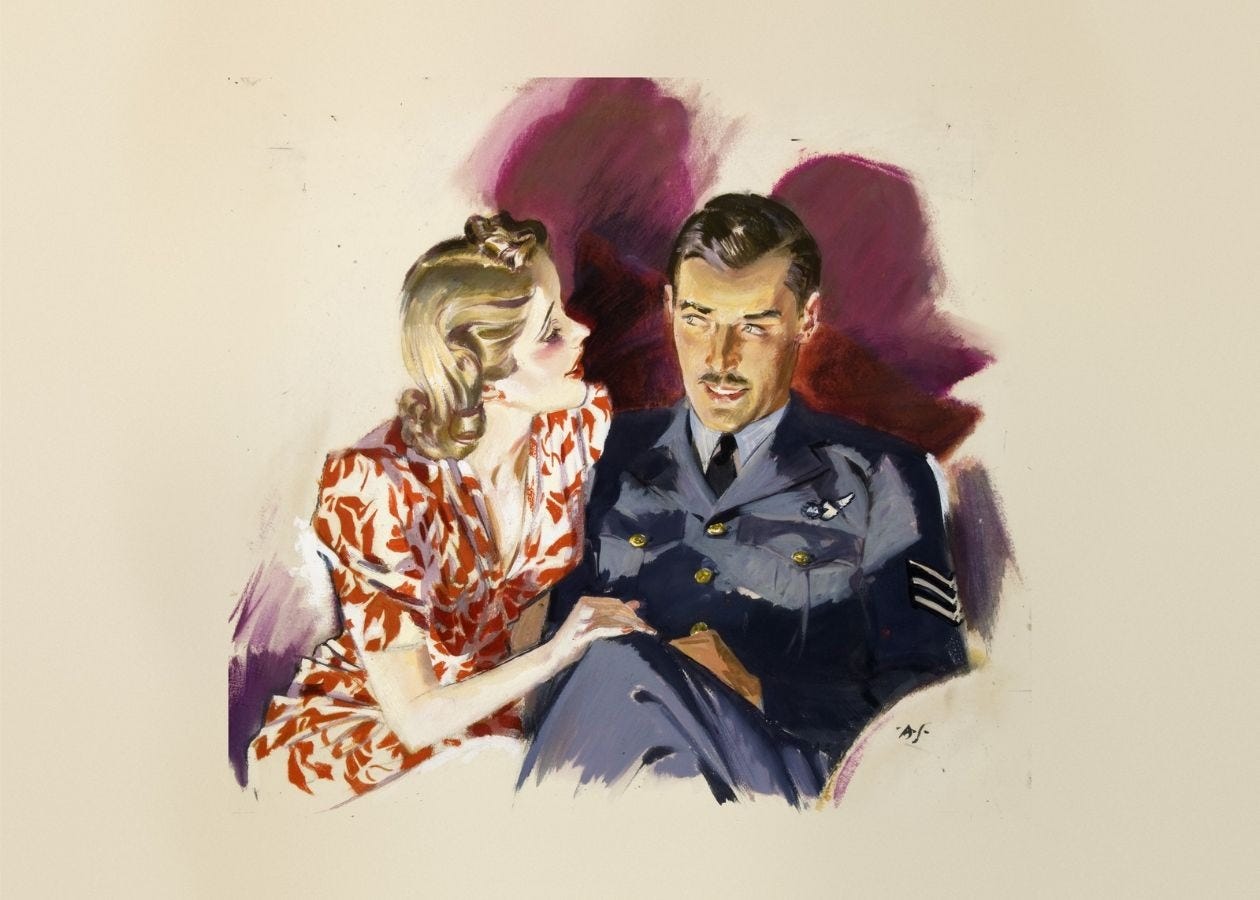
I have a distinct memory of sitting in a personnel security briefing as a 21-year-old State Department intern. At one point, the presenter cast a humorless glare at the men in the room. He reminded us that upon joining the State Department and receiving a security clearance , we had not suddenly become God’s gift to woman, and any sudden romantic advances should be viewed with appropriate suspicion. At the time, I found it all kind of funny. I figured that college students would not be prime targets for honeypotting, so I filed away the warning as an amusing anecdote.
Fast forward to 2023, a little over a year after Russia’s full-scale invasion began. As CEO of the Renew Democracy Initiative, I was organizing our aid for frontline communities in Ukraine, advocating with lawmakers for more military assistance to Kyiv, and speaking at rallies and appearing regularly on Ukrainian television. My work also took me to Europe, where I attended conferences with allied leaders to try to line up more support for Ukraine.
At one European conference, I met a Ukrainian woman. She was in her 20s, probably a few years my junior. We hit it off. She loved my travel stories. She was eager to hear about my work at RDI. And she wanted to know all about our chairman, Garry Kasparov.
We hung out, and then we hung out again, and again. I was single and enjoying my time with my new Ukrainian friend. Who knows where our meet-cute might lead?
There were a few yellow flags about our interactions. Initially, I reasoned my way around them. We spoke in Russian—but then, many Ukrainians still speak Russian behind closed doors (including President Zelenskyy). She was very curious about RDI’s work. However—without being too self-aggrandizing—I’m lucky enough to have an interesting job! Then there were her questions about Garry. They were a little specific—she wanted to know where he’d be at upcoming events, for example. In fairness, I thought, Garry is an international celebrity, and he’s especially famous in the former Soviet Union. Plenty of people want to meet him without harboring any ulterior motives. She wouldn’t be the first superfan who wanted an introduction.
There’s one more element to this. If you’ll permit me to be a bit crass, my new friend was attractive, but she wasn’t a supermodel. I say this because the archetypal spy who loved me would likely be out of my league. I felt like our thing was good, but not too good to be true.
A while later, I was at the Munich Security Conference, one of the top gatherings of military and political leaders in the world. And there, on the very first day of the conference, I ran into my new friend again.
Of all the gin joints.
She told me she was there for a side event for Ukrainian graduate students. There are plenty of side events at Munich, so that didn’t grab my attention. But then she started peppering me with questions: Which side events was I going to? Could I get her into a fancy dinner the Ukrainian delegation was hosting?
Wasn’t she there with a Ukrainian group? Why did she need a special invitation to meet with other Ukrainians if she’d already scored an invite to one of the more exclusive events in the world? That was odd.
At this point, I was pretty busy and I decided to focus my attention on the event rather than my friend’s mounting requests.
Still, I couldn’t shake the feeling that something was off about her. Back in America, I started replaying our time together. Unbidden, that long-ago State Department briefing came to mind.
RDI’s work is sensitive—we have many people in our network who are wanted by hostile foreign dictatorships, to say nothing of our on-the-ground efforts in Ukraine (including two delegations) and my own Russian-language media appearances. So, feeling pretty ridiculous, I decided to reach out to an acquaintance in federal law enforcement to see if he could look into this. I opened the call by apologizing for wasting his time with what was probably just paranoia.
A few weeks later, my contact called me. Could I meet him and a colleague for lunch? In a scene that was a little film noir, we sat down at a New York diner and he slid a photo across the table. It was a candid, taken at a distance. The woman in the photo was on the move, clearly unaware she was being recorded. It was my Ukrainian friend, the one I’d met in Europe.
Except she may not have been Ukrainian, and we definitely weren’t going to be friends. These feds believed she was FSB—Russian intelligence.
Guess I wasn’t being paranoid after all!
In recent days, I’ve returned to this experience because it means I have something in common with mega billionaire, AI godfather, close Trump associate, and now former CEO of Nvidia Jensen Huang: we were both approached by foreign intelligence agents in honeypot schemes. Huang, it appears, had a two-year affair with a Chinese asset.
That’s where the similarities end. Our respective net worths are separated by several orders of magnitude. I run a non-profit. Huang led—until today—the single most important chipmaker in the world.
More importantly, Huang’s two-year-long indiscretion may have allowed his would-be CCP lover to smuggle hundreds of thousands of restricted AI chips back to China. My own experience turned out to be little more than an interesting story precisely because I was cautious enough to pull the alarm before anything happened.
This difference is especially galling the more you think about it. As head of Nvidia, Huang had a security team rivaling that of a head of state. And he was close to actual heads of state, including our president, Donald J. Trump.
How did he miss the warning signs? Did he miss the warning signs? Recent reporting suggests President Trump may have known that Huang was in a relationship with a Chinese spy when he brought the tech exec in his entourage to Beijing earlier this year. This seems like the sort of thing the president might have wanted to take up with a man ostensibly ensuring American dominance in the AI race.
On a personal level, there’s also the fact that Huang is (was?) married. I was single throughout my brush with the Russian secret services. Apparently, the Chinese agent wasn’t Huang’s only extramarital affair—he also had a relationship with a direct report. This means that unless he was in an open marriage, he was already sneaking around. We know that Huang’s security team was aware of his proclivities, since they got that employee to sign an NDA. Couldn’t they have also looked into the Chinese woman he was surreptitiously dating? In the end, it seems he was more worried about his wife discovering his personal secrets than he was about the Chinese government discovering trade secrets with vast national-security implications.
I can’t really pat myself on the back for picking up on something that Jensen Huang missed. I did little more than exercise a bare-minimum degree of common sense. The real takeaway is that some subset of the most powerful men in the United States either lose their sense of self-awareness in the face of basic temptation or they simply don’t care if dictators who mean America harm use them to advance Chinese, Russian, or other interests at the expense of our own.
Uriel Epshtein is the CEO of the Renew Democracy Initiative, which publishes The Next Move.
Become a premium subscriber. Your contribution supports the work of the Renew Democracy Initiative—direct humanitarian aid to frontline communities in Ukraine, dissident-led civic education in the US, and getting more content up here on The Next Move. You’ll get exclusive access to the premium subscriber chat with Garry, early access to podcasts, and automatic entry for special giveaways.


SORRY Totally stupid even after having been trained not to fall for it! …. what is it with men? Supposed UKRAINIAN friend only spoke Russian… but he fell for it…GAHHHH! He is lucky he still has a job.
It's good to know where to draw the line & set boundaries even when having an enjoyable time.