


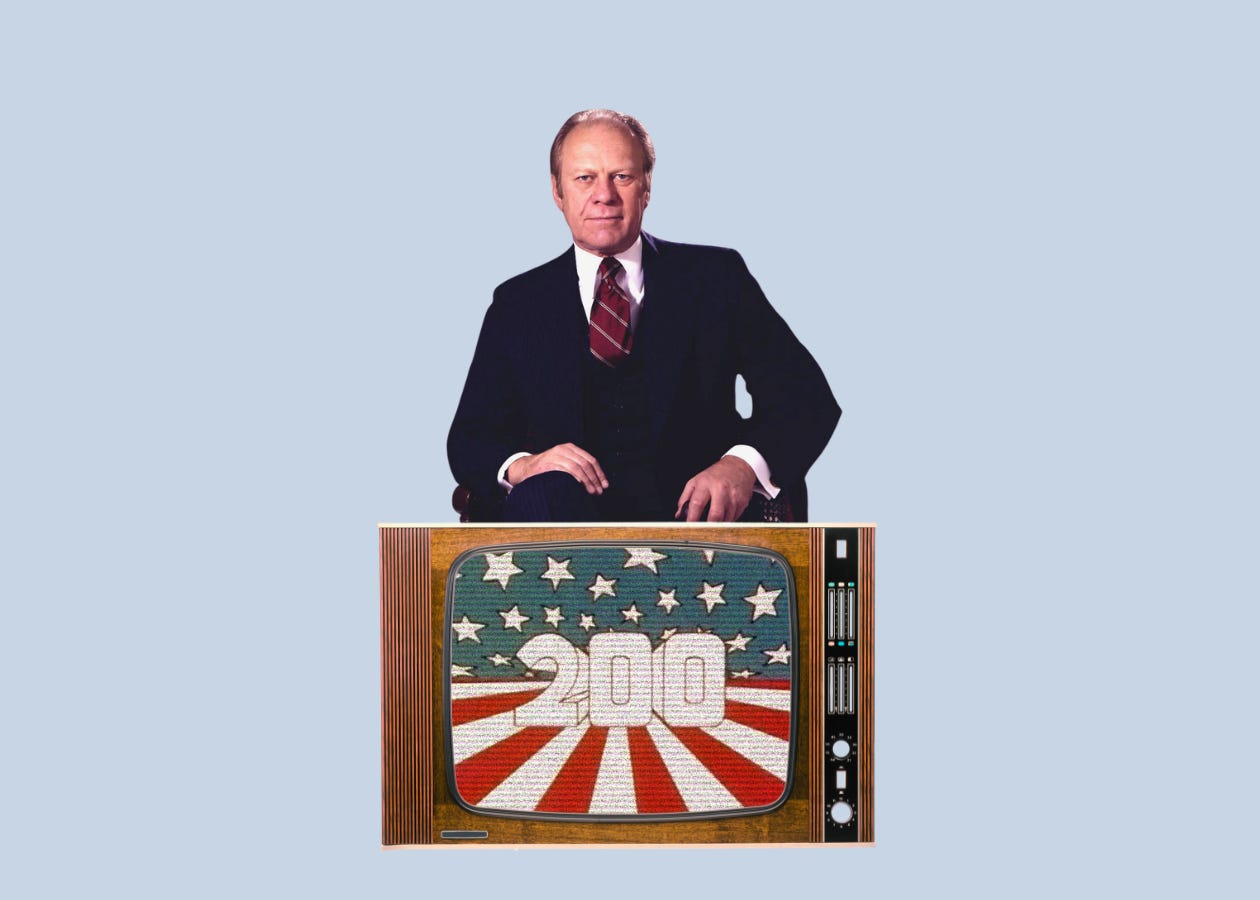
This column is Part II in a mini series looking at America’s milestone birthdays—and how contemporary leaders handled those anniversaries. Read last week’s installment on Calvin Coolidge at America’s 150th, and stay tuned for our coverage of Donald Trump at the semiquincentennial.
Jay Nordlinger is a senior resident fellow at the Renew Democracy Initiative and a contributor at The Next Move.
Last week, I wrote about President Calvin Coolidge and the speech he gave in 1926 about the Declaration of Independence. That year, America was marking the 150th anniversary of the Declaration.
Fifty years later, Gerald R. Ford was president. I remember that year, 1976, our Bicentennial, pretty well. I was 12.
With every passing week, I was becoming more interested in national and world affairs. The year 1976 was not only our Bicentennial, it was also a presidential election year.
Fresh on the scene was Jimmy Carter, the former governor of Georgia. On the Republican side, President Ford was battling with Ronald Reagan, the former governor of California, for their party’s nomination.
I listened to the GOP convention in Kansas City on the radio. (I grant you, this was somewhat abnormal in a 12-year-old.)
For years already, I had loved the American founding. And 1976 was a bonanza for lovers of 1776 and all that.
Circulating in our money were “Bicentennial quarters.” It was cool to get one—not just a regular old quarter.
On television (CBS), we had the “Bicentennial Minute.” Nightly, there would be some nugget about the Revolution.
I remember the tall ships, gathered in New York Harbor, and later in Boston.
I remember the royals, too: Queen Elizabeth and her husband, Prince Philip. They participated in our Bicentennial activities. Pretty sporting of them, I thought.
They gave us a “Bicentennial Bell,” cast at the same foundry in London as our Liberty Bell. The inscription on the Bicentennial Bell ends with “LET FREEDOM RING.”
That was very sporting, indeed. Those words come from “My Country, ’Tis of Thee,” our patriotic song, which has the cheek to use the tune of “God Save the King” (or Queen).
ICYMI: Tune in to the latest episode of the Older/Wiser Podcast

July 4, 1976, was a very busy day for President Ford. But, before getting to that day, I would like to touch on the day after—July 5. Ford presided over a naturalization ceremony at Monticello, Jefferson’s home.
He spoke to the new Americans about the place of immigration in our national story. People had always come from all over, he said, bringing something of the old, to blend with the new.
“Such transfusions of traditions and cultures, as well as of blood, have made America unique among nations and Americans a new kind of people. There is little the world has that is not native to the United States today.”
We have been able to offer citizenship to pretty much everybody. How? Because, said Ford, “we are uniquely a community of values, as distinct from a religious community, a racial community, a geographic community, or an ethnic community.”
Yes.
Our nation was founded, the president continued, “not on ancient legends or conquests or physical likeness or language, but on a certain political value which Jefferson’s pen so eloquently expressed.”
What did that pen express? “We hold these truths to be self-evident,” etc.
Everyone has his own idea of what it is to be an American. We fight about that nearly every day. Here is Ford’s idea:
“To be an American is to subscribe to those principles which the Declaration of Independence proclaims and the Constitution protects—the political values of self-government, liberty and justice, equal rights, and equal opportunity.”
And “these beliefs are the secrets of America’s unity from diversity—in my judgment the most magnificent achievement of our 200 years as a nation.”
Ford ended his remarks with an admonition:
“Remember that none of us are more than caretakers of this great country. Remember that the more freedom you give to others, the more you will have for yourself. Remember that without law there can be no liberty.”
Right on. Ordered liberty is the name of the game. The noun and the adjective are equally important. Liberty without order is something like anarchy, and order without liberty is—unfreedom.
About immigration, I would like to mention a simple fact. In our most recent presidential campaign, the two main nominees were Kamala Harris and Donald Trump. Three of their four parents were immigrants. And the fourth—Trump’s father—was the son of immigrants.
This is classically American.
On July 4, 1976, while we were absorbed in tall ships and the like, there was big news from far away: Israel had rescued its hostages in Entebbe, Uganda, in a daring raid. Only one Israeli commando lost his life—Jonathan Netanyahu (brother of the future prime minister).
In the morning, President Ford delivered remarks at Valley Forge. He began, “They came here in the snows of winter over a trail marked with the blood of their rag-bound feet.”
That is an arresting sentence.
Further on, he told a story about the Battle of Concord. A veteran of that battle was interviewed at the age of 91. His interviewer asked, in essence, “Why did you do it? Why did you take up arms against the King? Had you been especially oppressed?”
“No,” came the answer, “never paid a penny for one of them stamps, never drank any tea, never heard of Locke. Only read the Bible and the Almanac.”
(The Stamp Act and the Tea Act were hated and resented by the American patriots, and the philosopher John Locke was a prime articulator of political freedom.)
Well then, why did he do it?
“Young man,” said the old man, “what we meant in going for those Redcoats was this: We had always governed ourselves, and we always meant to. They didn’t mean that we should.”
A few hours after appearing at Valley Forge, Ford spoke at Independence Hall in Philadelphia. He said, “Our Founding Fathers knew their Bibles as well as their Blackstone” (the standard book on law).
The population in general knew the Bible, if not Blackstone. Think of the Concord vet we have just heard from.
Our founders, said Ford, “boldly reversed the age-old political theory that kings derive their powers from God and asserted that both powers and unalienable rights belong to the people as direct endowments from their Creator.”
What’s more, “they declared that governments are instituted among men to secure their rights and to serve their purposes, and governments continue only so long as they have the consent of the governed.”
This is A-B-C—kindergarten talk. But it must be learned and relearned, in perpetuity.
Here is a shrewd point, made by Ford: “Seldom in history have the men who made a revolution seen it through, but the United States was fortunate.” How so? “The result of their deliberations and compromises was our Constitution, which William Gladstone, a great British prime minister, called ‘the most wonderful work ever struck off at a given time by the brain and purpose of man.’”
Have you ever thought about the relationship between the two “great charters” on which we are founded? In a pithy sentence, Ford said, “The Constitution was created to make the promise of the Declaration come true.”
He ended his speech by asking for “a moment of silent prayer and meditation in gratitude for all that we have received and to ask continued safety and happiness for each of us and for the United States of America.”
I have cited a lot of Fourth of July rhetoric—literal Fourth of July rhetoric. But, you know? I believe it all. And I hope that Americans will want to keep this unusual project going.
The Renew Democracy Initiative, publisher of The Next Move, is pleased to join the Institute for the Study of Modern Authoritarianism, publisher of The UnPopulist, as a media partner for the third annual Liberalism for the 21st Century Conference—LibCon 2026—in Washington, DC on July 16 and 17. Click here for more information and to register. Coinciding with America’s 250th anniversary, the theme of the conference is the Reconstruction Agenda. The conference will assess the damage that authoritarian and demagogic politics have caused to the country’s liberal institutions and propose a path forward to rebuild accountability and confidence in the rule of law. The conference features a stellar lineup, including RDI Vice Chair Linda Chavez, along with Francis Fukuyama, Anne Applebaum, David French, Hong Kong dissident Nathan Law and many more. We’ll be there and so should you.


Outstanding. We will continue the journey back in November
I would not call it “rhetoric”, as you should just call it self evidently the truth…All men are created equal in the eyes of God. Anywho, one of these dayz The Don is going to finally answer for his crimes against civilization…but, in the meantime, we the people are going to have to bear witnessing an anti Truth Neo Nationalist sociopath disgrace to truth, justice and the American Way megalomaniac give a pat on his own back speech on July Fourth for all the political world to grovel at…God HELP U.S. We the Living in Idiocracy. Here we are now, Trump entertain U.S. Gotta run on. Thanks for taking my rant. Peace through superior mental firepower