


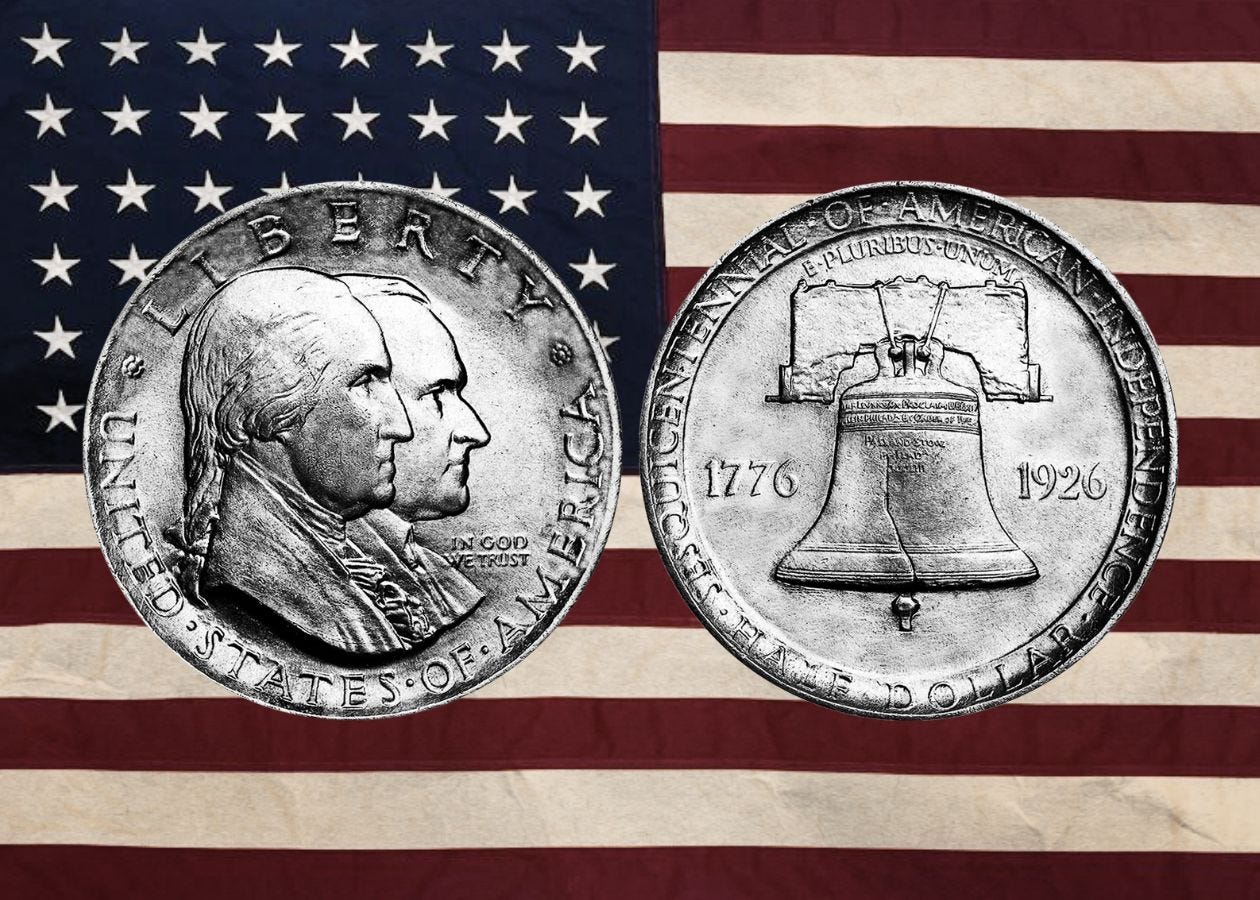
This column is Part I in a mini series looking at America’s milestone birthdays—and how contemporary leaders handled those anniversaries. Stay tuned for our coverage of President Ford at America’s bicentennial and Donald Trump at the semiquincentennial.
Jay Nordlinger is a senior resident fellow at the Renew Democracy Initiative and a contributor at The Next Move.
“You go to war with the army you have,” said Donald Rumsfeld. By the same token, you mark a major American anniversary with the president you have. We are now celebrating the 250th anniversary of the Declaration of Independence.
In 1826, on the 50th, John Quincy Adams was president. On the day itself—July 4, 1826—his father, John Adams, died. So did another former president, Thomas Jefferson.
In 1876, on the centennial, Ulysses S. Grant was president. (Short years before, on the field of battle, he had played a pivotal role in saving the Union.) In 1926, on the 150th anniversary, Calvin Coolidge was president. In 1976, for the bicentennial, it was Gerald R. Ford. And today, of course, the president is Donald Trump.
Here and now, I would like to focus on 1926. That year, Coolidge delivered an excellent speech—even a profound one—on the Declaration of Independence, and on the American founding in general.
That it speaks to us today—even in urgent tones—need hardly be said. But I will say it regardless: it does.
Coolidge delivered the speech in Philadelphia on the day after, i.e., July 5. His birthday, by the way, was July 4. He is the only president to have been born on the Fourth of July.
This president was known as “Silent Cal,” because he was taciturn. Do you know this famous anecdote about him? Whether it is true or not, it is illustrative.
When it is her turn in a receiving line, a woman says to Coolidge, “I have a bet with my husband that I can get you to say more than two words.” Coolidge replies, “You lose.”
He may have been sparing with his words—but he usually made them matter, as he did on that July day in 1926.
Coolidge described the Declaration of Independence as “the most important civil document in the world.” Its publication, he said, was “an incomparable event in the history of government.” That is not mere Fourth of July rhetoric—or Fifth of July rhetoric—but true, or at least arguably so.
“Amid all the clash of conflicting interests, amid all the welter of partisan politics,” said Coolidge, “every American can turn for solace and consolation to the Declaration of Independence and the Constitution of the United States with the assurance and confidence that those two great charters of freedom and justice remain firm and unshaken.”
I believe we are in need of “solace and consolation” today, amid that “clash” and that “welter.” Do we care to turn to our “two great charters”? Are we sufficiently aware of them? They may be the only thing that can hold us together.
ICYMI: Tune in to the latest episode of the Older/Wiser Podcast

When I was in college, I sometimes heard the American Revolution mocked as “conservative”—not a real revolution, such as France would see 13 years later! Well, Coolidge embraced this. Referring to the Declaration, he said, “It had about it nothing of the lawless and disordered nature of a riotous insurrection.”
(The words “riotous insurrection” might remind you of January 6, as they do me.)
Our founding was “in no sense a radical movement,” said Coolidge, “but took on the dignity of a resistance to illegal usurpations. It was conservative…”
If you want to start a brawl, just say, “America is an idea” (apart from blood and soil). In Philadelphia, Calvin Coolidge said that our founders established a new nation, yes, but also a new kind of nation: one built on ideas, principles, ideals.
He cited a big three—three “very definite propositions,” as he called them: all men are created equal; they have inalienable rights; the just powers of government come from the consent of the governed.
In 1926, as today, there were people who thought that the Declaration was outdated, that we needed something more suited to modern life. Coolidge would have none of it.
“If all men are created equal, that is final. If they are endowed with inalienable rights, that is final. If governments derive their just powers from the consent of the governed, that is final.”
Do you fancy yourself a progressive? Do I? What are we progressing from?
“No advance, no progress, can be made beyond these propositions,” said Coolidge. “If anyone wishes to deny their truth or their soundness, the only direction in which he can proceed historically is not forward, but backward…”
Backward to when?
To a time “when there was no equality, no rights of the individual, no rule of the people. Those who wish to proceed in that direction cannot lay claim to progress. They are reactionary.”
Every day, I hear the claims of the “post-liberals.” To me, it usually seems that they are “pre-liberals.” The Enlightenment was a big mistake, and so was the American founding. Some of them say so outright (which has the virtue of candor).
You know what Benjamin Franklin said, after the Constitutional Convention. When someone asked, “Do we have a republic or a monarchy?,” Franklin answered, “A republic, if you can keep it.” Here is Coolidge:
“A spring will cease to flow if its source be dried up; a tree will wither if it roots be destroyed. In its main features, the Declaration of Independence is a great spiritual document. It is a declaration not of material but of spiritual conceptions.”
For example?
“Equality, liberty, popular sovereignty, the rights of man—these are not elements which we can see and touch. They are ideals. They have their source and their roots in the religious convictions. They belong to the unseen world.”
And here comes a warning:
“Unless the faith of the American people in these religious convictions is to endure, the principles of our Declaration will perish. We cannot continue to enjoy the result if we neglect and abandon the cause.”
Government has a role, right? It does. “Of course the government can help to sustain ideals and can create institutions through which they can be the better observed…” There is a but coming.
“…but their source by their very nature is in the people. The people have to bear their own responsibilities. There is no method by which that burden can be shifted to the government. It is not the enactment, but the observance of laws, that creates the character of a nation.”
That last sentence deserves to be read twice, as does the whole speech.
I will leave you with a passage—another one—that is beautiful, thought-provoking, and, to my sense, true:
“We live in an age of science and of abounding accumulation of material things. These did not create our Declaration. Our Declaration created them. The things of the spirit come first. Unless we cling to that, all our material prosperity, overwhelming though it may appear, will turn to a barren scepter in our grasp.”
The Renew Democracy Initiative, publisher of The Next Move, is pleased to join the Institute for the Study of Modern Authoritarianism, publisher of The UnPopulist, as a media partner for the third annual Liberalism for the 21st Century Conference—LibCon 2026—in Washington, DC on July 16 and 17. Click here for more information and to register. Coinciding with America’s 250th anniversary, the theme of the conference is the Reconstruction Agenda. The conference will assess the damage that authoritarian and demagogic politics have caused to the country’s liberal institutions and propose a path forward to rebuild accountability and confidence in the rule of law. The conference features a stellar lineup, including RDI Advisory Board Member Anne Applebaum and RDI Vice Chair Linda Chavez, along with Francis Fukuyama, David French, Hong Kong dissident Nathan Law and many more. We’ll be there and so should you.


Lovely. We need another Silent Cal. And the type of citizens who’d back him.
Thank for this. You can trace the throughline from Coolidge to Reagan. But not to Trump. Will it ever be picked up again?