


Jay Nordlinger is a senior resident fellow at the Renew Democracy Initiative and a contributor at The Next Move.
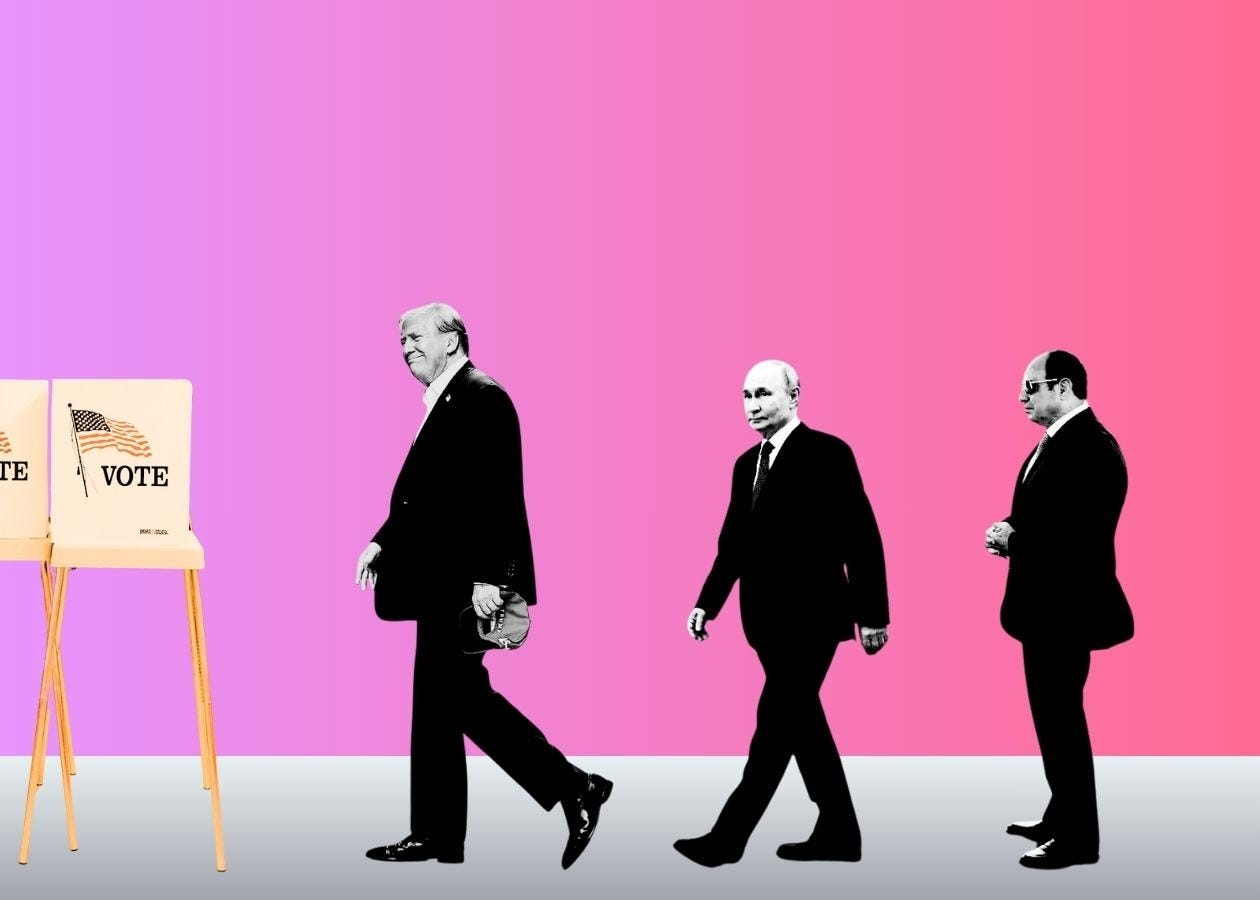
In June, at the G7 summit in France, President Trump said, “Look, our elections are totally rigged. We have rigged elections.” America’s enemies have always said that our democracy is a sham. Now we have a president who says it, and on foreign soil.
Who needs Kremlin propaganda? And who undermines trust in American democracy more than the president himself?
Traditionally, the rigging of elections is a job for dictators and their cadres. Last week, Meduza, the Russian news organization in exile, ran an article under the following headline: “As support for Putin slips, the Kremlin lowers the ruling party’s election target amid fears a landslide victory would look suspicious.”
That headline says a lot about the nature of dictatorships.
Russia will “hold” “legislative” “elections” in September. (There will be an unusual number of quotation marks in this piece of mine.) “President” Putin does not have to “run again” until 2030. But he has done pretty well in “elections” past.
In 2000, he squeaked by with 53 percent of the “vote.” (His closest competitor got 29 percent.) Since then, his total has ranged from 64 percent to 87 percent.
Of course, it helps if your main opponents are dead. Boris Nemtsov, the valiant opposition leader, was murdered in 2015 within sight of the Kremlin. Alexei Navalny, another valiant one, was murdered in 2024 while in prison.
In a 1987 column, Charles Krauthammer came up with the “Tirana Index.” Named for Albania’s capital, the index holds that, in Krauthammer’s words, “repressiveness correlates with electoral success.” In 1982, the Albanian dictator Enver Hoxha had won by 1,627,959 votes to 1.
Why was there a need for any opposing vote at all? One vote does not make a fig leaf. Maybe a thousand votes would have been more imaginative?
François Duvalier was not a man for fig leaves. In 1957, he was elected president of Haiti. This election was less corrupt than subsequent elections would be.
In 1961, Duvalier decided to stage a referendum, asking the people whether they would like six more years of him as “president.” They answered in the affirmative—by a vote of 1,320,748 to zero.
Duvalier, humble, said, “I accept the people’s will. As a revolutionary, I have no right to disregard the will of the people.”
Not waiting for the expiration of his “term,” Duvalier staged another referendum in 1964. This time, he asked the people whether they wanted to make him “president” for life. They did—by a vote of 2.8 million to 3,234.
That’s a lot of no votes—almost amounting to a fig leaf.
In 1971, the dictator was ailing and in need of a successor. That would be Jean-Claude, his only son. But according to the Haitian constitution, you had to be 40 to be president. And Jean-Claude was 19.
Duvalier père, ever thoughtful, asked the people whether they wanted the age minimum lowered to 18. In tandem with that, he asked them whether they wanted Jean-Claude to be his successor.
Amazingly, they did, and without a fig leaf: the result was 2,391,916 to zero.
“Papa Doc” died in April 1971, and the 19-year-old “Baby Doc” took over, becoming the youngest national leader in the world. (Those interested in more on this subject may consult my book Children of Monsters: An Inquiry into the Sons and Daughters of Dictators.)
ICYMI: Tune in to the latest episode of the Older/Wiser Podcast

Saddam Hussein took power in Iraq in 1979. In 1995, it occurred to him to hold a referendum, ratifying his rule. Why do they do it? Why do dictators go through the charade? Their ego may demand it. Also, these charades might be the tribute that vice pays to virtue.
In 1995, 8.4 million “votes” were “cast,” and Saddam Hussein got 99.96 percent of them. Some 3,000 “votes” went the other way—same as in Haiti in 1964.
By 2002, Saddam Hussein was even more popular. He staged another referendum, this time winning 100 percent, in a 100 percent turnout—11,445,638 “votes.”
Putin is more canny than that, you see. He assigns himself more plausible, though equally fraudulent, percentages.
In Egypt, “President” Sisi had an “opponent” in the 2018 “election.” It was an interesting kind of opponent to have: the man, Moussa Mostafa Moussa, endorsed Sisi. Moussa got almost 3 percent of the vote anyway.
Back in 1996, Yasser Arafat allowed an opponent in the Palestinian Authority. She was a grandmother, Samiha Khalil, who got 11.5 percent against Arafat—which was pretty respectable, under the circumstances.
I have written in a jocular or sardonic manner about a grave and maddening subject: the faking of elections by dictators and the denial of rights to citizens.
For many years, I heard people say, “Castro is popular with his people, you know!” One answer was this: “If that’s true, why doesn’t he prove it? If he is so popular, why doesn’t he allow opposition parties? Why doesn’t he allow independent media? Why doesn’t he allow free and fair elections?”
Also: “Why does he exile, jail, maim, or murder his critics?”
In recent years, I have heard people say, “Putin is popular with his people, you know!” The same answer applies.
Let me end where I began, with the United States. On January 2, 2021, President Trump got on the phone with Brad Raffensperger, the secretary of state in Georgia. Trump had lost the election in November 2020, and he was trying to overturn it. One state he was trying to reverse was Georgia.
Trump said to Raffensperger, “What I want to do is this: I just want to find 11,780 votes.” That is a specific, not a ballpark, number. Biden had won Georgia by 11,779. Trump was not even allowing himself a cushion.
On Thanksgiving Day, at the White House, Trump had said of Raffensperger, “He’s an enemy of the people.”
Dictators, rather than democrats, talk that way. So far, our constitutional “guardrails” have held, more or less. But whack on them long enough, and who knows?


I’m fond of saying “if Trump were a known Russian agent, what would he be doing differently”
Theodore Dalrymple covered these lopsided “election” results. (Now you’ve got me doing it.) The point is to humiliate and demoralize the people. You see ridiculous lies coming from the official media, and you look around and see virtually all your countrymen pretending to believe them. You conclude that all of your countrymen are liars or cowards, so what would be the point of resisting?
Trump’s done this in America on a smaller scale, which is why his nominees to high office tell Senate committees they have no idea who won the 2020 election.