


Jay Nordlinger is a senior resident fellow at the Renew Democracy Initiative and a contributor at The Next Move.
The new NSS is interesting, in the sense of the familiar curse: “May you live in interesting times.”
“NSS” stands for “National Security Strategy” (i.e., America’s). The one issued last month includes the now-standard flattery of the president: “President Trump has cemented his legacy as The President of Peace.” But there are plenty of other matters to interest the reader.
One of those matters is this:
Middle East partners are demonstrating their commitment to combatting radicalism, a trendline American policy should continue to encourage. But doing so will require dropping America’s misguided experiment with hectoring these nations—especially the Gulf monarchies—into abandoning their traditions and historic forms of government. We should encourage and applaud reform when and where it emerges organically, without trying to impose it from without.
That is a perfectly reasonable statement. But the phrase “traditions and historic forms of government” should be examined. Which I will do in a moment. First, a word about “hectoring.”
One man’s hectoring, I suppose, is another man’s standing up for basic human values: for instance, a critic of the government should not be tortured to death.
Trump’s first trip abroad as president, in 2017, was to Saudi Arabia. On landing in Riyadh, he said, “We are not here to lecture. We are not here to tell other people how to live, what to do, who to be, or how to worship.”
What a relief that must have been, to dictators! Because, as they see it, it’s their job to tell other people how to live, what to do, etc.
Early in his second term—in May 2025—Trump again flew to Saudi Arabia. (It would have been his first foreign trip of the term, but he had gone to Rome to attend Pope Francis’s funeral.) Trump again assured officials that the United States would not be giving “lectures on how to live.”
But Trump and his people—his vice president, his cabinet—like to give lectures. Especially to Canada, Denmark, Germany, and other democracies.
Five days after he returned from the Middle East last May, President Trump hosted South Africa’s president, Cyril Ramaphosa, in the Oval Office. There, Trump gave a quite stern lecture, accusing the South African government of genocide.
Genocide, no less.
Has he ever accused the Chinese government of genocide—genocide of the Uyghurs? Has he ever accused the Russian government of genocide—genocide of the Ukrainians?
It’s hard, if not impossible, to imagine Trump doing so.
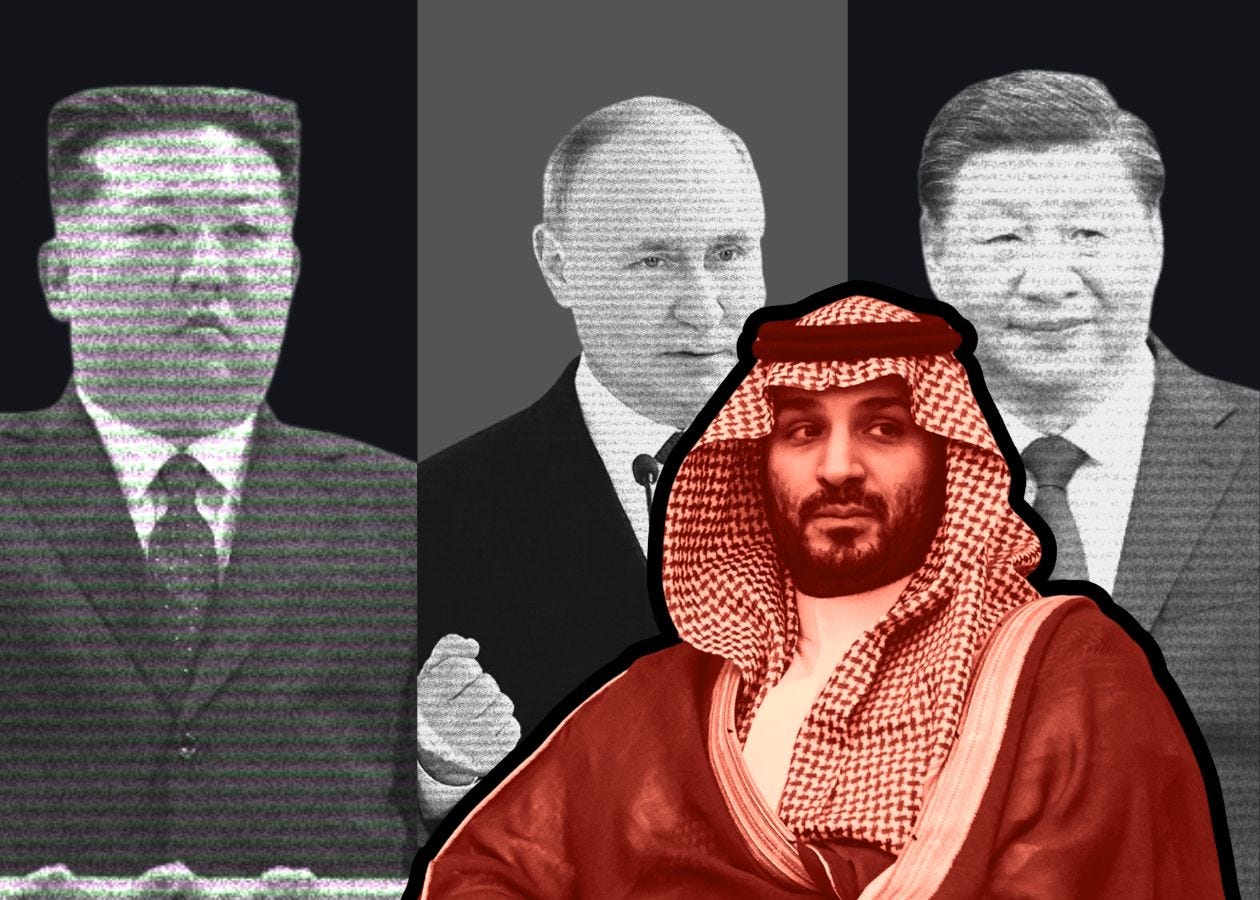
Ukraine’s president, Volodymyr Zelensky, he has labeled a “dictator.” Is Trump in the habit of so labeling real dictators? Vladimir Putin, for example, or Xi Jinping, or Mohammed bin Salman?
Now to this matter of “traditions and historic forms of government.” When you hear such language, watch out—it can be an excuse for tyranny.
Defenders of dictatorship in Spain and Portugal used to say, “Those countries aren’t made for liberal democracy. Liberal democracy is for the English types. The Iberians respect throne and altar.”
The transitions of Spain and Portugal to democracy in the 1970s were brave, inspired, and inspiring affairs.
When I was growing up, in the ’70s and ’80s, I heard a lot about “Asian values.” Asia had its own values, you see, and they did not include liberal democratic ones, which were for Westerners (including Spaniards and Portuguese, apparently).
Is Japan not Asian? Is Taiwan not Asian—indeed, a Chinese country? You can imagine how Taiwan spooks the autocrats in Beijing: What if people on the mainland get the idea that they, too, can live in democracy?
The Kremlin is similarly spooked. Vladimir Kara-Murza, the Russian politician, dissident, and former political prisoner, made this point to me back in 2017.
More from The Next Move:

It’s one thing if democracy takes root in Latvia, say, or Poland. It’s another if democracy takes root in Ukraine—which has long had so much in common with Russia. Maybe people in Russia will get dangerous ideas! Could they rebel against their “historic form of government,” namely dictatorship?
In the 2010s, millions of people in Hong Kong took to the streets, trying to hang on to the democracy they had enjoyed. But what Beijing succeeded in imposing on them was—well, the “historic form of government,” if that’s what Chinese communism (which took power in 1949) is.
The Korean Peninsula is a textbook case. People in North Korea and South Korea speak the same language. They share the same DNA, the same ancestry. They eat the same food (to the extent the North Koreans can eat).
Tell me, is the communism of Kim Il-sung and his heirs the North’s “historic form of government”? (The Soviets set up that government in 1948.)
South Korea, meanwhile, is a liberal democracy, having thrown off military dictatorship in the 1980s (as the Taiwanese were doing in the same period).
Not all soil is equally fertile for democracy. The sands of the Middle East are stubborn. Yet there are many Arabs, Iranians, Turks, and others who long for basic freedoms and rights—freedoms and rights that many of us take for granted.
I recall something that Bernard Lewis, the great Middle East historian, liked to say. It went something like this: “Some people think that Arabs aren’t fit for democracy and can never be. Unlike Westerners, they are born to be ruled.”
Then Professor Lewis would lean forward with a twinkle in his eye and say, “This is known as the ‘pro-Arab view.’”
You could argue, plausibly, that dictatorship is the “historic form of government” for all mankind. But the Enlightenment was a blessed bump in the road.
In 2020, the U.S. Congress passed the Uyghur Human Rights Policy Act. The vote was 413 to 1—and the 1 was Thomas Massie, the Kentucky Republican, who said, “When our government meddles in the internal affairs of foreign countries, it invites those governments to meddle in our affairs.”
I thought of Solzhenitsyn, who said,
On our crowded planet there are no longer any “internal affairs.” The Communist leaders say, “Don’t interfere in our internal affairs. Let us strangle our citizens in peace and quiet.” But I tell you: Interfere more and more. Interfere as much as you can. We beg you to come and interfere.
This is not always possible and it is not always wise. Prudence should be a leading factor in foreign policy. But a democratic and decent government will spare a thought for the dissidents, the political prisoners, the people risking and sacrificing everything for a better national life.
For years, people said to me, “Fidel Castro is popular with his people, you know.” One response was: “Oh? Is he as sure as you are? He bans opposition parties and independent media. He refuses to hold free and fair elections. He imprisons, exiles, or kills his critics. Does that sound like someone confident of his own popularity?”
In the last many years, people have said to me, “Vladimir Putin is popular with his people, you know.” The same response applies.
Yes, there are “traditions and historic forms of government”—and in some cases, they ought to be respected. They should certainly be borne in mind. But “tradition” can simply mean that one family, or one party, has lorded it over everyone else for generations.
There’s nothing on earth more traditional than slavery. But thank heaven for the abolitionists—for the freedom advocates, wherever they live.
More from The Next Move:

Trump’s Attack on Immigrants Will Redefine What It Means To Be American

The administration’s immigration aims and the meaning of citizenship.

Cheeto’s And Nazi Republican Attack On Voting Rights
Fundamental to the Nazi Republican attempt to turn our republic into an authoritarian regime is to do away with thousands if not millions of registered voters who are labeled “enemies of the people” It’s important with daily news cycle distributed information to lose sight of the Nazi’s primary goal
Make no mistake the underlying ongoing effort to subvert and suppress registered voters is THE primary action of the Nazi Republican party So we should not take our eyes off the process that the Nazis have put in place as their primary objective
Cheeto loyalists at DOJ have replaced those who worked to insure free and fair elections Agencies to oversee elections including foreign interference have been cut Of course the gerrymandering has gotten to a boiling point And we can expect more attacks going forward
But Marc Elias at Democracy Docket(can sign up for free) underscores that elections and their certification occur not at the Federal but at the state level so protections against Cheeto’s attack and usurp electoral results will only go so far So WE the People control our own destiny when it comes to preventing the republic from collapse
In a just political world, the Dick Tators (hat tip Jonah) pictured above would be WANTED DEAD OR ALIVE…for I believe in the death penalty for mass murderers. Trump likes doing business with monsters because The Don envies the mobsters power over millions of people, whose subjects not only have to kick up to their dear leaders, but go down on them too…GOD HELP U.S. We the Living in Kakistocracy (hat tip Allah Pundit), I mean Idiocracy. Here we are now, Trump entertain U.S. In the meantime, can some so called leader in the still free Western world put a billion dollar bitcoin bounty on Stalin’s, I mean Putins head.