


Jay Nordlinger is a resident senior fellow at the Renew Democracy Initiative and a contributing writer at The Next Move.
President Trump, his administration, and his Republican Party have not been blasting Russia and China. Those are monstrous, murderous dictatorships (and sworn enemies of the United States). No, they have been blasting Canada.
The United States has been fortunate in many ways. We have certainly been fortunate in having Canada as a neighbor. How many countries get so friendly, so like-minded, a neighbor, no matter our occasional disagreements?
Remember this extraordinary fact: the border between our countries is the longest undefended border in the world.
Nevertheless, Trump & Co. have cast Canada as a villain. They say that Canada has taken advantage of us, swindled us, done us dirty. In the minds of the new Republicans—the post-2016 Republicans—America is perpetually a victim, a “pitiful, helpless giant” (to borrow Nixon’s phrase).
What’s more, Trump & Co. have repeatedly threatened to annex Canada. “The 51st state,” they call it.
Are they just joking? “Trolling”? If so, is that the way the US government—any serious government—should conduct itself?
On Tuesday, the White House put out this charming meme:
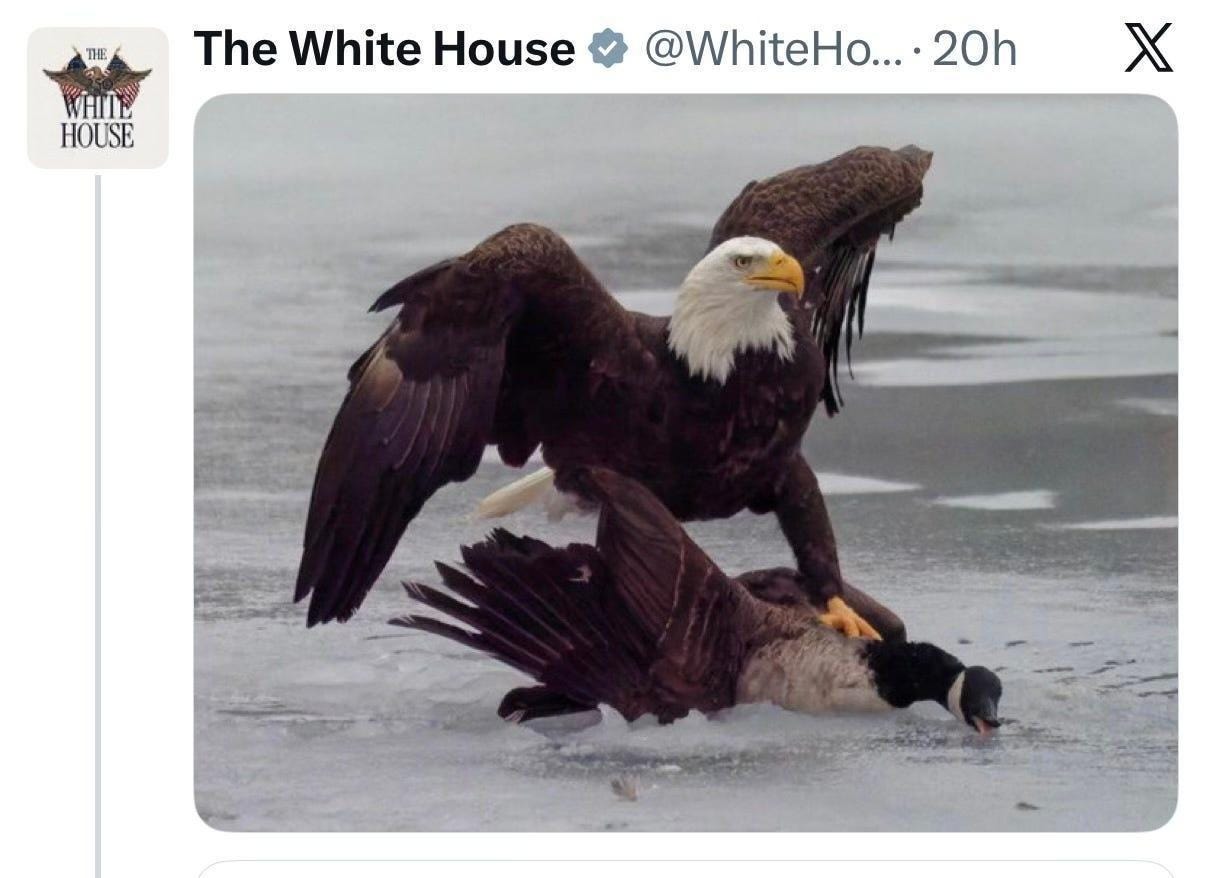
Here we have an eagle, mauling a goose—a Canada goose. Get it? Pretty cool, huh?
Then there is this:
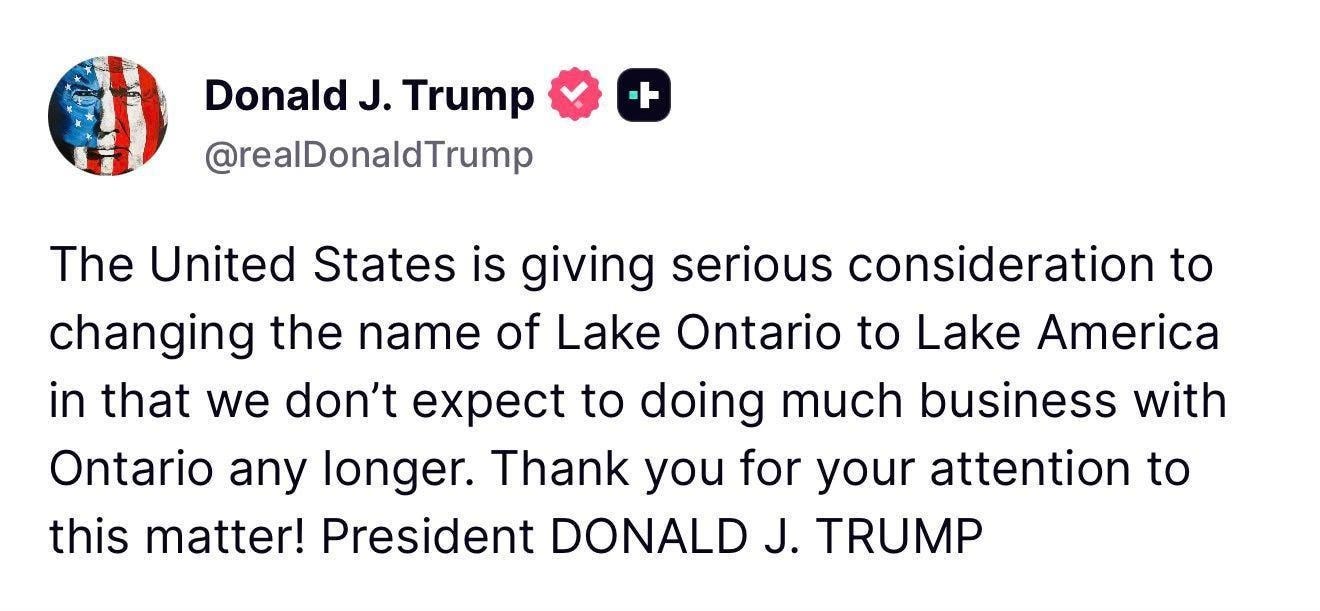
Our president is big in the renaming business. (Think “Gulf of America,” as opposed to the somehow intolerable “Gulf of Mexico.”) Trump doesn’t consult anyone—that would be prissy process stuff. He is the type who decrees.
Here is another example of the president’s handiwork:
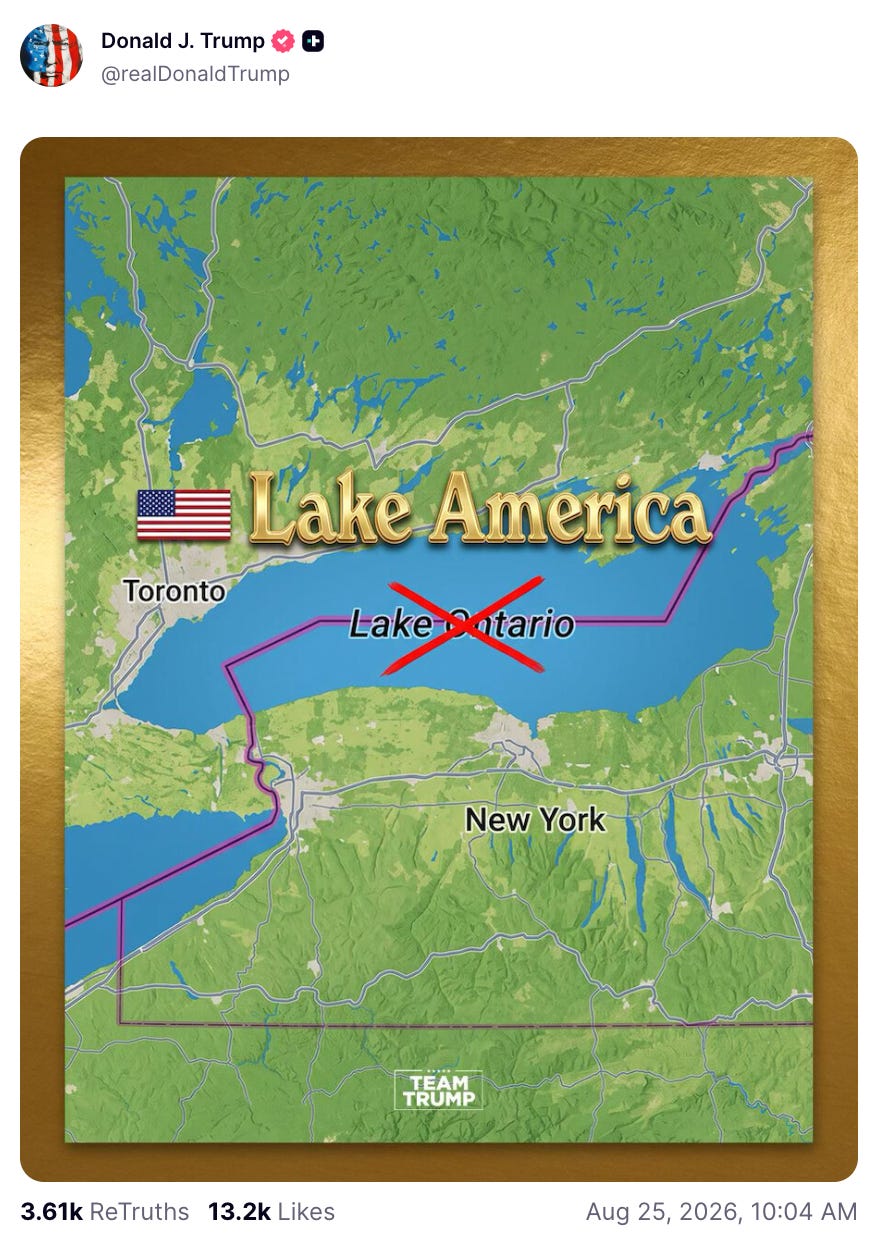
If you regard this as childish, some will claim that you have “TDS,” i.e., “Trump Derangement Syndrome.” In all likelihood, you simply have a mature idea of what a president of the United States, and his country, ought to be.
Turn, now, to the vice president, JD Vance, who earlier this week told an audience, “Canada is a state. Sorry. Freudian slip. That was actually an accident.” Was it?
The first month of 2025 seems a long time ago, but think back to it. On January 30, 10 days after the second Trump administration began, Kristi Noem, who was then our secretary of homeland security, traveled to the Northeast. She visited the Haskell Free Library and Opera House, which straddles the US–Canadian border.
On one side is Derby Line, Vermont; on the other is Rock Island, Quebec. The Haskell family built the structure on the border because they wanted Americans and Canadians to have equal access.
Throughout the building, there is a black line, indicating the border. On her visit, Secretary Noem hopped from one side to the other. “USA No. 1,” she said on the American side. “The 51st state,” she said on the other. She did this over and over.
In a piece published a few months later, I asked, “Was this patriotism? If you’re really number one, do you have to thump your chest about it? Do you have to belittle someone else? How should a great and good country behave?”
Long ago, I learned a point from William F. Buckley Jr., the late and great writer. It went something like this: “There are Americans who fail to grasp that other people, too, have patriotism. That others, too, have a sense of national pride, of national dignity.”
You have heard about the “Ugly American”—the lout, ignoramus, and jingoist who crashes his way around the world. I have always kicked against this stereotype. Argued against it. Resented it. Have our president and vice president made it true? I’m afraid they have—that they, indeed, typify it.
Days after Donald Trump was sworn in for the first time, in January 2017, I had occasion to write a post titled “Mexico and Us.” “The United States is the top dog—the top dog in all the world,” I said. “Diminished, yes, but still top.”
And “in dealing with such countries as Mexico—very far from the top—we can afford to be large-minded, generous, considerate.”
In diplomacy, this costs you nothing, and gains you a lot.
“A nation, a people, must be allowed its self-respect,” I went on. “Its dignity. A nation, when it is little, must not be made to feel like a lackey or a wretch—or to be made to pay.”
You may remember that one of Donald Trump’s selling points in the 2016 presidential campaign was that he would build a wall along our southern border, and make Mexico pay for this wall.
Whatever became of that wall, by the way (never mind the funding for it)?
Bill Buckley had experience everywhere, but he had a great deal of experience in Latin America. He had lived there, and spoke Spanish. He knew the keen sensitivity in Latin America about the yanqui colossus. He had a sense of where and how the United States should tread, when it came to our southern neighbors.
Buckley was one of the relatively few conservatives who supported President Carter’s Panama Canal treaties. (George F. Will was another one.) In 1978, Buckley had a famous debate with his friend Ronald Reagan on the subject.
In that post of mine in January 2017, I wrote, “I think my 14-year-old self was on Reagan’s side. But you couldn’t deny that Buckley made some good points.”
Yes. See whether you agree:
“I hope that Governor Reagan will not tell us tonight that Panamanian pride is not involved in the matter of the treaties. He may tell us that Panamanian pride must, in this case, be subordinated to our national interest. And if he convinces me that the national interest requires the subordination of Panamanian pride, I shall side with him.”
There is, of course, a “but” coming.
“But he must not tell me that pride does not count.” And “he ought not to suggest that American pride is one thing and Panamanian pride quite something else.”
With apologies to Bill (Buckley), maybe I could leave the final words to Calvin Coolidge. That president was known as “Silent Cal,” but when he spoke, he truly had something to say.
On October 6, 1925, Coolidge delivered a speech in Omaha, Nebraska. Its title: “Toleration and Liberalism.” (This meant what sometimes goes by “classical liberalism,” of which Coolidge was a representative.)
“The generally expressed desire of ‘America first’ cannot be criticized,” said the president. “It is a perfectly correct aspiration for our people to cherish. But the problem which we have to solve is how to make America first.”
This “cannot be done by the cultivation of national bigotry, arrogance, or selfishness. Hatreds, jealousies, and suspicions will not be productive of any benefits in this direction.”
No, “we can make little contribution to the welfare of humanity on the theory that we are a superior people and all others are an inferior people. We do not need to be too loud in the assertion of our own righteousness.”
A final sentence from that president, 101 years ago:
“We can only make America first in the true sense which that means by cultivating a spirit of friendship and good will, by the exercise of the virtues of patience and forbearance, by being ‘plenteous in mercy,’ and through progress at home and helpfulness abroad standing as an example of real service to humanity.”
That was a different kind of Republicanism, a different kind of Americanism. We can have it again—if we want (and only if we want). “A nation is a daily plebiscite,” said Ernest Renan, the 19th-century French scholar. May we soon hear and heed the better angels of our nature.


In years gone by, residents of nations around the world took notice of the boorish ignorance of travelling Americans. Now we can see "Ugly" without ever leaving home. Sadly, millions saw what "Ugly" looks like, and voted for it ... three times. And(!) they still think "Ugly" is cool.
The best metaphor for what has happened to the US under Trump is the crater of destruction around the White House. It follows that our closest neighbors are going to suffer because proximity begets exposure. US, Canada and Mexico are like long time homeowners who have been friends for so long they get into each other’s yards. Then, one day the guy in the middle goes bananas and the rest is history.