


Garry Kasparov is the chairman of the Renew Democracy Initiative, which publishes The Next Move.
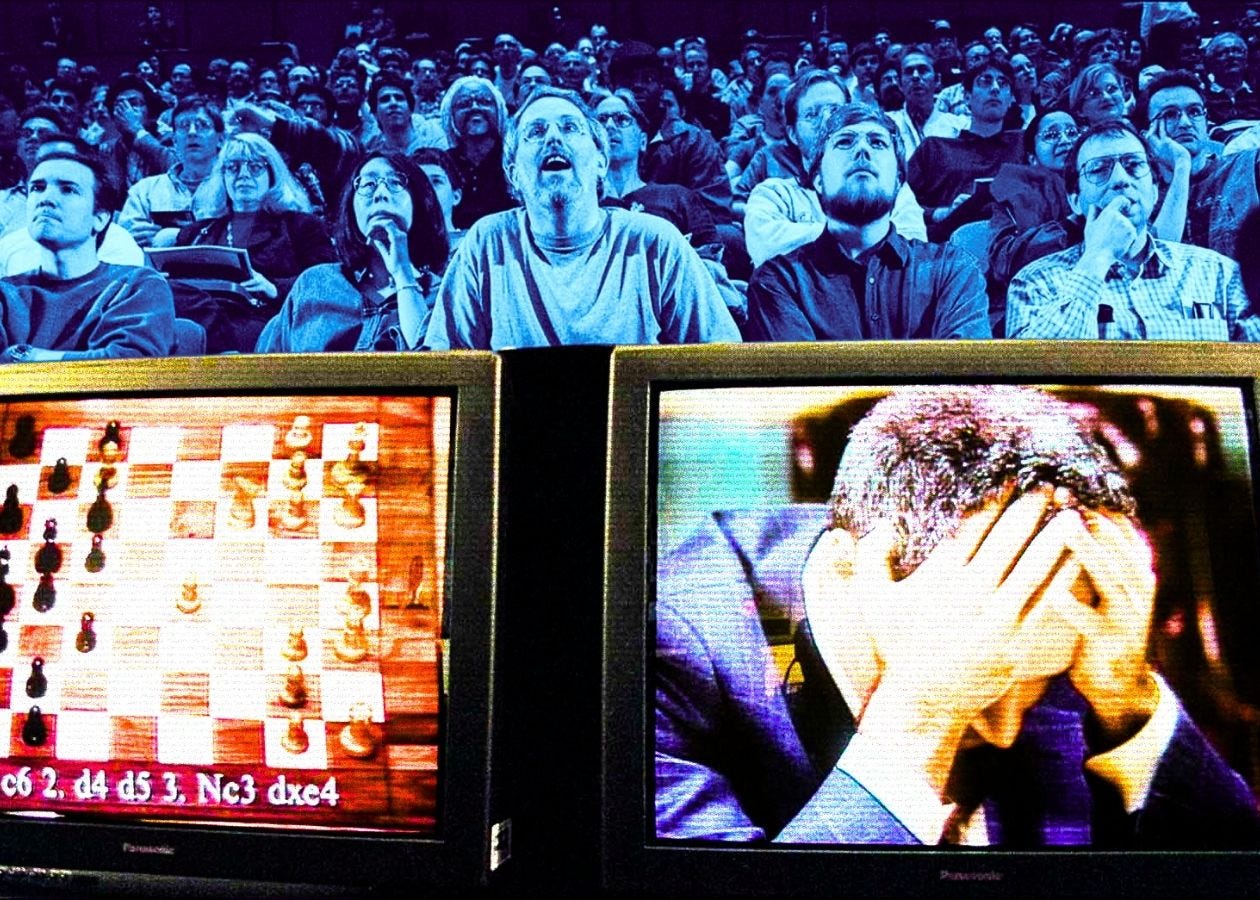
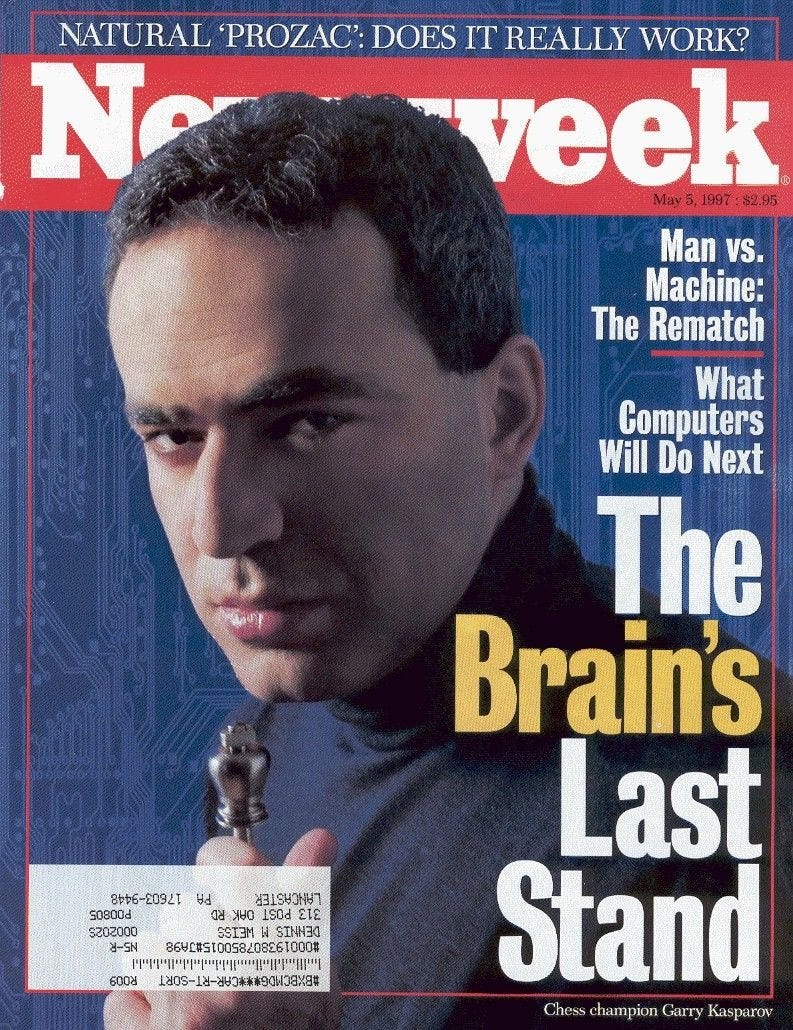
Newsweek called it “the brain’s last stand:” the brain in question was mine, bested at chess in a rematch against an IBM supercomputer called Deep Blue. Nearly 30 years ago, I became the first knowledge worker to lose their job to a machine in the AI era.
Today, artificial intelligence can do a lot more than embarrass a Russian chess player. AI is already driving medical breakthroughs and improvements in everyday life. Yet over the past year, AI has become a political third rail among Americans. Attitudes have evolved from hopeful to outright apocalyptic.
This trend isn’t exactly surprising. The public is being treated to increasingly fevered rhetoric around AI, with each new pronouncement more outrageous than the last. One Anthropic researcher, Jacob Coxon, resigned in dramatic fashion over the technology’s allegedly world-ending risks. Another Anthropic employee responded with a now-viral X post, casually suggesting a greater than one-in-ten chance that AI will destroy humanity in the near future.
Not long after that exchange, Anthropic CEO Dario Amodei appealed for a slowdown in development. Elon Musk and OpenAI’s Sam Altman both seconded him. Donald Trump entered the fray, dismissing calls for pacing and regulation out of hand. According to Trump, the only AI safeguard Americans need is a “STRONG AND SMART (High IQ!) PRESIDENT.”
Amid these mixed signals, I fear that we’re losing the plot. There are undoubtedly serious risks associated with this technology, but also transformative opportunities. Humanity has confronted this tradeoff at every revolutionary turn in the history of science. We can pursue AI’s benefits without giving up the habits of thought that make us capable citizens of a democracy. The democratic world urgently needs a coherent, positive vision for artificial intelligence. That vision should be buoyed by AI’s enormous potential to improve the life of every person—and grounded in the reality that authoritarian regimes will continue developing this technology even if free societies stop.
Humanity’s AI opportunity
In the 1960s, American leaders made the case to the public that going to the moon was worth it. They often did so in positive, values-based terms. Space exploration was a point of national pride, even as it was beset by unknowns; as President Kennedy put it, a “goal [that] will serve to organize and measure the best of our energies and skills.”
AI is already yielding benefits small and large. Perhaps you’ve already used it to plan a trip. Or maybe you’re feeling a little less like Dilbert after utilizing AI to eliminate repetitive, mind-numbing tasks at work.
Millions have already ridden in self-driving cars, made possible by AI, which are much safer than their human-driven counterparts and could ultimately eliminate traffic accidents, a leading cause of death among Americans.
Researchers are making advances in early cancer detection. AI-powered personalized cancer vaccines sound like science fiction. They cleared phase three trials last month.
These early breakthroughs are just the tip of the iceberg. AI-assisted screening and treatments for diseases will almost certainly give way to cures. Artificial intelligence’s capacities for pattern recognition and rapid data processing open the door to even more transformative discoveries. This, too, can be a field that organizes and measures the best of our energies and skills.
In fact, Americans are experiencing tangible benefits from AI far more directly than they ever felt the consequences of the lunar landing. Yet no leader has stood up and made the moonshot case for artificial intelligence. Part of this simply comes down to who is in the White House right now—suffice it to say, Donald Trump is no Jack Kennedy.
Still, even Trump’s opponents are reactive—unsure of what to do about AI. Democratic voters will place “science is real” signs in their front yards, yet they tend to be even more pessimistic about artificial intelligence than their Republican neighbors. Senator Bernie Sanders and Representative Alexandria Ocasio-Cortez are pushing a nationwide data center moratorium that essentially stops science in its tracks.
Risks, real and exaggerated
In spite of AI’s enormous potential, conversations around artificial intelligence invariably start with the downsides. Negativity bias and loss aversion are simply human nature: we feel losses roughly twice as intensely as we do equivalent gains. And the risks are real.
People respond to what hits their wallets and their ability to provide for their families. It makes sense that the average American’s biggest fears about AI relate to job displacement or the impact of data centers on their communities.
While millions ponder the prospect of machines taking their jobs, elite observers, including industry leaders like Amodei, have raised the specter of bad actors assembling biological weapons with the help of AI.
However, AI can’t autonomously manufacture the equipment needed to build a bioweapon, just as homemade bomb recipes published on the Internet don’t automatically grant users access to the ingredients. In other words, plenty of hurdles remain before an attack is actually carried out and there are clear things we can do to prevent it. Federal law enforcement agencies have worked with companies to detect suspicious purchases that could be the pieces of a DIY terrorism plot. Authorities can also work with AI companies to detect when someone is trying to create something truly dangerous.
Some forecasts are even more theatrical than talk of bioweapons. Predictions that AI will bring about the end of the world in the near future will continue to grab headlines, even as they remain light on specifics. Our social media-driven public discourse rewards being loud over being nuanced.
Today, well-intentioned researchers may feel the only way to bring attention to problems with AI is to make bombastic claims. “We really do earnestly believe AI could kill all humans!” wrote Anthropic’s Evan Hubinger, who set the now-infamous odds of AI-driven extinction at over 10% in the next 10 years.
People like Hubinger and Jacob Coxon generate buzz now. But what happens in a decade when we are all still alive (as I expect we will be)?
The answer is that genuine concerns about AI will be subject to a boy-who-cried-wolf effect. AI doomerism echoes climate doomerism. How many fatal climate-related deadlines have we passed already? Climate change is real, and AI does pose risks, but people can only hear that the planet is in its death throes so many times before they check out. This means that those who oppose regulation of AI altogether will gain the upper hand against discredited, alarmist critics.
Thinking about what could go wrong with artificial intelligence isn’t the problem. It would be irresponsible not to.
The issue is that we too often end the conversation with the negatives. We assume that things won’t improve. Our leaders need to reject this fatalism and lay out a dynamic vision.
Take the question of data centers: they’re understandably unpopular given concerns around noise, land usage, and the cost to communities where they’re built. But Americans talk about data centers and AI as if the way they exist in 2026 is the way that they’ll exist forever. Imagine if people at the turn of the last century had looked at the Ford Model T and decided that cars weren’t worth it because they would always be loud, dirty, primitive motor carriages. We would never have moved forward.
The answer to data centers is not to ban them but to regulate them to mitigate negative impacts and ensure that they don’t increase the cost of living for those nearby. In the long run, we can innovate beyond many of these issues. A responsible, forward-looking leader would outline AI’s incredible promise while acknowledging—and ultimately overcoming—the hazards.
Conquer the AI challenge, don’t retreat from it
AI has people anxious about regulation, about their jobs, and about our very ability to tell what’s real from what isn’t. These are serious concerns, but they can be addressed, and the benefits of AI demand that we do.
Let’s start with the issue of regulation. In Anthropic CEO Dario Amodei’s recent appeal for an AI slowdown, he suggested third-party evaluators do the job, going so far as to call out a specific organization already contracted by the company. This is an industry asking to police itself; for all of Amodei’s admirable rhetoric, he and other AI execs will never invite a monitor that is overly critical of their work. The AI industry requires real checks and balances, and we shouldn’t have to ask “who watches the watchmen?”
Instead, in a democracy, the government—accountable to the people—should be responsible for this oversight. Most Americans (with the significant exception of Donald Trump) agree that there should be some measure of regulation. This would cover things like research, privacy and safety, and the bounds of consumer access.
The other risks, like job displacement and detecting AI-generated content, can’t just be regulated away. These are questions of how we relate to this burgeoning field. These addressing them will require whole-of-society efforts to prepare us for the proliferation of AI.
A massive, nationwide training program will be necessary to get Americans acquainted with artificial intelligence and transition them from roles that will be eliminated by AI to careers that will be created by it. People will need opportunities to hone their ethical judgment and discernment, uniquely human skills necessary for the effective management of AI agents.
Robust social norms will reinforce these campaigns. My children, like millions of others who came up through American schools, learned that Wikipedia is a brainstorming tool rather than the be-all and end-all source for completing homework. The next generation will need to be taught the same lesson about AI.
Parents, teachers, and students should heed the words of my friend Bret Stephens, who recently argued in The New York Times that writing with AI is “mentally enfeebling—an escalator toward a result when you really need to make a daily habit of taking the stairs.” I’d add a caveat to Bret’s words: there’s nothing wrong with taking the escalator from time to time, but children need the opportunity to build the muscles that enable them to walk, run, and climb in the first place.
Finally, Americans of all ages will have to learn how to identify “slop.” This will become an essential element of media literacy and democracy’s first line of defense against those seeking chaos and disruption.
For now, some practice and intuition can reveal the tells of AI writing (“It’s not just X, it’s Y”). Enough exposure and you’ll instinctively know the difference between artwork created by the human hand and the eerie sheen of AI-generated art. Your ears may be trained to know that a real person’s voice does not carry the metallic reverb heard in AI-generated videos.
Yet the very existence of these tells means someone will engineer around them and create content whose artificial-intelligence origins are not readily observable, and models are progressing quickly. A more future-proof plan will involve developing and mastering tools—many of them created with AI!—that can distinguish man-made from machine-made. Just as every home should be equipped with a carbon-monoxide detector, every person should have access to AI-detection technology.
People see their news feeds laden with AI-created content and feel their humanity slipping away. Setting boundaries for where AI belongs and where it doesn’t, being able to tell AI from organic—these can be empowering experiences, a way of reasserting our authenticity and restoring the hierarchy that puts people over robots.
The democratic world’s AI responsibility
During the space race, American leaders felt a responsibility to outrun the USSR. As someone who grew up behind the Iron Curtain, I’m glad that America won: ceding technological superiority to the autocratic Soviet regime would have been a moral and political catastrophe for the entire world.
Americans must rediscover that sense of responsibility in the AI race. The far-reaching potential of AI means that the stakes are even higher this time around. Our liberal, human values mean that democracies must stay ahead. Artificial intelligence can be an engine for incalculable progress in a society that prioritizes personal agency and individual liberty, or it can be a dangerous weapon when abused by a system where the individual does not matter.
The AI conversation in this country is too often inward-looking, detached from the reality that China and other authoritarian states are constantly innovating. Of course, dictators want it this way: China and Russia are whipping up anti-AI opinion in the United States through bots and propaganda. They are exaggerating legitimate concerns and instigating a moral panic. This is the Soviets telling you to scrap the Apollo program in 1961.
I can say with a fair bit of certainty—and firsthand experience—that apparatchiks in the Kremlin and party functionaries in Beijing are not reflecting on the moral quandaries of the AI age. They are thinking about how to wield this technology in service of their imperialistic ambitions.
Xi Jinping knows that Chinese supremacy in AI would increase Beijing’s economic leverage over smaller, poorer countries. Military innovations powered by artificial intelligence may give China a better shot at conquering Taiwan than any conventional or numerical advantage could. In such a dominant position, the Chinese Communist Party would not stop in Taiwan.
These exigent circumstances don’t mean that the US should eschew introspection. Democracies must maintain the necessary safeguards even if countries like China and Russia don’t, just as democracies still uphold freedom of speech even though our authoritarian rivals don’t.
However, the democratic world cannot turn back the clock on AI—the technology exists, it is evolving, and free countries have a duty to ensure that despots don’t acquire a monopoly on it.
The good news is that extending and preserving the democratic world’s lead on AI is in our interests anyway. Even without the threat from China, Americans still stand to benefit tremendously from artificial intelligence. The US needs public officials who are ready to buck public opinion; people who are confident in the case for the AI future, not batted around by events; lawmakers who recognize that the imperatives to innovate and to regulate are not zero-sum. Free people everywhere are waiting for leaders who embrace the challenge of AI—to paraphrase one American president—not because it is easy, but because it is hard.
More from The Next Move:
Russia Is at War With the West. Don’t Call It ‘Hybrid.’

From Georgia to Ukraine to a German airport, it’s war, plain and simple.

The people who have used AI the most are by far the most concerned about the hugging face attack.
We are entering a new era where a bad actor can rally thousands of AI agents to launch relentless cyber attacks, each one with the skill of a career hacker.
It’s sensible to discuss these dangers.
I agree on principle, but where are the people with policy skills in this administration? Nowhere!