


Garry Kasparov is the founder and chairman of the Renew Democracy Initiative, which publishes The Next Move.
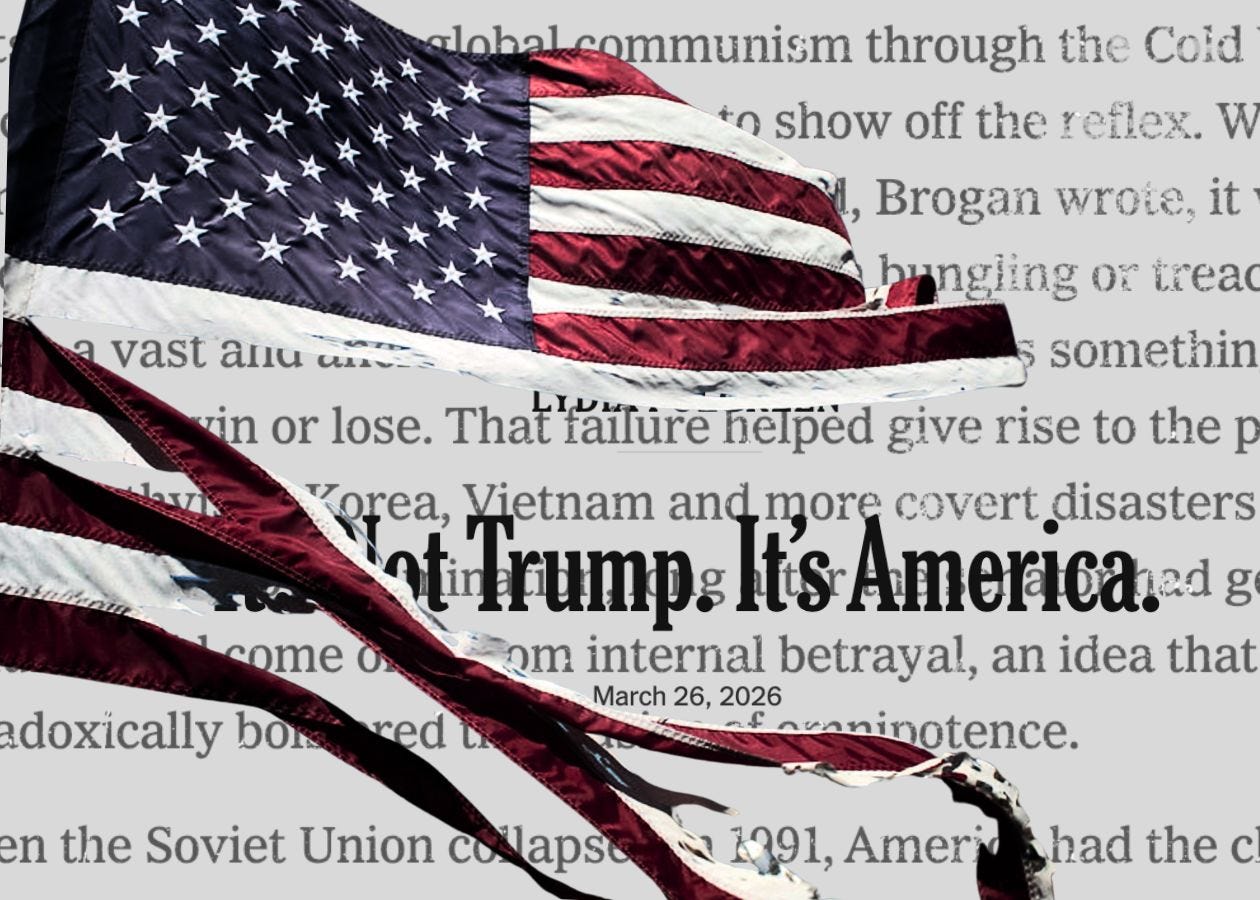
“It’s Not Trump,” a recent New York Times opinion headline proclaims, “It’s America.”
It’s an incendiary take. For columnist Lydia Polgreen, it’s not enough that America has a terrible president (and I agree, he is terrible!)—America, Polgreen insists, is a terrible country.
“Trump has revealed a much older malady,” she writes. That affliction is America’s “unshakable faith in its ability to shape the world to its liking.”
Ms. Polgreen’s piece follows in a long tradition of arguments that twist the facts to cast the United States as a nation of sin. The war in Iran provides the hook for her case that America is an inherently overconfident bully.
To prove her point, she cites Trump’s “popular-vote triumph” two years ago, sounding almost like the president himself in turning a razor-thin electoral victory into a mandate to recast all of America as MAGA country.
According to Polgreen, this is what Americans wanted (well, 49.8% of the 64.1% of eligible voters who cast their ballots), and so, this is what America is.
ICYMI: Tune in to the latest episode of the Older/Wiser Podcast

From Iran, Polgreen reaches back into America’s actions in the Cold War. Here, her analysis becomes even sloppier.
The Korean War is bafflingly listed as a US-led “disaster” alongside Vietnam.
Of course, the truth is that it was North Korea with Soviet and Chinese support that aggressed against its neighbor. US intervention in Korea is what spared half the peninsula from Stalinist tyranny under the Kim dynasty.
Yes, the history isn’t so neat—it never is. South Korea was an authoritarian government, but it was not a closed prison state like the north. American protection allowed it to flourish into a successful democracy and economic powerhouse (and I am certain that some of you are reading this article on a phone or computer made in South Korea—that wouldn’t be the case had 36,000 Americans not sacrificed their lives to save the country from communist invasion!).
In the post-Cold War era, the author pins the blame for rising Chinese autocracy on American leaders who “persuaded” Beijing to open its economy. For one thing, this process had been underway since Mao’s death in the 1970s. For someone who thinks American “omnipotence” is a dangerous illusion, Polgreen sure ascribes a lot of power to Washington.
More than that, dictators have agency. Authoritarianism is a choice. I grew up behind the Iron Curtain, witnessing the arbitrariness and cruelty of communist rule from childhood. Frankly, as a chess prodigy, I had it easier than most. Still, I can assure you that there were no US puppeteers forcing the Party’s hand. The imperfect freedom I know in America is vastly superior to what I saw in the USSR, and its zombie successor, the Russian Federation.
There are kernels of truth hidden amid Polgreen’s distortions. Yes, the problem is not Trump alone. Yes—as I have written—the presidency has become too powerful and unrestrained. I embrace self-reflection; what I reject is self-flagellation.
Anyone who makes blanket condemnations of the US (“America does not know how to exist in a world it does not control”) is more interested in appearing righteous than in winning back their country. If Americans want to reclaim their democracy, then they need to carve out a middle ground in their self-image between the ideologically-blinkered history of the 1619 Project and the state-sponsored whitewashing of Trump’s 1776 Commission.
Finally, I’d like to challenge Polgreen’s central conceit: her rejection of America’s “unshakable faith in its ability to shape the world to its liking.”
The United States was the first country founded on principles rather than ethnic or religious affiliation, or upon the hereditary right of kings. It remains unique today, painting a sharp contrast to Russia’s blood-and-soil nationalism or Iran’s Islamic Revolution.
It makes sense that Americans, who belong to a community of democratic ideas, a mission-driven organization, believe they can shape the world. People like Lydia Polgreen belong to a community of ideas too, and they would surely like for their ideas to shape the world. Their outlook is just one that is deferential to authoritarians (so long as the authoritarians are not American).
I wouldn’t call Americans’ belief in global democracy “unshakable,” as Polgreen does. Yet that commitment is there, and, I’d argue, a good thing to fight for. The United States is not perfect, but the idea of freedom is.
More from The Next Move:
Admiral Bill McRaven: We Are the Good Guys

The American war hero offers a vision of what the United States has been and still can be.

I do like reading these articles but here I’d say both Polgreen and Kasparov are partially right and totally wrong.
Polgreen’s correct that the problem isn’t just Trump, the American system created him. But framing America as uniquely sinful ignores structural realities. Korea wasn’t a “disaster”—it prevented half the peninsula from becoming a Stalinist prison state. Blaming US “persuasion” for Chinese authoritarianism gives Washington too much credit and Xi too little agency.
Kasparov’s correct that self-flagellation isn’t strategy. But his claim that “the United States was the first country founded on principles rather than ethnic or religious affiliation” is nationalist mythology, not history.
The facts:
Switzerland’s confederation (1291, formalized 1848) was built on federalism and direct democracy centuries before the US existed. Scandinavian countries developed egalitarian governance structures independent of ethnic nationalism. The Dutch Republic (1581) established religious tolerance and representative government 200 years before Philadelphia.
The US founding in 1776 wasn’t about equality, it was for wealthy white landowners. No women. No Black people. No poor people. That’s not liberal interpretation. That’s documented fact.
By international measures (and I can state this as a former US Foreign Service Officer with no hesitation), the United States wasn’t a full democracy until the Civil Rights era, 1960s at earliest. We’ve been backsliding significantly over the past decade on every democratic ranking index.
My family came from Ukraine. Like most Americans, we came from somewhere else. But I rejected nationalism and foundational myths precisely because they’re the problem.
Why do we cling to nationalist myths about American exceptionalism when we could build humanist futures instead? I worked for the US government because I believed, and still believe, America can do good in the world. But “can do good” doesn’t mean “is perfect” or “was founded purely.”
The US has done tremendous harm internally: the legal system crushes the poor and minorities, economic disparity rivals developing nations, violence is endemic. Externally, yes—some interventions prevented worse outcomes. Others were/are disasters.
Both things are true simultaneously: The American system created the conditions for Trump AND Trump made it worse. That’s not contradiction, that’s gradient.
Polgreen’s error is treating America as uniquely terrible. Kasparov’s error is treating America as uniquely principled. Both miss that nations are systems…designed by people, for purposes, with trade-offs.
The US wasn’t founded on universal principles. It was founded on principles for some people with the rhetorical framework to expand inclusion over centuries of violent struggle. That expansion happened—-incompletely, unevenly, and it’s now reversing.
The question isn’t whether America is good or bad. It’s whether we’re building systems that reduce suffering and increase flourishing regardless of national identity. Humanism as nationality. Not American exceptionalism. Not self-flagellation. Just clear-eyed assessment of what works, what fails, and what we’re building next.
Myths: American, Russian, Iranian, Icelandic, any nationalist mythology are the problem. They prevent us from seeing systems clearly and building better ones.
—Johan
P.S. At least Icelandic mythology is honest about chaos, impermanence, and Ragnarök…the gods themselves aren’t immortal. American founding mythology requires pretending wealthy white landowners invented equality while owning humans.
I’ll take the Norse honesty;)
I’ll likely get slammed for saying this, but i think what’s happening in the US political world is happening because of widespread complacency and/or complicity amongst a majority of US citizens.
Sure, DJT is a monster, and anyone paying the least bit of attention saw that before he was even elected. If they somehow still managed to miss his blatantly cruel, crude, racist, and sexist remarks, they could not have missed his words and deeds during and after his first term. Yet in November 2024, after so much was known about him, after he’d shown his true colours, after the Epstein revelations, after Jan 6, after he and countless members of his innermost circle were shown to be criminals, approximately 36% of eligible voters still didn’t care enough to show up. Of the ones who did, approximately half of them were willing to throw away women’s independence, the safety of non-whites, the legitimacy of any LGBTQ+, reasonable access to healthcare, poverty and addiction programmes, international aid, etc etc. FAR too many Americans are willfully indifferent to any form of oppression, suffering, and abuse, as long as what’s happening suits their personal desires. US schools are crap, gun violence is an epidemic, and ignorance and complacency run rampant. It’s 2026, and US still allows the rich to buy the government. It still doesn’t care that non-white communities are woefully underfunded and underserved. It still hasn’t managed to pass the equal rights amendment. Where is the love for one’s fellow citizens? Where are the Christian values?
Even many of the people who didn’t vote for Trump are part of the problem. They’re definitely clutching their pearls now that these issues are headline news, but how much did they care when they could ignore them? With a few notable and inspiring exceptions, even your opposition party’s been brilliant at the game of avoidance.
Sure, DJT is a puppet, a symptom, a puss-laden boil on the face of your country. What he isn’t, however, is the root of the rot.