


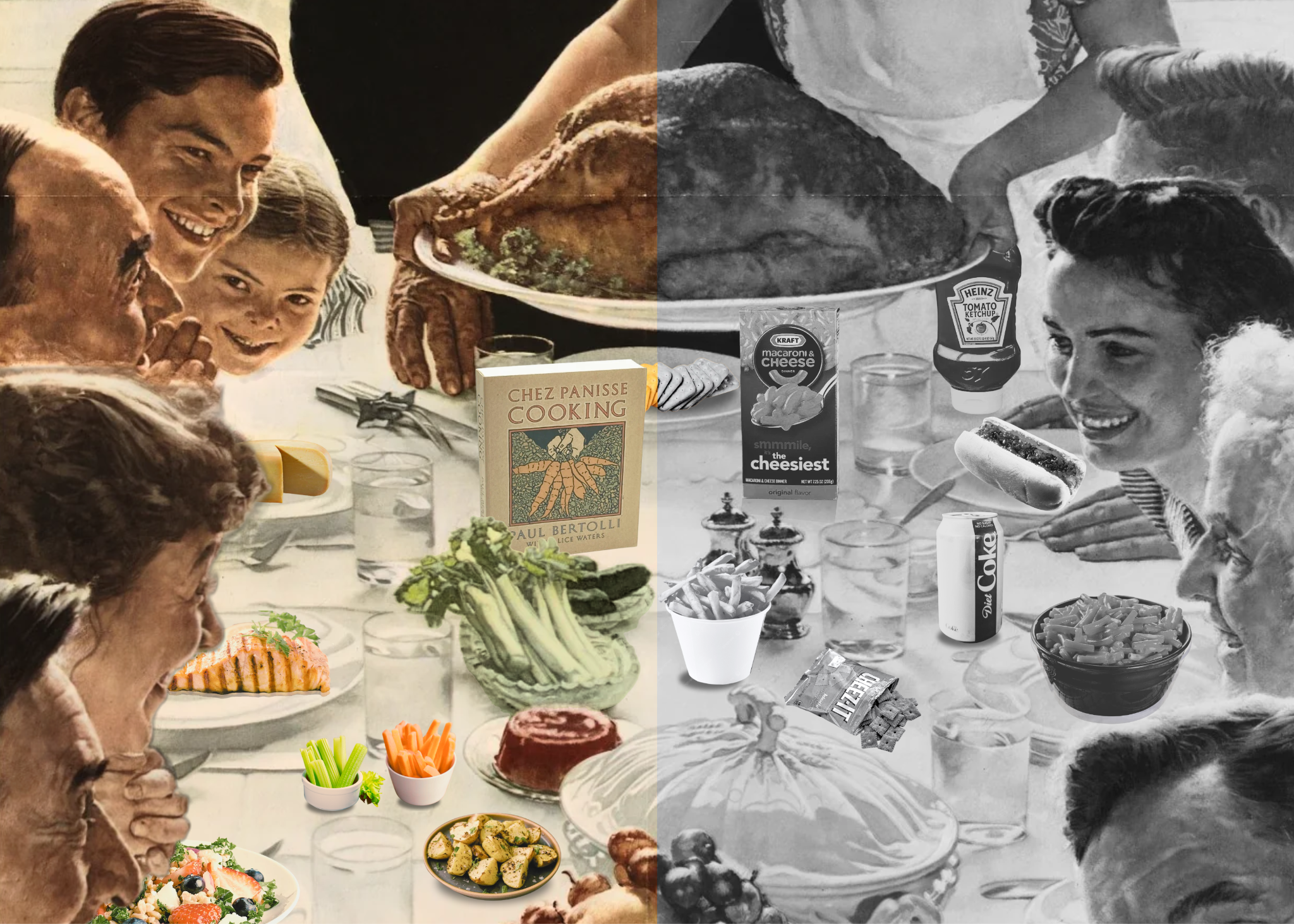
As I think about what goes on the table this Thanksgiving, I’m grateful for my mother’s refusal to buy ultra-processed foods, something I resented for most of my childhood. In fifth grade, I remember jealously watching my friend pull a brightly colored Lunchables container from his backpack. Despite my protests, my mom didn’t allow sugary cereals in the cupboard, let alone Lunchables.
Today, the internet would call her a “MAHA mom” or “MAHA adjacent” (that is, Robert F. Kennedy Jr.’s Make America Healthy Again movement)—though she wants it known that her interest in healthy living stops at eating whole foods and reading ingredient labels, and certainly doesn’t extend to raw milk and vaccine skepticism. That my liberal, Bay Area mom could now get lumped in with RFK Jr. and Trump voters says a lot about the drift of wellness culture from the American left to the right in recent years.
My mom’s opposition to ultra-processed foods is backed by evidence and should be a winning issue for a Democratic Party that insists that we “trust the science.” And on the policy front, Democrats have been leaders—last October 2025, California Governor Gavin Newsom signed a first-in-the-nation law to phase out ultra-processed foods from California school lunches. The City of San Francisco is now suing ultra-processed food makers, likening those companies’ exploitative strategies and negative health outcomes to the crimes of Big Tobacco. (Indeed, many snack manufacturers’ worst practices were pioneered in the late 1970s when tobacco giants RJ Reynolds and Philip Morris owned Nabisco and Kraft, bringing the same technology they used to engineer cigarettes to food.) On the national level, the Biden administration proposed having GLP-1 drugs for obesity covered by Medicare and Medicaid.
Yet, where the Democrats have the advantage on substance, they’ve ceded the playing field on the culture front. Democratic strategists recently outlined a three-part plan to counter MAHA: expose Republican policies that contradict MAHA’s priorities, promote the party’s work on lowering health care costs, and highlight its record on issues like pesticides. This offers no far-reaching vision beyond a checklist. As Sam Kass, the food policy adviser and White House chef who ran Michelle Obama’s Let’s Move campaign, told Politico last year, “The Democratic Party has absolutely blundered this issue.”
Meanwhile, conservatives think they’re healthier, whether or not that’s actually true—according to Psychology Today, Republicans self-report fewer health issues than Democrats. That presents a two-pronged problem: it enhances the allure of MAGA populism by tying it to the perception of a healthy lifestyle, and it also makes impressionable voters susceptible to MAHA’s pseudoscientific ideas.
ICYMI: Tune in to the latest episode of the Older/Wiser Podcast

What would it look like for Democrats to reclaim the idea of a healthy lifestyle? For starters, Democrats must recognize why people are anxious about their health and treat those anxieties like a crisis meriting serious attention. Look at the stats: In clinical trials, ultra-processed foods, which dominate about three-quarters of the US food supply, have been shown to cause overeating and weight gain. Now, nearly one in five American children have obesity, and the damage follows them into old age; a diet high in ultra-processed foods is linked with a 58% higher risk of developing dementia and a 46% higher risk of cognitive impairment. People are going to react strongly when this specter is looming over their kids’ well-being.
Next, Democrats must rally around a healthy ideal. They need to be willing to commit to the idea that being active and athletic are good things, and that a clean diet is good too. This will entail a mindset shift for some Democrats, who are loath to prescribe anything approaching a narrative of personal responsibility for fear of imitating the virtue ethics of the heavy-handed Christian right. They may also want to avoid ruffling feathers on the Far Left or among the staffer class, where “body positivity” means silencing conversations about a healthy ideal. But liberals can frame eating healthy foods in terms of freedom of choice—the freedom to choose healthier options, rather than being cornered into buying processed products by large corporations—reclaiming language that RFK Jr. has seized upon to cast doubt on vaccine safety, and repackage it in service of healthy living.
Democrats are only going to win back the lifestyle conversation if they actually promote a lifestyle. The good news is that Democrats have ready-made healthy-living messengers in the new members of Congress elected this month. Take Iowa Senator-elect Josh Turek, who won Paralympic gold in wheelchair basketball in Rio and Tokyo. Illinois Senator-elect Juliana Stratton started training at 40 and has since finished five marathons and seven triathlons. Colin Allred, the former Tennessee Titans linebacker, is returning to the House from Texas. These members join numerous other Democratic electeds with athletic backgrounds.
To be clear, this doesn’t mean that Democrats should tolerate vaccine skepticism, especially now that the US has just lost its measles elimination status. Instead, they should draw a clear line between an actual healthy lifestyle and the snake oil RFK Jr. is peddling. They can point to the fact that Kennedy has failed to regulate the food industry or even release an official definition of “ultra-processed food.” On August 10, Kennedy held a celebratory press conference announcing that the definition was on its way, but it is still stuck at the White House Budget Office with no release timetable. As the Center for Science in the Public Interest put it, the press conference served “to distract from the real harm this administration has already carried out on independent science and healthy food access.”
The Trump administration has fired thousands of expert staff at the FDA and disbanded food safety advisory committees. While telling Americans to “eat real food,” it has eliminated SNAP-Ed’s nutrition education that provides cooking classes and farmers markets in low-income neighborhoods, and ended funding for a program that helps schools buy fresh food from local farms.
My mom held the line against two children who begged for sugary, salty treats. This week, millions of Americans will be investing the same thought and care into their Thanksgiving menus that my mom put into our school lunches. Rather than write those people off as MAHA, Democrats should recognize the salience of culture-war issues like healthy living—and take them back from the Republican Party.
Ellie Lerner is an editorial associate at the Renew Democracy Initiative, where she supports editorial production and contributing authors for The Next Move.
Become a premium subscriber. Your contribution supports the work of the Renew Democracy Initiative—direct humanitarian aid to frontline communities in Ukraine, dissident-led civic education in the US, and getting more content up here on The Next Move. You’ll get exclusive access to the premium subscriber chat with Garry, early access to podcasts, and automatic entry for special giveaways.
More from The Next Move:
My Grandfather Helped Start DSA. Its Platform Is Dangerous.

When political idealism bleeds into political absolutism.
Not ‘A New Yalta.’ The Trump-Putin-Xi Summit Is Something Worse.

A novel kind of geopolitical farce.
