


Jay Nordlinger is a senior resident fellow at the Renew Democracy Initiative and a contributor at The Next Move.
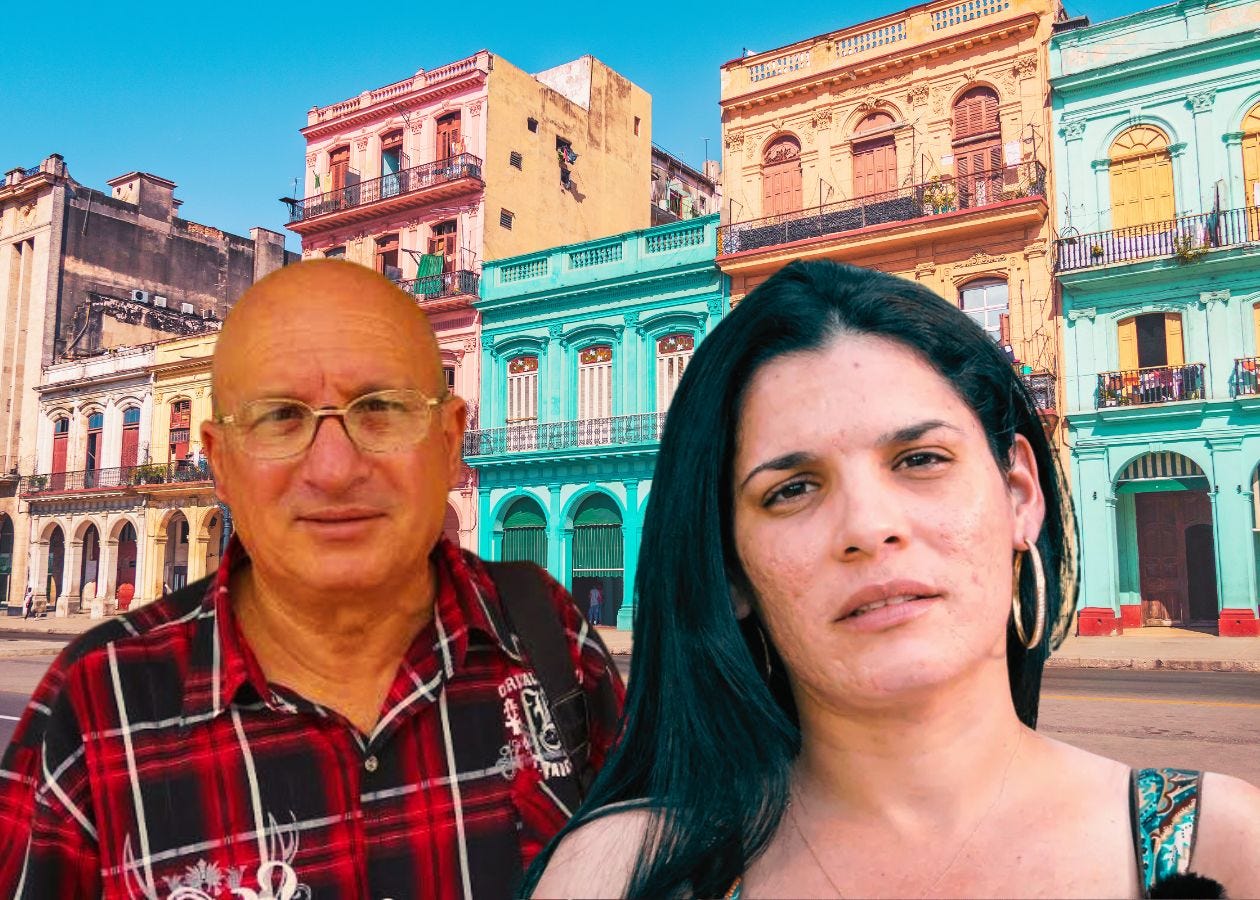
There are some 1,300 political prisoners in Cuba, and two of them are Félix Navarro and Saylí Navarro. They are father and daughter. It is very rare for a father and daughter to be political prisoners. I can think of no other example.
Félix, 73, is in Agüica Prison, a notorious maximum-security facility. Saylí, 40, is in La Bellotex, a women’s prison. Both of these prisons are in Matanzas Province.
No one in the Cuban democracy movement is more esteemed by his fellow democrats than Félix Navarro. In March 2022, the Council for Democratic Transition in Cuba put out a statement, saying, “Félix Navarro represents all the solid values that enrich the human soul: order, justice, moderation, humility, and honesty.”
The statement continues, “Hardened in the face of the unjust sentences suffered for defending freedom and rights for Cubans, he has not lost an iota of his nobility, despite the cruelty to which he has been subjected, especially now, when his daughter has also been sentenced to prison.”
Saylí Navarro is cut from the same cloth as her father.
The National Endowment for Democracy, in Washington, will honor various people with Democracy Awards in a ceremony at Mount Vernon this September. One of the honorees (in absentia) will be Félix.
NED was founded in 1983 at the instigation of President Reagan. Last year, Elon Musk, when he was a senior adviser to President Trump in charge of cutting government, said this about NED: “That evil organization needs to be dissolved.”
Fortunately, that blessed organization still breathes.
Félix Navarro Rodríguez was born on July 10, 1953, in Perico, Matanzas Province. His family was a peasant family. Bright and curious—and with a desire to help others—Félix became a teacher. But in the 1980s he took the fateful step of democratic activism.
In 1992, he was arrested for such acts as distributing pro-democracy posters. He was sentenced to prison on charges of being “anti-revolution” and spreading “enemy propaganda.” He was released in 1994 but stripped of his license to teach.
Saylí Navarro Álvarez was born on March 11, 1986, on the Isla de la Juventud, the Isle of Youth. Her youth would not be like others’. She was six when her father first went to prison. The Navarros were subject to the indignities and horrors visited on an “anti-revolutionary” family: raids on their home, arbitrary detentions, etc. Young Saylí, filled with anxiety, experienced hair loss.
But she became something strong and extraordinary. “I had to grow up prematurely,” she said in a 2013 interview with Ivette Leyva Martínez. “I feel good about what I do, I assume it as something natural. My dream is to see a democratic and legally constituted state arise in Cuba.”
In March 2003 came the “Black Spring”—the dictatorship’s crackdown on pro-democracy groups. Seventy-five democracy leaders were imprisoned, including Félix Navarro. His wife, Sonia Álvarez Campillo, and their daughter, Saylí, were among the founders of the Ladies in White.
This is a group of prisoners’ relatives who attend Mass every Sunday, wearing white, and walk peacefully through the streets. Those walks are seldom peaceful, however: the ladies are harassed and attacked by agents of the state.
ICYMI: Tune in to the latest episode of the Older/Wiser Podcast

Over and over, Saylí was detained, often violently. She said in that 2013 interview, “I never resist arrest, but they always use excessive force and hit you. I am able to overcome my fear because I know they are the ones who are committing a crime.”
Owing to her position as a dissident’s daughter, and a dissident herself, Saylí was denied the higher education available to others. But she is obviously wiser than most.
After about eight years, in late 2010 and early 2011, the Black Spring prisoners were released, in a deal brokered by the Vatican. Almost all of the prisoners were exiled to Spain, as a condition of their release. The last two prisoners to be released were Félix Navarro and José Daniel Ferrer—as they had refused to go into exile. They vowed to continue their work on the island, which they did.
On July 11, 2021, the island exploded, in mass protests. Many were arrested that day. On July 12, Félix went to his local police station, to inquire about those arrested—which was like him. He himself was arrested, along with the woman who had accompanied him: Saylí.
Félix was sentenced to nine years in prison, Saylí to eight. On what charges? You know, it doesn’t matter. If a dictatorship wants to imprison you, it just will. But, for the record, the made-up charges included “contempt,” “disturbing the peace,” and “disobedience.”
It probably goes without saying that the conditions in which the Navarros are kept, in their respective prisons, are vile and inhuman. Moreover, the 73-year-old Félix is in bad health: with diabetes, post-COVID pulmonary complications, and yet more ailments.
A few months ago—on April 8—Félix was savagely beaten in prison. They then handcuffed him and threw him into a punishment cell. Anamely Ramos, a veteran democracy activist, spoke for many when she said:
“Neither his age, nor his condition, nor the respect he commands has been sufficient to contain the violence. Félix should never have been in prison. … It is public knowledge that he is an innocent man.”
But he is not innocent of opposing the dictatorship and standing up for the rights of his fellow Cubans and human beings. Neither is his daughter.
In recent weeks, the auxiliary bishop of Havana, Eloy Ricardo Domínguez Martínez, has paid visits to both of them. He has proposed a deal: release at the price of exile. Both Navarros have refused.
Exile is a touchy subject. “Stay or go.” It is a personal, individual subject. There are great and heroic dissidents who accept exile, however grudgingly, with whatever agony. And there are others who do not. Some have no choice at all.
And whether you really have a choice can be gray …
Cubans, wherever they live, are in awe of the Navarros, and of the others like them. A totalitarian society tends to give birth to heroes. Cuba has.
Félix and Saylí are “patriots,” says Maria Werlau, the co-founder and executive director of Cuba Archive. “That, plus their great project of helping people, is considered dangerous by the Cuban dictatorship. Thus, they are paying such a high price. Their suffering breaks my heart.”
I suspect we will see the Navarros freed one day. And even Cuba itself.


As a Canadian, one of the greatest sources of national shame is my Country’s comfort and coziness with the architects of such a brutal, oppressive, stinking, torture state.
Pierre Trudeau- Justin’s father- was close friends with Fidel Castro. They would skin dive together, visit at Christmas, and entertain each with a little too much enthusiasm.
For decades, my fellow Countrymen have been happy to lap up cheap vacations, subsidized by the oppression of the Cuban people.
In a sane and just world, the Navarro family would be seen as was Nelson Mandela: that is, as a selfless, liberating spirit of a splendid people.
This was Jay Nordlinger at his best.
Well done, friend.