


Jay Nordlinger is a senior resident fellow at the Renew Democracy Initiative and a contributor at The Next Move
We should not let Hong Kong fade away. We should not let Joshua Wong fade away. Or Jimmy Lai, or others. Let me elaborate.
For a few years—2019 and 2020 in particular—the eyes of the world were on Hong Kong. It was probably the chief battleground in the perpetual war between freedom and tyranny, democracy and dictatorship.
The Chinese Communist Party was determined to make Hong Kong a city like any other in China—unfree, totalitarian. Millions of Hong Kongers were determined to keep the freedom they had enjoyed. The CCP has won, at least for now.
As Perry Link, the eminent scholar of China, remarked to me, we saw a great city “murdered before our eyes.” When I was in my 20s, I saw great cities liberated: Prague, Berlin, Budapest, Warsaw … To see a reversal was jarring and painful.
Jimmy Lai is probably the best-known political prisoner in Hong Kong. The 78-year-old businessman and democracy champion has been in prison since December 2020. (For a piece of mine about him, published in 2023, go here.)
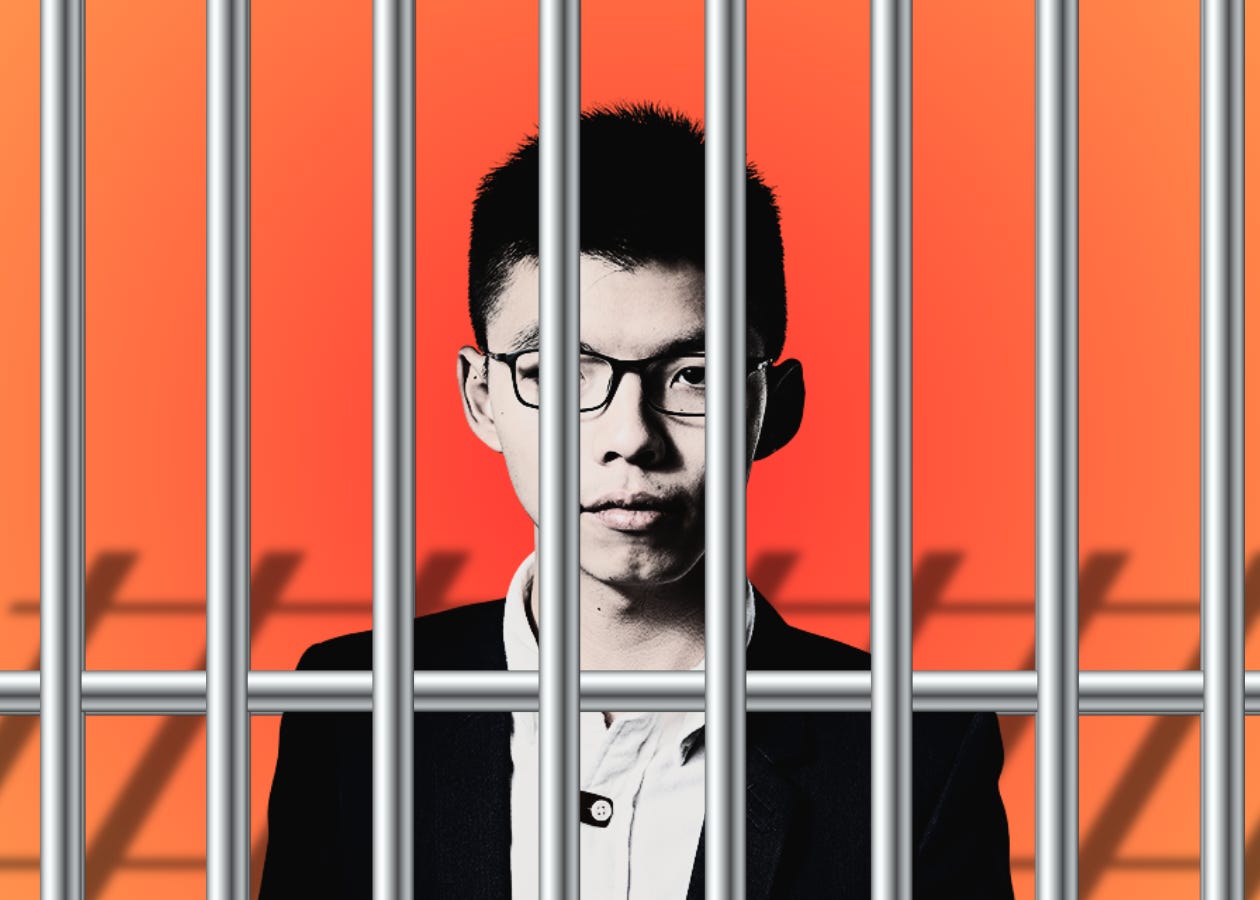
Also well-known is Joshua Wong, age 29. He has been in prison for a month longer than Jimmy Lai.
Both of them would be quick to tell you that there are other political prisoners, less well-known, who deserve all the admiration and help we can muster.
Joshua Wong, as the BBC put it, is “the poster child for political activism in Hong Kong.” In October 2014, when he was 18, he was on the cover of Time magazine: “The Face of Protest.” The cover also said, “Teenager Joshua Wong and the youth of Hong Kong are standing up for democracy. Can they win?”
It transpired that they could not—although, as I alluded to above, we are entitled to take a longer view.
ICYMI: Tune in to the latest episode of the Older/Wiser Podcast

Wong was due to be released in January 2027, after six years and two months, but he has now been charged again and faces another sentence—which could be life.
He was charged with encouraging Western governments to impose sanctions on human-rights abusers in Hong Kong and back the city’s democracy movement. In court, Wong did not dispute the charge. He pleaded guilty.
In Hong Kong’s justice system, such as it is, you have a chance at a more lenient, or less draconian, sentence if you plead guilty.
About 40 of Wong’s supporters were present in the courtroom, and some called out, “Hang in there, Joshua!”
The details of his short but eventful life can be found elsewhere, and I will confine myself to a few basic facts. He was born on October 13, 1996, to a Christian family that followed the Lutheran tradition. He went to the United Christian College (Kowloon East) and then the Open University of Hong Kong.
In May 2011, when he was just 14, he co-founded a group called Scholarism, which opposed attempts by Beijing to inject propaganda into Hong Kong curricula. In April 2016, he co-founded a political party, Demosistō, whose name was a blend of Greek and Latin, conveying the idea of standing up for democracy.
One of his co-founders was Nathan Law, who was able to leave Hong Kong in the summer of 2020, as night fell on the city. On June 30 of that year, the National Security Law went into effect. This law, in sum, bans opposition to the government. Nathan Law found asylum in Great Britain.
(Last month, The Next Move’s Linda Chavez podcasted with Law, here. I podcasted with him myself back in 2021, and subsequently wrote a piece about him and the fate of Hong Kong. For those items, go here and here.)
Joshua Wong was at the forefront of democracy protests in Hong Kong for the better part of a decade. He was in and out of prison. Upon being sentenced in 2017, he said, “You can lock up our bodies, but not our minds! We want democracy in Hong Kong. And we will not give up.”
The United States has not covered itself in glory in this matter. As time was running out, in that summer of 2020, Wong requested asylum of the United States but was denied. This, according to a 2023 book by the journalists Shibani Mahtani and Timothy McLaughlin: Among the Braves. (For an article on this subject, published by Radio Free Asia, go here.)
In the summer of 2019, as Hong Kongers were massing in the streets, a reporter asked President Trump, “Are you concerned by reports that the Chinese army may be preparing to intervene in Hong Kong against the demonstrators?” Trump said:
“Well, something is probably happening with Hong Kong, because, when you look at, you know, what’s going on, they’ve had riots for a long period of time. And I don’t know what China’s attitude is. Somebody said that at some point they’re going to want to stop that.”
The word “riots,” used by the president of the United States, was particularly unfortunate. That was the CCP’s word for these democratic protests. And the penalty for rioting in Hong Kong is severe.
Trump went on to say about the situation, “That’s between Hong Kong and that’s between China, because Hong Kong is a part of China. They’ll have to deal with that themselves. They don’t need advice.”
In November 2019, the president said, “Look, we have to stand with Hong Kong, but I’m also standing with President Xi. He’s a friend of mine. He’s an incredible guy.”
“President Xi,” the “incredible guy,” is, of course, Xi Jinping, the boss of the CCP. How you can stand with Hong Kong and stand with its persecutor at the same time is something I must leave to others to discern.
I can tell you about Joshua Wong, however. In fact, I will give the floor to Yaqiu Wang, a Chinese democracy activist in exile here in the United States:
“Joshua Wong represents precisely the kind of young citizen any society should value: intelligent, principled, and politically engaged. Instead of celebrating those qualities, the authorities have turned them into grounds for persecution. By potentially imprisoning him for life, Beijing also wants Hong Kongers to forget Joshua Wong—a young man who came to symbolize the energy, courage, and political awakening of an entire generation.”
There is a “but” coming, from Yaqiu Wang.
“But keeping him behind bars will not erase him. It will only make him an even more powerful symbol. The CCP and its henchmen in Hong Kong may be able to suppress the Hong Kong people’s desire for freedom and democracy, but they cannot extinguish it. Severe repression only drives those aspirations underground and makes them return with greater force.”
Perry Link, the scholar, is inclined to agree. He cites what he calls a “Chinese idiom”: “The bird that sticks its neck out takes the bullet.” Joshua Wong—like Jimmy Lai and many others—has stuck his neck out. “He has paid a price and is still paying it,” says Professor Link. “Is time on his side?”
The professor answers the question he has posed as follows:
“In the long run, I believe that it is, because the impulse to act morally is indeed rooted in human nature. There are victories and defeats along the way, but no oppressive authority can finally kill that impulse. I think Martin Luther King was right to say that ‘the arc of the moral universe is long, but it bends toward justice.’ Joshua’s choice was not wrong.”
More from The Next Move:
AfD: Three Lessons for America From the German Far Right’s Victory

On catch-all politics, communism, and the failure of the moderates.
An Orbán Man, Now Working for China

The tale of Foreign Minister Péter Szijjártó is a tale of our (tawdry) time.

Jay, are you familiar with the writing of journalist Terry Glavin, who happens to be Canadian?
Your contribution to these files has no challenger, but Terry comes mighty close.
I would pay extra to hear Nordlinger interviewing Glavin.
Well-done, Jay.
A fine essay about an incredibly brave man. Thank you, Jay