


Garry Kasparov is the chairman of the Renew Democracy Initiative, which publishes The Next Move.
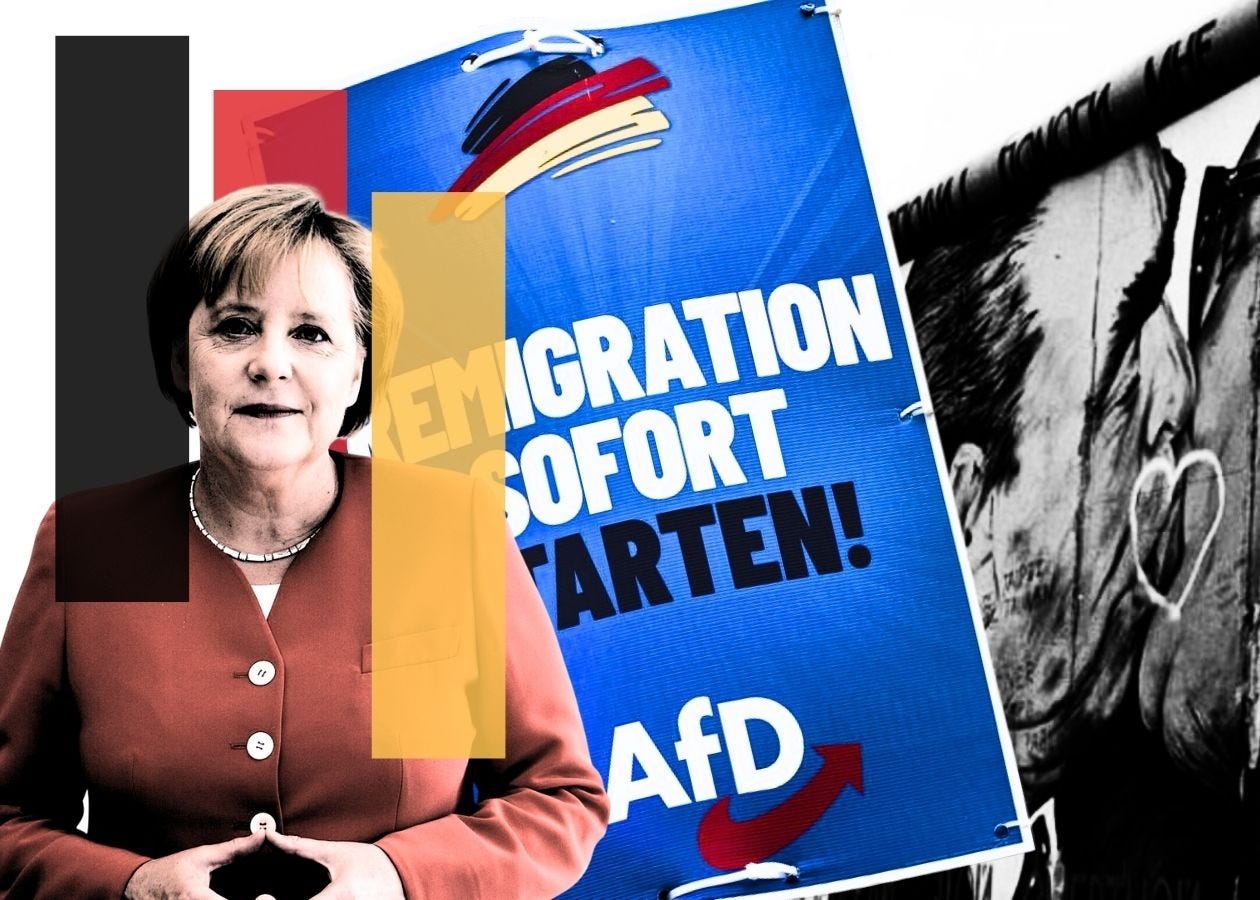
“The far-right is on the march” is the last headline you want to read in a place like Germany, but this is exactly the trajectory of the country’s politics. On Sunday, the Alternative für Deutschland (AfD) won a significant plurality—43.8% of the vote—in the state legislature elections for Saxony-Anhalt in eastern Germany. It’s the biggest victory for any party labeled “extreme right” by the German government since World War II.
There are plenty of reasons to criticize the AfD—their xenophobia, Third-Reich apologia, and pro-Russian stances, among them. But simply labeling them Nazis obscures the sources of their appeal. AfD has loomed on the precipice of success for several years now, and their next big win could be national in scale. That’s why understanding the party is so important.
Americans could benefit from this exercise as well. America’s AfD, the MAGA Republican Party, represents a far more advanced stage of the far-right cancer, which has infected all three branches of government.
If these authoritarian populists are to be excised, small-d democrats, German and American alike, will have to internalize three lessons about the far-right’s success.
AfD is all things to all people
The first lesson for Americans is that, like MAGA, AfD is succeeding in being all things to all people. Much of that is a credit to its leader, Alice Weidel.
Take AfD’s anti-woke platform, which calls for banning Pride flags from public buildings. But when it’s politically convenient, AfD will also paint a contrast against socially conservative, anti-LGBT Muslims. More to the point, Weidel is openly lesbian, with two adopted children. Recall that Donald Trump happily accepted the superlative of being the “most pro-gay president in American history.”
The same trick works with AfD’s approach to Jews and Israel. AfD is pro-Israel every other day. Weidel represents the philosemitic face of the party, easier to sell on a national level. Scratch the surface, and you will find that AfD members embrace varying degrees of pro-Nazi, anti-Jewish talking points. Pro-Israel Republicans and the antisemitic Tucker Carlson wing awkwardly cohabitate inside of one party.
The AfD is also anti-immigrant, but it is especially anti-certain-types-of-immigrants (read: Muslim). Roughly a fifth of Germans with foreign backgrounds support the AfD. About a third of Soviet/Russian-born Germans back the party. The party even got 6% of the Muslim vote in the last federal election. These numbers are all the more significant when you consider that German democracy is not a duopoly like America’s, and more than two parties are competing for immigrants’ votes. Meanwhile, Weidel’s partner is a Sri Lankan immigrant (and the first lady of the United States, a Slovenian one). Republicans, for their part, gained significant ground with immigrants between the past two presidential election cycles.
The upshot from all of this is that AfD and MAGA defy simple categorization. Yes, they are both populist, right-wing, and authoritarian-leaning, but these textbook descriptors tell us little about the people who make up their respective big tents. Rather, it’s the contradictions within each that are most revealing, pointing to a politics based more on grievance than on any consistent ideology. These competing imperatives will not sustain a stable coalition forever, and recognizing the contradictions on the far right can ultimately help us break them down.
ICYMI: Tune in to the latest episode of the Older/Wiser Podcast

AfD is the illegitimate child of communism
The second lesson is on the corrosive effects of communism. Today, openly pro-communist grifters are ascendant on the American left. DSA hacks sing the praises of China and Cuba. What the illiberal left will never acknowledge is that the same broken system that governs its favorite “workers’ paradises” also sired the far-right AfD.
A quick refresh: for half a century, eastern Germany was a single-party communist state, a Soviet satellite separated from the western two-thirds of the country. In 1989, the Berlin Wall fell, and the communists lost their monopoly on power; the next year, the two Germanies formally reunited, but the Iron Curtain remains an open wound.
AfD’s regional strongholds map neatly onto the borders of the old East Germany, where the ingredients for a populist, authoritarian-right movement are all present. Wages in the east lag behind western Germany. While the overall German population has grown since reunification, millions of people—mostly educated—fled eastern Germany. Fewer people live in the five states of the ex-Deutsche Demokratische Republik today than at the end of the Cold War. It is easiest to sell this demographic the line that foreigners are reaping the benefits of German prosperity while they get left behind, although notably fewer migrants actually live in the east.
East Germany’s persistent stuntedness is quite the indictment of communism. Democratic, capitalist West Germany quickly recovered from the comprehensive physical destruction of World War II, becoming an economic superpower. Other former right-wing dictatorships like Taiwan and South Korea prospered upon democratization. This is because, as bad as those regimes were, they remained plugged into global trade networks.
Communist regimes like East Germany, by contrast, underwent a total societal reordering. They were isolated from the rest of the world. People who were not attached to the party or state industries came into democracy with no property and no foundation for building wealth. Remember what a communist “utopia” left in its wake in eastern Germany the next time an American Democratic Socialist points to Castro as one of their icons.
AfD succeeds when moderates fail
The final lesson for Americans is that AfD sprints ahead when moderates stumble. The generation that East Germany spent under communism provided the seeds of AfD’s success, but it was the failures of the German mainstream that watered those twisted roots.
In Germany, as in America, the mismanagement of immigration energized the far-right. Germany’s case is closely tied to the situation in Syria: at the start of the last decade, dictator Bashar al Assad set about crushing the uprising in his country. He did so with the backing—and eventually direct military support—of Vladimir Putin’s Russia.
Putin understood that the brutality of Assad’s crackdown would create a humanitarian mess, not only in the Middle East but in nearby Europe as well. But even the most ambitious Kremlin strategists could not have predicted how badly Europe, and Germany especially, would bungle the refugee crisis.
In 2015, Chancellor Angela Merkel adopted an open-door policy to Syrian refugees and other migrants from the Middle East and Central Asia. She declared that other European countries should balance the burden of the human wave, but those other nations tightened their entry restrictions while over a million Syrians arrived in Germany.
The result was, in many ways, the worst of both worlds. Compassionate intentions crashed against hard realities. There were serious problems with integration; only about a quarter of the million-plus arrivals have received citizenship. A number of high-profile terrorist attacks carried out by migrants and asylum seekers lent credibility to the populist right. A decade later, the German government is trying to get some Syrians to go home, but understandably few want to.
Merkel dismissed concerns about the sudden influx of migrants with a now-infamous handwave, “Wir schaffen das”—“we can handle this.” Small wonder that the biggest loser in the Saxony-Anhalt elections was the Christian Democratic Union, the center-right party of Merkel and incumbent Chancellor Friedrich Merz.
Merkel’s arrogance is a painful echo of the Democrats’ obliviousness to the border crisis under President Joe Biden. Advisers reportedly warned Biden of “chaos” on the US-Mexico frontier if he forged ahead with lax border controls. Instead of a rational immigration policy, Americans got their own version of “Wir schaffen das,” and then they got Donald Trump.
Stating that Biden’s immigration policies strained government resources and public support is not an endorsement of MAGA xenophobia or rogue ICE excesses but an appeal for mature policymaking. Radicals on the far-right and far-left are good at pointing out problems moderates would rather not address, even if their preferred answers are extreme. If you are too afraid to confront the diagnosis, then you’ll get bad medicine.
Don’t miss out on more commentary and analysis like this. Subscribe to The Next Move today!
More from The Next Move:
Russia Is at War With the West. Don’t Call It ‘Hybrid.’

From Georgia to Ukraine to a German airport, it’s war, plain and simple.
Debate: Banning Democracy to Save Democracy?

Two perspectives: Banning an extremist party like Germany’s AfD could make the far-right faction a martyr. Or it could be the proactive defense required to protect democracy from those who abuse it.
An extensive immigration reform bill under Biden negotiated by Republican Senator Lankford of Oklahoma was killed in the Senate in February 2024. Trump himself wanted it killed, allegedly so he could campaign off immigration. You can't say nothing was done on the border during the Biden presidency.
https://apnews.com/article/congress-border-deal-rejected-lankford-immigration-045fdf42d42b26270ee1f5f73e8bc1b0
I'm glad to see focus on the former East Germany's special weakness for the AfD (I can't think of the right words to phrase this, sorry). That has gotten ignored by many, except as a simplistic "economic anxiety" excuse. And I'm glad to see the current version of the DSA called out; we do not need that poison in the Democratic Party. Too many are excusing or waving away what they actually say they stand for (this is too familiar a pattern these days).
A slight quibble about the Biden oblivious to border chaos narrative, with link to the NYT piece I found unbalanced at the time. Republicans obstructed any effort at solutions because they wanted to use immigration as a cudgel against Democrats. Biden came in with an plan on day one, which Republicans blocked. Near the end, when a bipartisan border compromise bill seemed close to passage, Trump ordered it torpedoed and Republicans obeyed. Sure, Biden made mistakes, but he did not have good-faith partners across the aisle.