


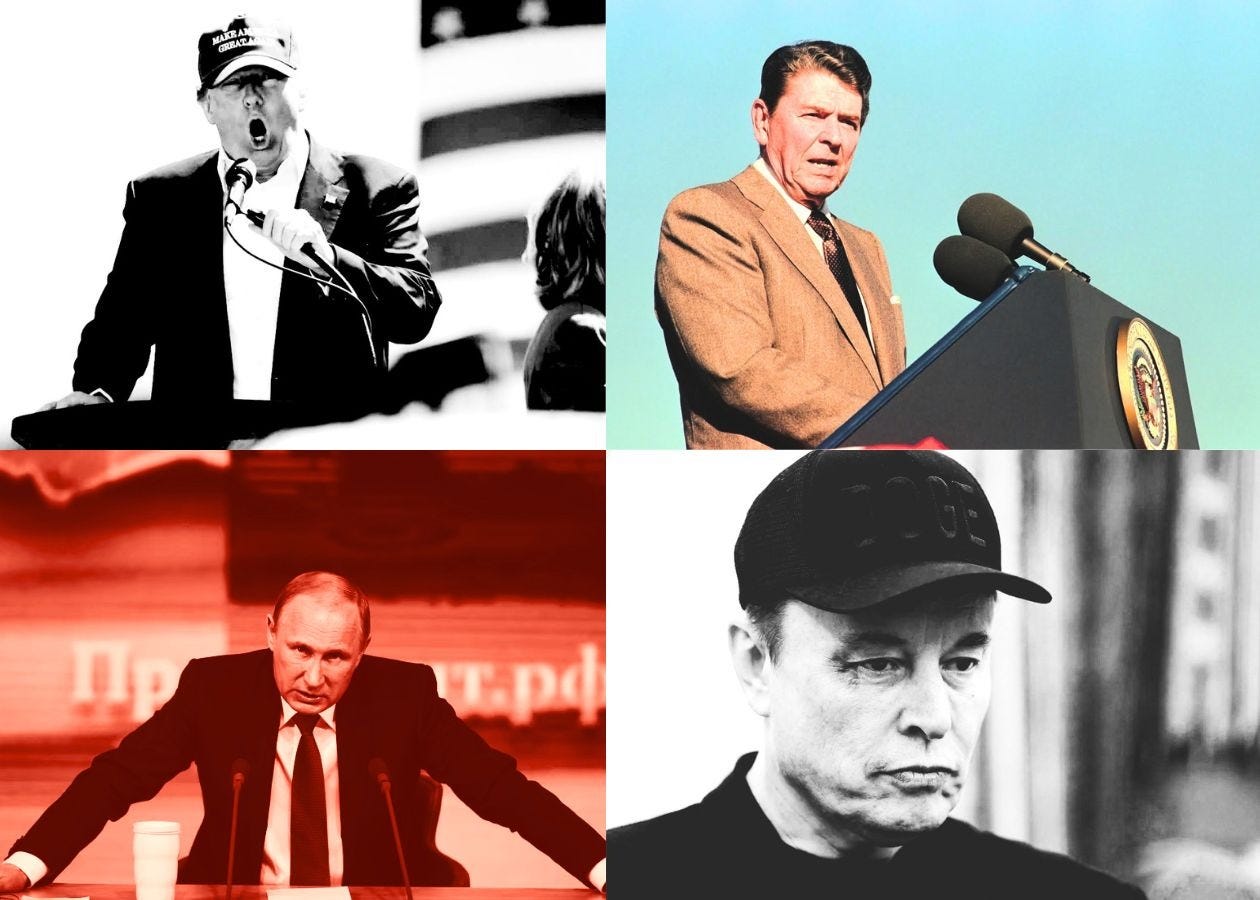
Jay Nordlinger is a senior resident fellow at the Renew Democracy Initiative and a contributor to The Next Move.
President Reagan called the Soviet Union an “evil empire,” and all hell broke loose. I remember it well. I was a freshman in college, alive to the drama of the world.
Reagan was speaking in March 1983 to the National Association of Evangelicals. He said we should beware treating the United States and the Soviet Union as moral equals. We should resist the temptation to regard the arms race as a “giant misunderstanding.” We should remember “the struggle between right and wrong, and good and evil.”
Many, many were aghast. Henry Steele Commager, the famed historian, said, “It was the worst presidential speech in American history, and I’ve read them all.” Anthony Lewis of The New York Times, in his column about the speech, said, “Primitive: that is the only word for it.”
Further, he said that Reagan had “applied a black-and-white standard to something that is much more complex.” (We will return to those colors, black and white, in due course.)
In his 1990 autobiography, Reagan addressed the controversy. His critics thought that the speech showed him to be “a rhetorical hip-shooter who was recklessly and unconsciously provoking the Soviets into war,” he said. But he made the speech, and others like it, “with malice aforethought.” (That is a typical Reagan touch—funny, sly.) “I wanted to remind the Soviets we knew what they were up to.”
Many found the speech refreshing, even cleansing. I call on Natan Sharansky, who, some 20 years later, gave this testimony:
“In 1983, I was confined to an 8-by-10-foot prison cell on the border of Siberia. My Soviet jailers gave me the privilege of reading the latest copy of Pravda. Splashed across the front page was a condemnation of President Ronald Reagan for having the temerity to call the Soviet Union an ‘evil empire.’”
How was the speech received in the Gulag?
“We dissidents were ecstatic. Finally, the leader of the Free World had spoken the truth—a truth that burned inside the heart of each and every one of us.”
Years ago, a friend told me about meeting a Polish businessman, shortly after the end of the Cold War. Making conversation, my friend praised John Paul II, the Polish pope. “He was a hero of the Cold War,” he said. But the Pole wanted to talk about Reagan.
He said he used to listen to the Voice of America in the middle of the night on a transistor radio. The radio was hidden in his house, unknown even to his family. When they were asleep, he would go into a room with no windows. He would put a towel underneath the door and an earpiece in his ear. And then listen.
One night, he heard about Reagan’s “evil empire” speech. And he knew the Cold War was over, and that the Americans had won. It was only a matter of time.
Mere truth-telling, and not so mere, can have a potent effect in a dark struggle. A little moral clarity can go a long way.
For years now, Putin’s Russia has unleashed evil on Ukraine: mass murder, mass torture, mass kidnapping. The depredations of Russian forces in Ukraine have been far worse than those of their Soviet predecessors in Hungary, say, or Czechoslovakia.
ICYMI: Tune in to the latest episode of the Older/Wiser Podcast

Last month, an article from National Public Radio quoted Robert Hamilton, a professor of international relations who spent 30 years in our military: “War crimes are part of Russia’s strategy in Ukraine, retired US Army colonel says.”
A week ago, Anne Applebaum, the historian, wrote, “People are now dying of hunger in Russian-occupied Ukraine. Another mass famine, carried out by another cruel regime.”
In 2018, Applebaum published a book about the “terror-famine,” or “Holodomor,” committed by the Soviets against Ukraine in the early 1930s: Red Famine: Stalin’s War on Ukraine.
Ten days ago, Alexander Dugin, the Russian ideologue often known as “Putin’s brain,” weighed in by saying, “The end of war in Ukraine can mean only the end of Ukraine. Nothing less.” Genocidal language, and intent, have been normalized.
Who will call it evil? Anyone?
Last Monday, a news report carried the following headline: “Trump calls on Ukraine to halt strikes on Russian diesel fuel, citing a global shortage.” If you wait to hear our president call on Russia to stop murdering civilians in Ukraine—men, women, and children—you will wait a very long time.
Recall those colors, black and white. Garry Kasparov spoke about them in April 2022, weeks after Russia’s full-scale invasion. For 20 years, he was world chess champion. He was also a Russian dissident. Today, he is the chairman of the Renew Democracy Initiative, which publishes The Next Move.
I will quote from his remarks, made those four and a half years ago:
“When I retired from chess in 2005 to form the anti-Putin opposition, many said, ‘Garry, this is not chess! Politics is not black and white!’ Putin’s war on Ukraine is not chess, it’s true. But it is black and white, good versus evil.”
Kasparov also said, “You cannot look at the images from Ukraine in recent weeks and say there is no pure evil.” And: “Meeting evil halfway is still a victory for evil. Evil tempts us with our weakness, with our desire for comfort.”
Things are not supposed to be black and white. They are supposed to be gray, nuanced, multilayered—complex. But it is not always so. I will now call on David Petraeus, the retired Army general and former CIA director.
In April 2023, he said that the Ukraine war is “about as clear a right-versus-wrong as we’ve seen in our lifetime.”
You may not think that the United States ought to help the Ukrainians, as they try to fight off this evil, although I hope you do. But, again, I cite President Reagan, this time speaking in July 1987 at the Ukrainian National Catholic Shrine in Washington, D.C.:
“Our global commitment to freedom does not mandate the sending of arms or troops, but at the very least it means that any people whose liberty is denied or whose independence is violated—that these people know we Americans are on their side.”
Do the Ukrainians know that we are on their side? I doubt they do. Moreover—are we?
President Trump is not shy about accusing a government of genocide. Repeatedly, he has made this accusation against the government of South Africa. He did so with the president of South Africa, Cyril Ramaphosa, sitting next to him in the Oval Office. Trump claims that the South African government is committing genocide against its white citizens.
He is not shy about using the word “evil.” When Nancy Pelosi announced her retirement from Congress, Trump was asked what he thought. He began his answer by saying, “I think she’s an evil woman.”
Elon Musk used that same word in the early days of the second Trump administration, when he was a senior adviser to the president. Speaking about the National Endowment for Democracy, founded at the instigation of President Reagan, he said, “That evil organization needs to be dissolved.”
America needs its head screwed on right. We need the kind of leadership that clears away the fog of obfuscation, moral idiocy, and lies.
More from The Next Move:
A Machine Beat Me at Chess. I’m Still Rooting for AI.

The democratic world needs a positive vision for artificial intelligence.
My Grandfather Helped Start DSA. Its Platform Is Dangerous.

When political idealism bleeds into political absolutism.
