


Evan Gottesman is the managing editor of The Next Move and director of communications and special projects at the Renew Democracy Initiative.
For all of the pomp around America’s 250th birthday, the Revolution has been conspicuously absent at the movies of late. It was the Minions who dominated the box office over the Fourth of July weekend. The only film tangentially related to the founding, Angel Studios’ Young Washington (directed by Jon Erwin), finished behind both the umpteenth Despicable Me spinoff and Toy Story 5.
(You know what they say about Washington: First in war, first in peace, third on opening weekend.)
After seeing Young Washington earlier this week, I can say that I understand those numbers. It’s not that American moviegoers think that the semi-verbal jaundiced Tic Tacs Bob and Kevin are more compelling figures than the father of our nation. It’s that the only recent movie about George Washington has nothing compelling to offer.
Which is odd, because Angel is an explicitly ideological operation. Not a traditional studio, Angel is mission-driven, and its mission—in the company’s own words—is “to amplify light.” What this actually means is that its theatrical releases often carry Christian and right-wing themes.
A movie about George Washington would be the perfect vehicle for Angel to seed these ideas, putting a religious conservative message at the heart of America’s independence. But Young Washington ditches 1776 for a more obscure episode in the future first president’s life, his service in the French and Indian War some two decades earlier.
This choice of setting is Young Washington’s first problem. The French and Indian War just isn’t the kind of conflict that will have you on the edge of your seat.
Most viewers will probably have last heard about this war in middle school, if they know about it at all, so Angel offers a refresher in a series of title cards. In the middle of the eighteenth century, Britain and France are butting up against one another as their respective colonies encroach deeper into the New World.
Unlike the Revolution or the Civil War, this isn’t a fight over competing visions of what America should be. About a half hour into the movie, it occurred to me that I really didn’t give a shit about which of these two creaking empires got to raise a flag over some outpost in the Ohio Country. The pointlessness of the war is reinforced by the heavy use of generative AI to illustrate many of the battle scenes and establishing shots (an AI producer, AI utility, and five AI artists are named in end credits).
I believe that the last major motion picture to feature the French and Indian War was 1992’s The Last of the Mohicans, with Daniel Day Lewis starring in an adaptation of James Fenimore Cooper’s novel. In that movie, the war is only a backdrop for characters who are far more engaging than the cliches and stereotypes that populate Young Washington.
In Angel’s Washington biopic, the colonists are predictably plucky. The British are out of touch and snobby. The French are even snobbier. There might be some truth to each of these characterizations, but Young Washington doesn’t go deeper than cardboard cutouts, to the point that different characters repeat the same lines of dialogue (take a shot every time someone declares that “even a pawn can defeat a king”). It gives the impression that it’s all one writer speaking through different masks rather than distinct characters to get invested in.
Angel’s politics do sneak through occasionally. There are some allusions to the almighty and faith as motivators for the characters, especially George and his widowed mother, Mary Ball Washington. In fairness, these didn’t feel terribly out of place given the period.
A few points that did feel more jarring. In one sequence, Washington proclaims a “miracle” as he and a colleague literally walk on water, striding across an icy river. Later, in a post-battle conversation, an Indian chief heavily implies that Washington enjoys divine protection. Now, there is some real history behind each of these scenes: Washington actually did walk over the frozen Allegheny in 1753. Two years later, after several very-close calls in battle with the French, Washington credited his survival to “the all-powerful dispensations of Providence.”
Nevertheless, I couldn’t shake the feeling that these interactions were meant to cast the founding father-to-be as almost Christlike. I’m a liberal, atheist Jew—not exactly Angel’s target audience. It’s not for me to say that deifying an American president is un-Christian, but it certainly feels un-republican in the classical sense. Then again, our current president believes that God rescued him “for a purpose,” or at least he says so.
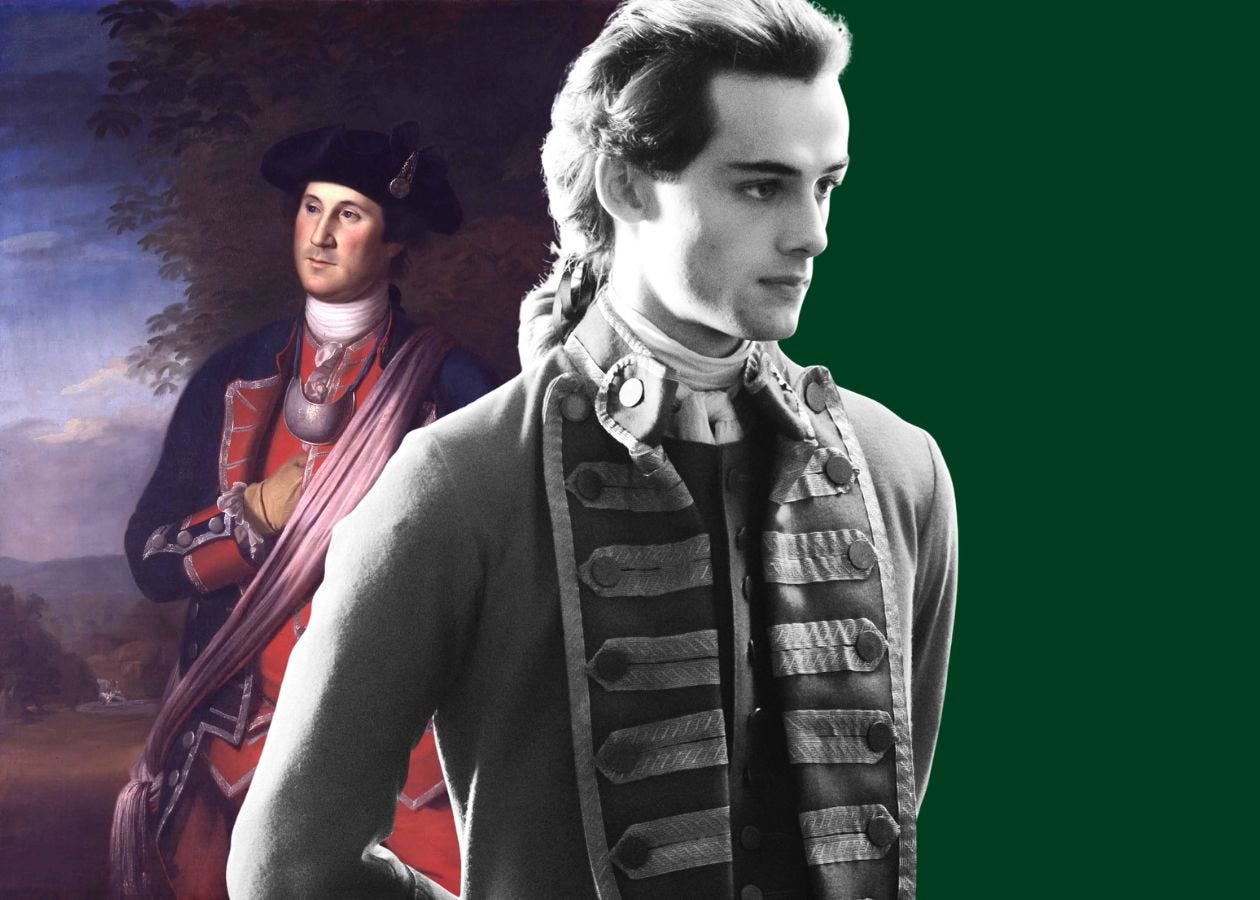
This isn’t to say that Young Washington is all bad. William Franklyn-Miller, who fills the title role in his debut as a lead, feels well cast to represent Washington’s famously understated presence. Andy Serkis, who portrays the overconfident British General Edward Braddock, is a lot of fun for the couple of minutes that he’s on screen. There’s the whiff of an interesting story arc here and there: Washington’s struggle to rebuild his life after his father’s death or the way that he grapples with failure on the battlefield, for example. But these threads are left underexplored in favor of more soulless, AI-infused battles.
The most interesting thing about Young Washington is Angel’s business model. In the middle of the credits, Kelsey Grammer (of Cheers fame) asks viewers to “pay it forward,” presenting a QR code inviting you to cover someone else’s ticket to Young Washington. I was shocked that the movie was still in theaters three weeks after release. Aside from myself and a friend who accompanied me, there were maybe seven or eight others in our small Manhattan theater. I say this with no cynicism at all: that’s a lot more than I expected for a weeknight showing of this kind of movie in New York City. I wondered if any of them were beneficiaries of Angel’s “pay it forward” appeal. Is there a left-of-center equivalent to this kind of brute-force messaging campaign, or have we ceded that territory too?
According to Grammer—who portrays Virginia aristocrat Lord Fairfax—the audience’s contributions will make Young Washington the number one movie in America and advance Angel’s message.
Well, young George Washington already lost the battle for number one to Buzz, Woody, and the Minions, and I’m still not sure what the message of this movie was. It’s curious that even conservative Angel Studios chose to sidestep the Revolution and the founding, the things that Washington is best known for. After 2020, there’s certainly a reluctance to glorify the Founding Fathers, especially those, like Washington, who held human beings in bondage. Yet just a decade ago, those early American leaders enjoyed a renaissance among liberals with the release of the musical Hamilton—once performed before the Obamas at the White House.
A good retelling of Washington’s life would account for the harm he inflicted on enslaved people. But Americans would also benefit from seeing Washington as the general who resigned his commission at the end of the Revolutionary War rather than reign as a military dictator. We are due for a reminder of the Washington who stepped down after two terms as president.
Rather than tell stories like these, stories that have something to say about our country—however messy and sometimes contradictory—Angel gives us a film about George Washington that somehow says nothing at all.
More from The Next Move:
The Russians Are Loving This

Charlie Kirk’s assassination and political violence in America have Russian propagandists downright giddy. It’s all fodder for a war being waged on social media.
What to This Russian Is the Fourth of July?

The America of my Soviet upbringing was both distant and extremely close.
I wondered if Washington-the-enslaver-of-people would make an appearance in the film. Not surprised. Angel et al like their heroes and saints to be uncomplicated by actual weaknesses and other glimpses of reality. Even with fully-human Jesus, they would blanch if you suggested that he ever belched, farted, or sneezed.
I think you are wrong on this one. My two sons, 23 years old, and I loved this picture as it as not boring. The battle scenes were great. I think his upbringing and showing the reality of hereditary position were pretty telling. I also think the young man who played Washington did a great job in a notoriously hard part to play.